How to Win Government Contracts With No Past Performance
Past performance requirements block new vendors across government, education, healthcare, and construction. This guide covers proven pathways: set-aside programs, mentor-protégé arrangements, subcontracting, the simplified acquisition entry lane, and translating existing experience into the language evaluators score.
Past performance requirements block new vendors before a single proposal is written, and the barrier spans every sector where competitive bidding exists. School districts require comparable reference projects before awarding technology contracts. Hospitals demand verified experience when sourcing specialized services. Construction agencies score it as a primary evaluation factor on capital projects. IT procurement weights reference lists heavily on high-risk engagements. Government formalizes the same barrier into scored evaluation factors with defined rating scales. The underlying problem is identical across all of them: if you have not won a contract yet, evaluators have no direct evidence to put in your column. The question is not whether the barrier is real. It is how you get past it.
- Most open solicitations do not formally gate on past performance: as of August 2026, only 958 of 64,144 open opportunities across 23,000+ sources explicitly mention it.
- The $250K simplified acquisition threshold is the most accessible entry lane, where technical approach and price typically carry more weight than documented history.
- CPARS Unknown ratings are not disqualifying: federal rules require agencies to treat the absence of past performance as neutral, not negative, a meaningful distinction at evaluation time.
- Mentor-protégé programs and joint ventures give new entrants a structural on-ramp by allowing past performance credit to flow from an established mentor firm to the joint venture.
- Commercial, academic, and internal project experience can count when translated into the exact evaluation language each solicitation uses.
Why an Unknown Past Performance Rating Is Not Disqualifying
You can win contracts with no past performance by targeting opportunities that do not formally evaluate it, pursuing programs built for new entrants, and positioning whatever experience you have in the language evaluators are trained to score. Federal procurement uses adjectival rating scales for past performance: Exceptional, Very Good, Satisfactory, Marginal, Unsatisfactory, and for vendors without a government history, Unknown. Unknown is not Unsatisfactory. Unknown means there is no data to evaluate. Unsatisfactory means documented failure on a prior contract. Federal acquisition rules require agencies to treat the absence of past performance as neutral, and that distinction opens real competitive space for first-time contractors. Set-aside programs often reduce the comparative weight of past performance further. Below the simplified acquisition threshold of $250K, many agencies do not formally evaluate it at all. The first move is mapping your situation to the right opportunity type before you write a word of a proposal.
Understand which opportunities actually require a track record
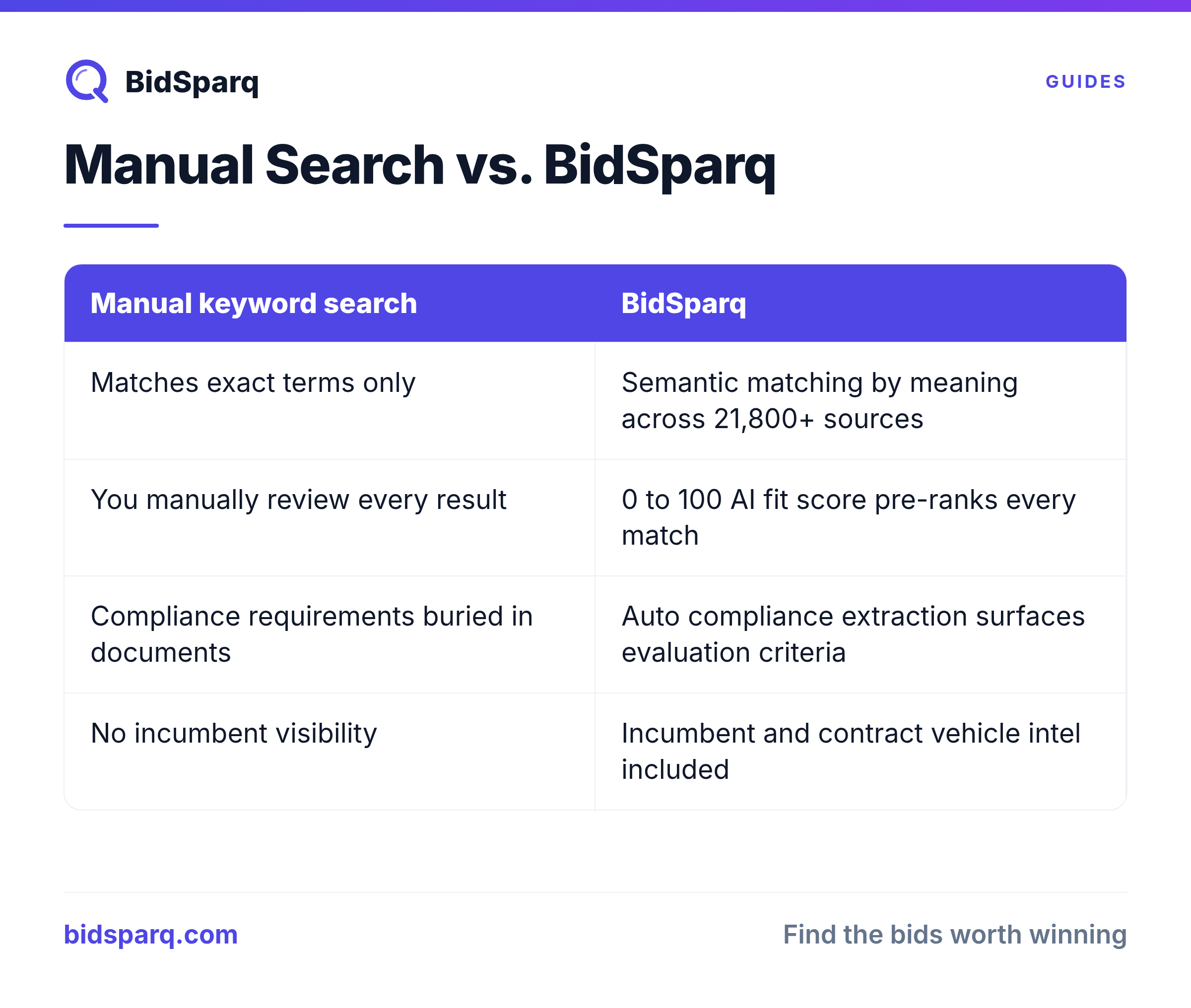
Most vendors treat past performance as a universal barrier, but the open solicitation market tells a far more specific story. As of August 2026, 64,144 solicitations are open across the 23,000+ sources BidSparq tracks, and only 958 of them explicitly mention past performance. Over the last 30 days, 1,766 new past performance solicitations were posted, with 599 of the currently open ones closing within the next 14 days. That flow is real, but it is a fraction of total opportunity volume. The most accessible entry lane for new vendors is the simplified acquisition threshold: purchases below $250K follow streamlined procurement rules where technical approach and pricing carry more weight than documented history, and many agencies skip formal past performance evaluation entirely at this level. Procurement across education, healthcare, construction, and IT follows the same pattern, with pilot programs, phased rollouts, and smaller contract actions regularly weighting capability over reference lists. Finding those opportunities efficiently is where keyword-based search falls short. Semantic matching surfaces bids where the scope aligns with your capability by meaning, even when the solicitation uses entirely different terminology than your search string.
64,144 open solicitations are live right now. The majority have no past performance gate. Find opportunities matched to your capability, free on BidSparq, no credit card needed.
Set-aside programs, mentor-protégé arrangements, and joint ventures
Federal set-aside designations and structured teaming programs exist specifically because open competition systematically favors incumbents, and they create a different competitive lane for new and smaller entrants. The 8(a) Business Development program, HUBZone certification, Women-Owned Small Business designation, and Service-Disabled Veteran-Owned status each create environments where past performance is weighted differently and the field of eligible competitors is smaller. In many set-aside evaluations, a first-time contractor receives a neutral or Unknown rating rather than being scored head-to-head against seasoned incumbents. Beyond certifications, the SBA mentor-protégé program pairs new entrants with established prime contractors through a formal joint-venture structure. A mentor-protégé joint venture can pursue contracts either firm might not win independently, and past performance credit can flow from the mentor firm to the joint venture, giving a new entrant access to a reference history they have not yet earned on their own. State and local set-aside equivalents follow similar logic, though certification requirements vary by jurisdiction. For businesses that qualify, these programs change the competitive structure of the opportunities they pursue in a measurable way.
Subcontracting is the fastest way to build a citable record
The most reliable path from zero past performance to a verifiable reference is a named subcontractor role on a delivered prime contract. As a named subcontractor, your company's scope, delivery timeline, and outcomes become citable in future proposals. Agencies expect and allow subcontract references, and many explicitly permit them for new entrants pursuing prime contracts. The fastest way to find the right primes to approach is incumbent and contract vehicle intelligence: knowing which companies hold active awards in your capability area lets you start focused teaming conversations rather than reaching out cold. Respond to sources sought notices before solicitations are formally issued. They signal upcoming opportunities and give your company visibility with the buying organization before evaluation criteria are set. Where possible, document subcontract performance in terms that translate directly into evaluator-ready language: what you delivered, whether it came in on schedule and within budget, and what it measurably produced. A single subcontract performed well and documented carefully is worth more in a future prime proposal than a long list of submissions without a track record.
Reframe the experience you already have
Government evaluators assess past performance to answer one practical question: can this vendor deliver what they are promising? Commercial contracts, university research partnerships, internal technology implementations, and consulting engagements can all serve as evidence when framed correctly. The translation work is what most vendors skip: scope complexity, budget managed, delivery timeline, and measurable outcomes map directly to government evaluation criteria. Many solicitations allow, and some explicitly encourage, non-government references for small businesses and new market entrants. Below the $250K simplified acquisition threshold, a strong technical approach with competitive pricing frequently outweighs the absence of a formal reference list. Auto compliance extraction surfaces the exact language evaluators will use to score past performance in each specific solicitation, rather than requiring you to parse the full document yourself. Pair that with a fit score against your stated capability profile and you can identify which bids are worth the proposal investment before you spend hours writing.
FAQ
Can you win a federal contract with no past performance at all?
Yes. Federal acquisition rules require agencies to treat the absence of past performance as neutral rather than disqualifying. Under the adjectival rating scale, a first-time vendor receives an Unknown rating, not an Unsatisfactory. Those two ratings are not equivalent: Unknown means no data exists to evaluate, Unsatisfactory means documented failure on a prior contract. Set-aside programs often reduce the comparative weight of past performance further, and purchases below the $250K simplified acquisition threshold frequently skip formal past performance evaluation altogether. Subcontracts, mentor-protégé joint ventures, and relevant commercial work can substitute for direct past performance in many evaluations above that threshold.
What counts as past performance for government contracts?
Past performance can include federal prime contracts, subcontracts on federal work, state and local government contracts, commercial contracts, and in some cases academic or research work. Mentor-protégé joint ventures may draw on the mentor firm's record. The key is translating your work history into a narrative that addresses how the project was scoped, whether it was delivered on time and within budget, and what it measurably achieved, structured to match each solicitation's specific evaluation criteria. Agencies differ in what they accept, so reading the past performance instructions in each solicitation and matching your narrative to the exact evaluation language is essential before submitting references.
How do I find contracts that do not require past performance?
Filter the open solicitation market to contract types where past performance carries less weight or is not formally evaluated: purchases below $250K, pilot programs, set-aside vehicles, and first-time-friendly IDIQ on-ramps. Manual keyword searches miss opportunities described in different terminology than your search string. Semantic matching surfaces relevant opportunities by meaning rather than exact terms, and a fit score against your capability profile puts the best-matched opportunities first so the shortlist stays manageable.
Run a fit score against your capability profile on BidSparq, free, no credit card needed.
Find RFPs that match your business
BidSparq monitors 23,000+ procurement sources and uses AI to score every opportunity against your capabilities. Try it free for 14 days.
Start Free Trial →