How to Find Education Technology Contracts and Bids
Find education technology contracts across districts, states, cooperatives, and consortiums without tab-juggling or keyword guesswork.
The hunt for an education technology contract usually starts with a tab stack: a state procurement portal, a regional purchasing cooperative, a district e-bid system, a vendor newsletter, and a search engine returning expired notices. Somewhere in that pile sits the one deal worth pursuing. The rest is noise that quietly eats the week.
Procurement is the broad market here. Government, education, healthcare, construction, IT, and commercial buyers all run the same gauntlet, and education is one vertical inside it. The teams that win consistently are not searching harder. They have stopped relying on keyword search across a dozen portals and switched to tooling that reads opportunities by meaning. Here is how to find education technology contracts and bids without losing a week to manual sprawl.
Key takeaways:
- Most edtech opportunities never appear on a single portal; they fragment across district, state, cooperative, and consortium sites.
- Keyword search misses real fits because buyers describe needs in pedagogical and statutory language, not your product taxonomy.
- Semantic matching surfaces opportunities by meaning, so a 'social emotional learning curriculum' RFP can match a 'character development platform' vendor.
- Automated fit scoring from 0 to 100 ranks what is worth pursuing, so teams triage by evidence instead of guesswork.
- Compliance extraction surfaces FERPA, COPPA, e-rate, insurance minimums, and accessibility rules in seconds instead of pages.
- Incumbent and contract-vehicle intel reshapes a proposal before the first page is written.
Where education technology contracts actually get posted
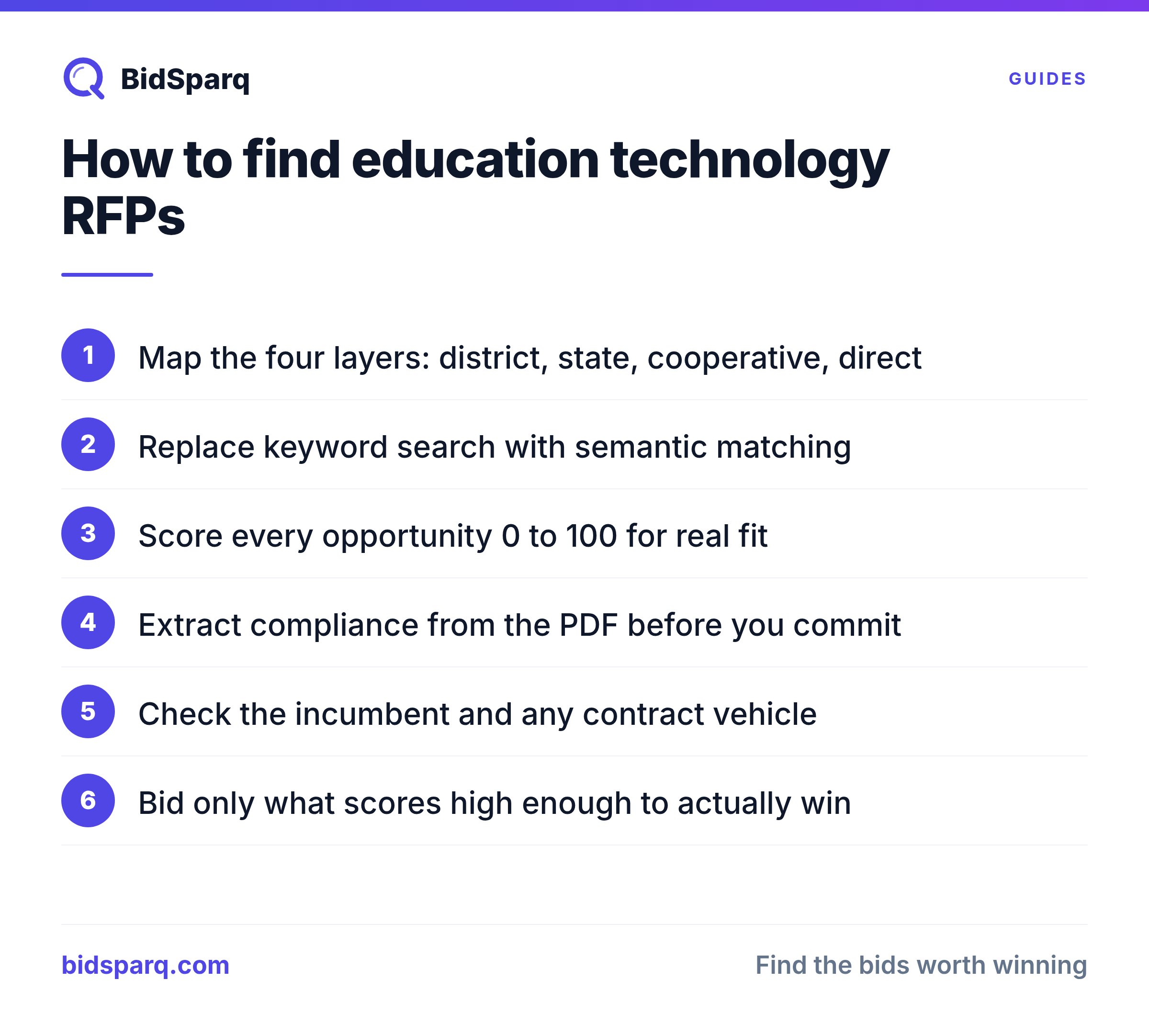
Stop treating procurement as a single search box. Education technology contracts are scattered across at least four overlapping layers, and a real pipeline depends on monitoring all of them:
- District e-procurement systems like Ionwave, Bonfire, and Periscope, plus dozens of in-house portals.
- State departments of education and central procurement offices.
- Regional purchasing cooperatives and consortiums such as TIPS, Sourcewell, AEPA, NCPA, and OMNIA Partners.
- Large district direct posts that never syndicate anywhere.
Watch one or two layers and the rest of the market stays invisible. The practical market spans thousands of issuers, which is why an automated index matters more than effort. BidSparq indexes 23,000+ distinct bid sources daily, so the breadth of coverage is no longer capped by how many tabs a person can keep open.
Why keyword search misses real edtech opportunities
Keyword search is why competitors look smarter than you. A district issuing an RFP for a 'comprehensive K-5 mathematics core program' is, semantically, the buyer for any math curriculum vendor. A keyword tool skips it unless the marketing copy happens to match by accident. The same gap hits a hospital team scanning for a 'patient engagement platform' or a construction firm hunting an 'integrated project delivery' opportunity, where buyer wording and vendor wording almost never line up. Semantic matching closes that gap automatically. BidSparq is built on it, so the engine understands that 'blended learning platform,' 'learning management ecosystem,' and 'digital curriculum delivery system' describe one need. Procurement officers write in pedagogy and statute, not pitch decks. The benefit is reach: search the way buyers actually write, and the half of the market a keyword tool hid from you appears on the same screen.
How to decide which education technology bids are worth pursuing
Pursuit cost is the silent killer in education sales. A serious edtech response can absorb most of a week across product, finance, security review, and proposal writers, so bidding every notice that mentions 'technology' is the fastest way to go broke before a single win. Automated fit scoring rates each opportunity from 0 to 100 against your real product, certifications, geography, and prior wins, so a 92 is a deal to work tomorrow and a 41 is a polite pass. Compared with reading every PDF by hand to guess at fit, the benefit is sharper triage in seconds. The score even explains itself: asking 'why is this a 78 and not a 90?' surfaces a missing differentiator before days disappear into a losing response.
What compliance requirements hide in an edtech RFP
Read the requirements first and the cover letter last. Education technology RFPs are dense with data privacy addenda, FERPA, COPPA, state student data privacy laws (SOPIPA in California, SOPPA in Illinois), e-rate eligibility, accessibility standards (WCAG 2.1 AA), insurance minimums, MBE and WBE participation goals, and security questionnaires long enough to be their own document. Automated compliance extraction parses the file and pulls these requirements into a structured checklist before the bid decision, instead of leaving a human to comb through pages of legalese. The benefit is brutal honesty early. If the cyber insurance floor or the data residency clause is out of reach, that shows up in minutes rather than days into a proposal.
How incumbent and contract-vehicle intel changes your bid
Walk in knowing who held the deal before you. Most education technology contracts have an incumbent, a prior award, or a piggyback off a cooperative purchasing vehicle. Surfacing the incumbent and any active contract vehicles tied to a district or state tells you whether you are competing on price against a renewal, displacing a tired solution, or proposing under TIPS instead of writing a clean response. The same logic carries to a healthcare vendor bidding into an IDN that already holds a Vizient agreement, or a construction firm responding under a JOC vehicle. That context reshapes pricing, references, and win themes. The same proposal against the same RFP, written with versus without this intel, lands very differently with an evaluation committee.
Which plan fits your bid volume
Match the tier to the volume of bids you actually pursue.
- Free: Search the full 23,000+ source index and run your first fit scores with no credit card.
- Pro Max at $249 per month ($199 billed annually): The full BidSparq feature set, including semantic search, fit scoring, compliance extraction, and incumbent intel.
- 14-day free trial: Every new account starts on the full Pro Max feature set, no credit card required.
FAQ
How do I find education technology contracts in my state?
Combine your state department of education portal with the central procurement office, then layer in the regional cooperatives your districts use (TIPS, AEPA, and ESC purchasing groups), and finally watch the large districts directly through their own e-bid systems. The goal is to cover all four layers in one place and get notified when a real fit appears, so the tab-juggling stops.
Are most edtech opportunities posted as formal RFPs or smaller bids?
Both. State and large district contracts typically run as full RFPs. Mid and smaller districts often use RFIs, RFQs, sole source justifications, or piggyback purchases off a cooperative vehicle. A real pipeline watches all of those, not just the headline RFPs that the rest of the market is already chasing.
What is the difference between a state contract and a district RFP for edtech?
A state contract is a master agreement that any eligible district can buy from, often with pre-negotiated pricing and terms. A district RFP is a one-off purchase by that single district. Winning a state contract is slower but unlocks downstream district deals for years. Winning a district RFP is faster, but the cycle restarts with the next district.
Run your first fit score free across 23,000+ bid sources, no credit card needed.
Find RFPs that match your business
BidSparq monitors 23,000+ procurement sources and uses AI to score every opportunity against your capabilities. Try it free for 14 days.
Start Free Trial →