Wrap Rate in Government Contracting: Price Your RFP Right
Wrap rate requirements appear in RFPs across IT, healthcare, construction, and professional services, not only federal contracting. Learn how to calculate a defensible rate under FAR cost principles, identify requirements buried as burdened rate or loaded rate, and find open wrap rate RFPs across 23,000+ sources before deadlines close.
Your wrap rate determines whether you win a labor contract and whether you make money when you do. Bid above market and the award goes to a competitor who knows their cost structure better. Bid below your true burdened cost and you sign a multi-year obligation that erodes on every billable hour. The math is straightforward; getting it right, and reaching the right RFPs before the deadline, is not.
- A wrap rate is a multiplier that converts a direct labor rate into a fully burdened bill rate by stacking fringe, overhead, G&A, and profit on top of base pay.
- Wrap rate requirements span the whole market: IT services, healthcare staffing, construction, and education RFPs all require disclosed loaded rates, not only federal solicitations.
- Mispricing in either direction is costly: overpricing loses the award, underpricing erodes margin on every hour billed through the life of the contract.
- Compliance language rarely uses the exact phrase “wrap rate,” so keyword searches miss requirements described as loaded rates, burdened rates, or billing rate ceilings.
- As of August 2026, 244 new solicitations mentioning wrap were posted in the last 30 days, and 48 of those close within 14 days, a tight window for teams relying on manual searches across a handful of portals.
- Vertical cost drivers shift the math significantly: clinical staffing firms often carry wrap rates above 2.0 due to malpractice and licensing costs, while distributed IT teams with lower facilities overhead can price more aggressively when savings are properly documented.
What a Wrap Rate Is and Where RFPs Require It
A wrap rate is the multiplier that converts a base labor rate into the fully burdened cost you charge a client, and it appears in RFPs across every sector where labor is the primary deliverable. In an IT services contract, a developer hired at a direct labor rate does not cost just that figure to deliver. Add employer payroll taxes, health benefits, paid leave, facilities and supervision overhead, G&A expenses, and a profit margin, and the actual bill rate can run between 1.5x and 2.5x depending on your firm’s cost structure and labor category mix.
Vertical cost drivers can shift that range significantly, and ignoring them in a competitive market means pricing against a floor your competitors may not share. Healthcare staffing agencies must embed malpractice insurance and professional licensing fees within their fringe pools, which routinely pushes clinical wrap rates above 2.0 even at firms with lean overhead. Construction primes bidding public works under Davis-Bacon face a mandatory direct rate floor but no ceiling on burden, so two contractors submitting on the same labor categories can carry materially different wrap rates based solely on their benefit structures. IT managed service providers with distributed remote workforces often carry lower facilities overhead than traditional on-site operations, creating a pricing advantage when the savings are properly documented and allocated. Government contracting codified the terminology and the disclosure requirements and introduced cost accounting standards governing how rates must be supported and defended, but the underlying cost structure is not unique to the public sector.
How to Calculate Your Wrap Rate for Government Contracting
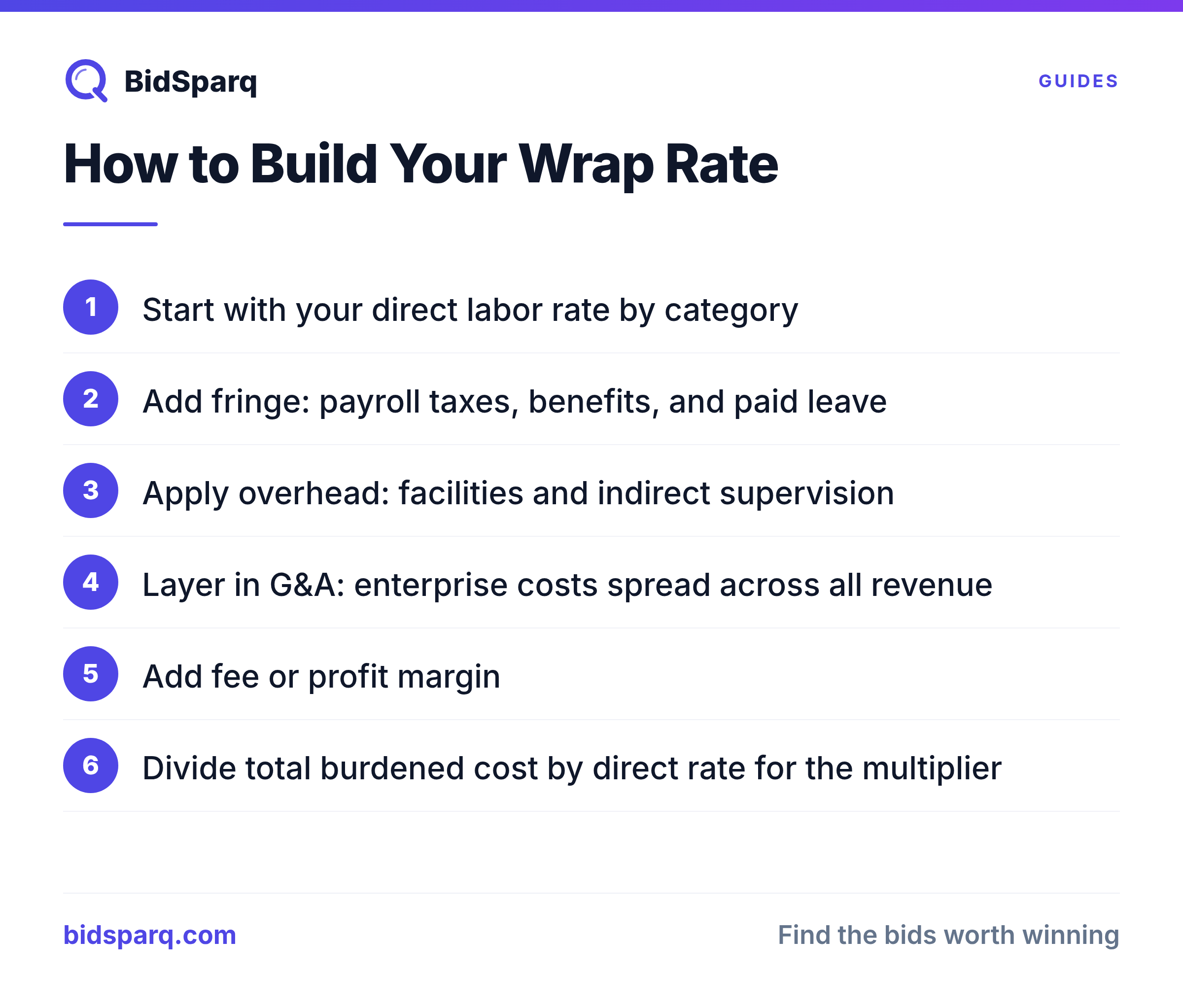
Build your wrap rate from the bottom up, category by category, so every dollar of indirect cost has a documented and defensible home before you put it in a proposal. The standard components are fringe (employer payroll taxes, health insurance, retirement contributions, and paid leave), overhead (facilities, supervision, project-specific indirect staff, and other costs directly attributable to client work), G&A (executive leadership, finance, HR, legal, and other enterprise costs spread across total revenue), and fee or profit.
A worked example shows how the layers accumulate. Start with a direct rate of $50 per hour. Fringe at 28 percent adds $14.00, loading to $64.00. Overhead at 20 percent of direct labor adds $10.00, loading to $74.00. G&A at 12 percent of running loaded cost adds $8.88, reaching $82.88. A fee of 10 percent adds $8.29 for a final bill rate of $91.17 and a wrap rate of 1.82. That is a defensible rate for a mid-size services firm at its current cost structure. The critical question is what happens when one indirect pool shifts, and that is where pricing errors become contract losses.
Under FAR 31.201-2, costs must be reasonable, allocable, and comply with applicable cost accounting standards to be recoverable on a government contract. Undocumented or unsupported cost pools are not just risky; they are unallowable. CAS 418 adds a structural requirement governing how indirect costs must be allocated across contracts, going beyond simply stacking percentage rates. Contract type shapes how all of this applies in practice: cost-plus contracts allow recovery of actual indirect costs, time-and-materials contracts often set ceiling rates that cannot be exceeded, and fixed-price contracts fold everything into the total with no adjustment mechanism. Matching your wrap rate structure to the contract type stated in the RFP is not optional; it determines whether your proposal is compliant before scoring begins.
Where RFPs Bury Wrap Rate Requirements
The phrase “wrap rate” may not appear anywhere in an RFP that nonetheless requires you to disclose and defend your fully loaded labor rates. Contracting officers use a range of terms: loaded rate, burdened rate, composite rate, fully burdened labor rate, billing rate, or a pricing table with named rate ceilings by labor category. A keyword search for the exact phrase returns a fraction of the solicitations where the concept actually controls how you price.
Parsing solicitation content for meaning rather than matching text strings changes what you can surface. Automated compliance extraction reads for rate obligations regardless of the label used and also pulls the associated structure: ceiling rates by labor category, cost accounting disclosure conditions, audit rights clauses, forward pricing rate agreement references, and wage determination schedules. A solicitation that buries a time-and-materials ceiling in an exhibit is just as binding as one that states it in the main pricing section; semantic parsing finds both. Having that structural detail before you commit a single hour to the response eliminates surprises in the cost volume review. Compliance gaps discovered after submission are not recoverable.
As of August 2026, 48 solicitations mentioning wrap close within the next 14 days across the 23,000+ sources in the market. Manual portal checks are not a reliable method for catching them all. Search open wrap rate RFPs now before the window closes.
The Real Cost of Getting Your Wrap Rate Wrong
Overpricing costs you the award. Underpricing costs you the contract.
A wrap rate priced too high makes your total evaluated cost uncompetitive on best-value or lowest-price bids and can draw a price reasonableness challenge on negotiated awards. Most teams recognize that risk. The corrective move of sharpening rates to stay competitive can tip too far in the other direction, and the damage is slower and harder to see.
Extend the earlier example to see how costs compound. The base calculation yields a final bill rate of $91.17 on a $50 direct rate. A benefits renewal that raises fringe four percentage points, from 28 to 32 percent, pushes fringe from $14.00 to $16.00. G&A recalculates on the adjusted base, and the final bill rate climbs to $93.63. On a time-and-materials contract with the ceiling locked at the original $91.17, you absorb $2.46 on every hour you bill. On a 10,000-hour contract, that single pool-rate change generates more than $24,000 in unrecoverable cost over the contract’s life. No line item flags it. No mechanism recovers it. On a multi-year award with large labor volumes, the shortfall is not a rounding error.
Accurate wrap rates require indirect cost data validated against your actual accounting records before submitting, not last cycle’s estimate carried forward into a multi-year obligation. Ceiling rates, audit rights clauses, and cost structure requirements in the solicitation all affect your exposure. Identifying them before proposal work begins is the difference between a profitable award and a multi-year cash drain.
Finding Wrap Rate RFPs Before the Deadlines Hit
Start your opportunity pipeline with the full market, not just the portals your team already checks. As of August 2026, 70,547 solicitations are open across the 23,000+ sources BidSparq monitors. Within that universe, 103 open solicitations mention “wrap,” with California leading at 14 and New York close behind at 13. Of the 244 new wrap solicitations posted in the last 30 days, 48 close within the next 14 days. The bids closing this month were posted weeks ago; teams relying on manual searches across one or two portals are working with a fraction of the available opportunity.
Semantic matching closes that gap by reading solicitations for what they mean, not just what they say. A staffing RFP that requires disclosed burden rates on named labor categories surfaces alongside an explicit wrap rate solicitation because the system recognizes the compliance requirement regardless of the label used. AI fit scoring then ranks open opportunities on a 0-to-100 scale against your firm’s capabilities and past performance, so the most relevant bids rise to the top without manual triage. Automated compliance extraction flags ceiling rates, audit clauses, and cost structure requirements before you commit a proposal hour, the same capability that surfaces buried rate obligations regardless of phrasing applied at the scale of the full source universe rather than a single portal.
Incumbent and vehicle intelligence adds another layer of risk reduction before you invest proposal hours. Knowing which contract vehicles already carry wrap rate disclosure requirements, and which incumbents currently hold them, lets you assess compliance burden and competitive positioning before committing resources. Entering a recompete without knowing what the incumbent disclosed is avoidable; that intelligence lives in the solicitation history and prior contract records.
FAQ
What is a typical wrap rate in government contracting?
Wrap rates vary widely depending on firm size, labor mix, and cost structure. A services firm with standard benefits and moderate overhead typically carries a wrap rate between 1.5 and 2.2 on direct labor. Firms with extensive facilities, large indirect workforces, or complex benefit structures often run higher, and clinical staffing firms frequently exceed 2.0 due to malpractice insurance and licensing costs embedded in their fringe pools. Government contracting requires you to disclose and defend your specific rates under FAR cost principles rather than benchmark against an industry average, so your actual indirect cost accounting data is what matters for a compliant proposal.
How do I calculate my wrap rate for a government contracting RFP?
Start with your direct labor rate for each labor category. Add fringe costs as a percentage of direct labor using your actual benefits data. Apply your indirect overhead rate, calculated by dividing your overhead cost pool by the appropriate allocation base (typically direct labor dollars or hours). Layer in your G&A rate, which spreads enterprise costs across your total cost base. Add your fee or profit margin last. Divide the total bill rate by the direct labor rate to get the multiplier. If the RFP specifies a ceiling rate or a required cost structure, verify your fully loaded rates against those constraints before submitting. Under FAR 31.201-2, costs must be reasonable and allocable; your indirect cost accounting records must support every component.
Where can I find government contracting RFPs that require wrap rate disclosure?
Solicitations requiring wrap rate disclosure are posted across federal procurement systems, state and local portals, education and healthcare purchasing platforms, and construction bid boards. Because contracting officers use varied terminology, searching a single portal for the exact phrase “wrap rate” misses a large portion of relevant RFPs. Monitoring 23,000+ sources with semantic matching surfaces requirements described as loaded rates, burdened rates, or billing rate ceilings alongside explicit wrap rate solicitations, giving you a full view of the market before opportunities close. As of August 2026, 48 solicitations mentioning wrap close within the next 14 days.
48 wrap rate RFPs close in the next 14 days. Find yours on BidSparq free, no credit card needed.
Find RFPs that match your business
BidSparq monitors 23,000+ procurement sources and uses AI to score every opportunity against your capabilities. Try it free for 14 days.
Start Free Trial →