ACAT III Contracts: Find Them Before the Incumbent Does
ACAT III programs are the DoD's most common acquisition category by volume and among the least monitored by competitors. Learn what defines them, where to find open solicitations, and how to build a proactive ACAT III pursuit pipeline.
Defense contractors lose ACAT III pursuits every year not because they lack the capability to perform, but because they discover the opportunity too late. By the time a solicitation appears on SAM.gov, the incumbent has often spent months briefing the program office, shaping requirements, and positioning past performance. ACAT III acquisition speed is an asset for the prepared and a liability for the reactive.
- ACAT III programs are managed at the component level, where the program office controls the acquisition timeline without upper-level milestone gates, giving contractors more direct access to decision-makers than on major programs.
- Faster than major programs, ACAT III acquisitions carry lighter documentation requirements and fewer centralized oversight steps, compressing the window from solicitation release to award.
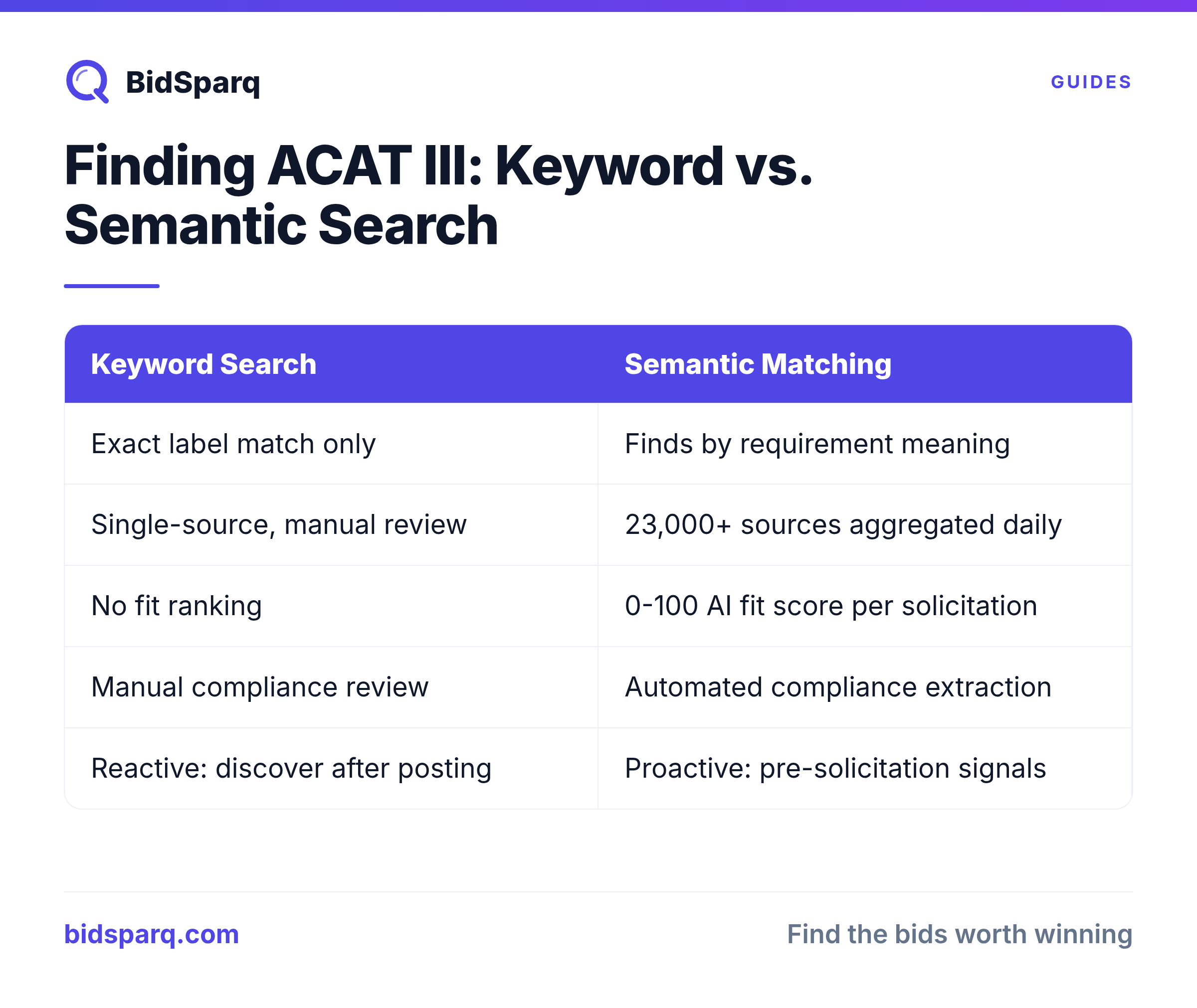
- Solicitations rarely label themselves as ACAT III, which is why semantic search, matching by requirement meaning rather than exact text, surfaces opportunities that keyword filtering misses entirely.
- Re-compete windows on ACAT III programs are predictable from acquisition records, making incumbent intelligence and contract vehicle data worth tracking months before any solicitation is published.
- Across dozens of simultaneous ACAT III opportunities, a 0-100 fit score lets pursuit teams triage without reading every statement of work in full.
The short answer
ACAT III (Acquisition Category III) is the DoD designation for programs that fall below the cost thresholds required for ACAT I or ACAT II classification, and by count, more active defense acquisition programs sit in this tier than in any other. ACAT III program offices hold more management authority than their counterparts on major programs, which produces faster acquisition timelines and fewer large-prime competitors on any given pursuit. The core challenge is not eligibility but discovery: these opportunities are distributed across dozens of buying commands and rarely carry the category label in the solicitation document itself. As of October 2026, BidSparq's tracked sources show 41 open solicitations referencing "acat," with 18 closing within the next 14 days, a live pipeline that rewards teams with proactive monitoring in place.
What ACAT III means in the DoD acquisition framework
Understanding where ACAT III sits in the acquisition hierarchy shapes every pursuit decision that follows. The DoD's acquisition category system classifies programs by cost threshold and oversight intensity. ACAT I covers Major Defense Acquisition Programs whose research, development, test, and evaluation costs or total procurement costs exceed the statutory ceilings defined in law, with the Under Secretary of Defense for Acquisition and Sustainment serving as the Milestone Decision Authority. ACAT II applies to programs below ACAT I thresholds but above a lower cost boundary, with MDA authority at the service acquisition executive level. ACAT III covers all remaining programs: no ACAT I or ACAT II cost trigger is met, and MDA authority is delegated to the Component Acquisition Executive or further to the Program Executive Officer. That delegation is what drives the speed and flexibility that characterize this tier. The specific thresholds are updated periodically by statute; the authoritative source is the current version of DoDI 5000.02.
Why ACAT III programs are overlooked and why that creates an opening
Business development attention concentrates on large, named programs, which leaves ACAT III opportunities facing thinner competition per dollar of contract value. A contract that falls below a prime contractor's minimum revenue threshold for investment can be a defining program-of-record for a mid-tier or small business. Because the program office holds more acquisition authority at this tier, the incumbent relationship, technical domain familiarity, and past performance at comparable scope carry more weight relative to corporate size than they do on major program competitions. The challenge is that ACAT III opportunities are scattered across commands, described in terms of capability rather than category designation, and posted on timelines driven by the individual program office calendar rather than any centralized acquisition schedule. Discovery is the constraint, not capability.
How to find ACAT III opportunities before the solicitation drops
Waiting for a formal solicitation on SAM.gov is the least effective pursuit posture because the incumbent's advantage compounds with every month of early program access. A proactive pipeline draws from multiple channels. SAM.gov posts sources sought notices and draft solicitations that precede formal release. Procurement forecasts published by major buying commands, including Army Contracting Command, Air Force Materiel Command, and NAVFAC, describe planned acquisitions months in advance. Congressional budget justification documents, available through the Office of the Under Secretary of Defense (Comptroller), describe programs by name, expected spend, and timeline well before any acquisition office releases solicitation documents. Industry day announcements signal that a program office is actively shaping requirements and open to industry input. Covering those channels manually across a portfolio of simultaneous pursuits is where BD capacity disappears. As of October 2026, 22 new solicitations referencing "acat" were posted in the last 30 days, with Florida, California, and Colorado generating the most activity among tracked sources.
Stop building your ACAT III pipeline by hand. Start your free pursuit search on BidSparq, no credit card required, and let semantic matching surface solicitations across 23,000+ sources that a single-portal keyword search would never return.
Qualifying and scoring ACAT III pursuits
Not every ACAT III match that surfaces is worth pursuing, and treating every relevant solicitation as a must-bid is the fastest way to exhaust a BD team. A practical qualification framework evaluates four factors: whether your company or a teaming partner holds past performance at comparable scope and contract size; whether the procurement vehicle aligns with your current portfolio, since many ACAT III awards flow through IDIQs and set-aside vehicles that require prior positioning; what the incumbent profile looks like and whether the program office has shown intent to re-compete or re-scope; and whether the solicitation-to-proposal timeline allows for a compliant and differentiated response. AI fit scoring and automated compliance extraction reduce the triage time per opportunity from hours to minutes, letting teams make qualified go or no-go decisions faster and with more consistent criteria across the full pipeline.
Building a repeatable ACAT III pipeline
A single ACAT III win matters; a structured pipeline tracked from forecast through re-compete is what builds a scalable defense business. The mechanics start with mapping the buying commands and program offices that fund work in your technical domain, then identifying which of their programs are in development, production, or sustainment phases, and setting calendar markers for the milestone reviews and re-compete windows that are predictable from each program's acquisition record. That structure shifts your company from reactive, discovering opportunities after they post, to proactive, with relationships at the program office level established before any solicitation exists. The same pipeline discipline transfers well to markets beyond defense: comparable program-of-record structures appear in healthcare IT, large-scale infrastructure, and enterprise technology procurement across state and local government.
Your ACAT III pipeline starts with visibility. Try BidSparq free and see which open ACAT III solicitations match your profile, with no credit card and no commitment required.
FAQ
What dollar threshold separates ACAT III from ACAT I and ACAT II programs?
A program is designated ACAT III when it does not meet the cost thresholds that trigger ACAT I or ACAT II classification. ACAT I applies to Major Defense Acquisition Programs with RDT&E or procurement costs above the statutory ceilings defined in federal law. ACAT II applies to programs below ACAT I thresholds but above a lower dollar boundary. ACAT III covers all remaining programs managed at the component level. Because those thresholds are updated periodically by statute and DoD instruction, always verify the current figures in the latest version of DoDI 5000.02 rather than relying on dollar amounts from any secondary source that may not reflect recent adjustments.
Where can I search for open ACAT III solicitations?
SAM.gov is the primary public source for active federal solicitations, including sources sought notices and formal postings from ACAT III program offices across all services and commands. Procurement forecast pages published by major buying commands provide pre-solicitation visibility on planned acquisitions. Congressional budget justification documents, available through the Office of the Under Secretary of Defense (Comptroller), describe funded programs by name and timeline well before any solicitation is released. A purpose-built aggregator pulls from thousands of sources simultaneously, including federal and state-level procurement channels, and uses semantic matching to surface ACAT-relevant solicitations that do not use the category label in their title or description.
How does competing on ACAT III differ from ACAT I and ACAT II programs?
The practical difference is oversight intensity and acquisition speed. ACAT I programs require USD(A&S) milestone approval and extensive documentation including Analysis of Alternatives and formal Milestone B reviews with high-level government sign-off. ACAT II programs require service acquisition executive approval. ACAT III programs are managed at the component level with the most tailored documentation requirements of the three tiers, and their program offices hold the most direct acquisition authority. For contractors, that translates to shorter windows from solicitation to award, more direct access to program office stakeholders, and a higher relative weight on past performance and technical domain knowledge compared to the corporate-scale factors that carry more influence on major program competitions.
Find RFPs that match your business
BidSparq monitors 23,000+ procurement sources and uses AI to score every opportunity against your capabilities. Try it free for 14 days.
Start Free Trial →