Government Set-Aside Programs: How to Qualify and Win Contracts
A complete guide to small business set-aside programs including 8(a), HUBZone, SDVOSB, WOSB, and how to use them to win government contracts.
Set-aside programs are one of the biggest advantages small businesses have in government contracting. The federal government is required to award at least 23% of prime contract dollars to small businesses, and specific programs carve out even more for disadvantaged, veteran-owned, and women-owned firms.
If you qualify for a set-aside, you're competing against a smaller pool of contractors: dramatically improving your win rate.
What Is a Set-Aside?
A set-aside restricts competition on a contract to businesses that meet specific criteria. Instead of competing against large defense contractors, you compete against other qualifying small businesses.
The major federal set-aside programs are:
Small Business Set-Aside
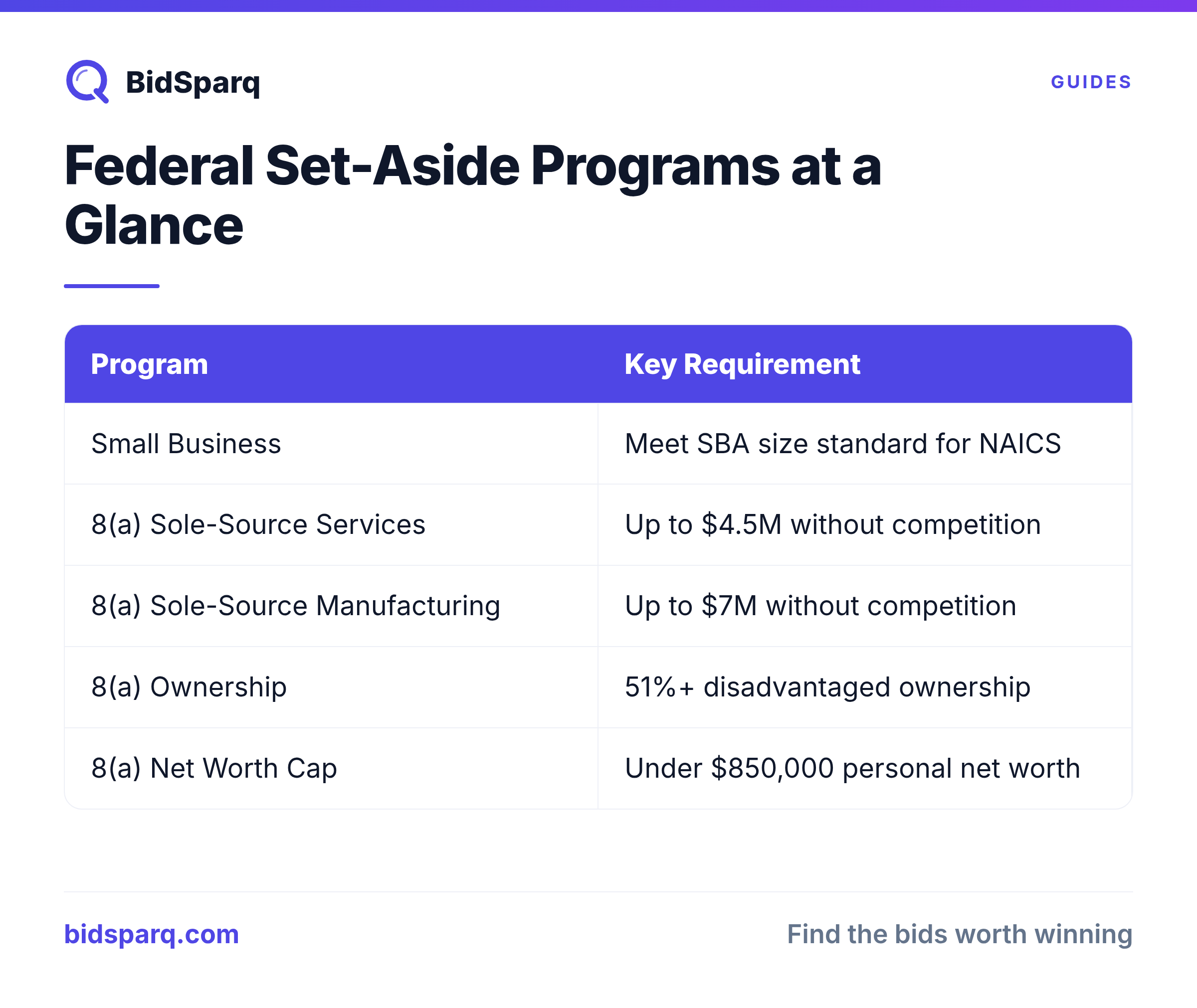
The broadest category. You qualify based on SBA size standards for your NAICS code: typically measured by annual revenue or number of employees.
How to qualify: Register in SAM.gov and self-certify as a small business under your primary NAICS code. SBA size standards vary by industry: an IT firm can have up to $34 million in annual revenue and still qualify as "small."
8(a) Business Development Program
The most powerful set-aside. 8(a) firms can receive sole-source contracts up to $4.5 million (services) or $7 million (manufacturing) without competition.
Requirements:
- Owned by socially and economically disadvantaged individuals
- At least 51% owned and controlled by qualifying individuals
- Small business under SBA size standards
- Owner's personal net worth under $850,000 (excluding primary residence and business)
- In business for at least 2 years (can be waived)
Benefits: Sole-source contracts, mentorship programs, access to SBA resources, and a competitive advantage on set-aside solicitations.
Duration: 9 years in the program.
HUBZone (Historically Underutilized Business Zones)
For businesses located in and employing residents of economically distressed areas, the HUBZone program gives them a competitive edge in government contracting.
Requirements:
- Principal office in a HUBZone
- At least 35% of employees live in a HUBZone
- Small business under SBA size standards
Benefits: 10% price evaluation preference on full and open competitions, plus access to HUBZone set-aside contracts.
Use the SBA HUBZone Map to check if your address qualifies.
SDVOSB (Service-Disabled Veteran-Owned Small Business)
For businesses owned by veterans with service-connected disabilities, the SDVOSB program provides dedicated set-aside and sole-source opportunities.
Requirements:
- At least 51% owned by one or more service-disabled veterans
- Managed and controlled by qualifying veterans
- Small business under SBA size standards
- Veterans must have a service-connected disability rating from the VA
Benefits: Sole-source contracts up to $5 million (services) or $7 million (manufacturing), plus set-aside competitions.
WOSB (Women-Owned Small Business)
For businesses at least 51% owned and controlled by women, the WOSB program carves out set-aside contracts in industries where women are underrepresented.
Requirements:
- At least 51% owned by one or more women
- Managed and controlled by women
- Small business under SBA size standards
- Self-certification through SAM.gov (third-party certification also available)
Benefits: Access to WOSB set-aside contracts in industries where women are underrepresented. EDWOSB (Economically Disadvantaged WOSB) provides additional sole-source authority.
How to Use Set-Asides in Your Bid Strategy
- Get certified. Register in SAM.gov, apply through SBA's certification portal, and keep your certifications current.
- Filter for your set-aside. When searching for RFPs, filter by your set-aside type to find opportunities where you have a competitive advantage.
- Highlight your status. In every proposal, prominently mention your certifications. Contracting officers have goals to meet for small business spending.
- Pursue sole-source opportunities. If you're 8(a) or SDVOSB, proactively market to agencies. They can award you contracts directly without competition.
Next Steps
- Start your free trial: BidSparq filters RFPs by set-aside type so you find matching opportunities instantly
- Read our guide on finding RFPs for small businesses: complete search strategy
- Read our guide on finding government RFPs
- Learn about RFP vs RFQ vs IFB solicitation types
- Read our SDVOSB deep-dive: how to win SDVOSB set-aside contracts
- Explore VA contracts guide for veteran-owned business opportunities
Find RFPs that match your business
BidSparq monitors 23,000+ procurement sources and uses AI to score every opportunity against your capabilities. Try it free for 14 days.
Start Free Trial →