Daily RFP Medical: Never Miss a Healthcare Bid
Healthcare procurement is scattered across dozens of portals and buying systems. This guide shows how to track daily RFP medical opportunities across hospital systems, Medicaid programs, and federal health agencies in one automated feed.
Medical procurement teams looking for daily RFP alerts face a structural problem that no keyword tool can solve: healthcare solicitations are scattered across dozens of fragmented buying systems, and the volume means a single missed day can mean a missed deadline. As of September 2026, 567 solicitations with daily service requirements close within the next 14 days, which illustrates exactly what ad-hoc monitoring costs a team without a systematic daily routine.
- Healthcare buying is highly fragmented: solicitations appear across hospital purchasing networks, state Medicaid agencies, federal health programs, and group purchasing organizations, each using different portals and terminology with no single source covering all of them.
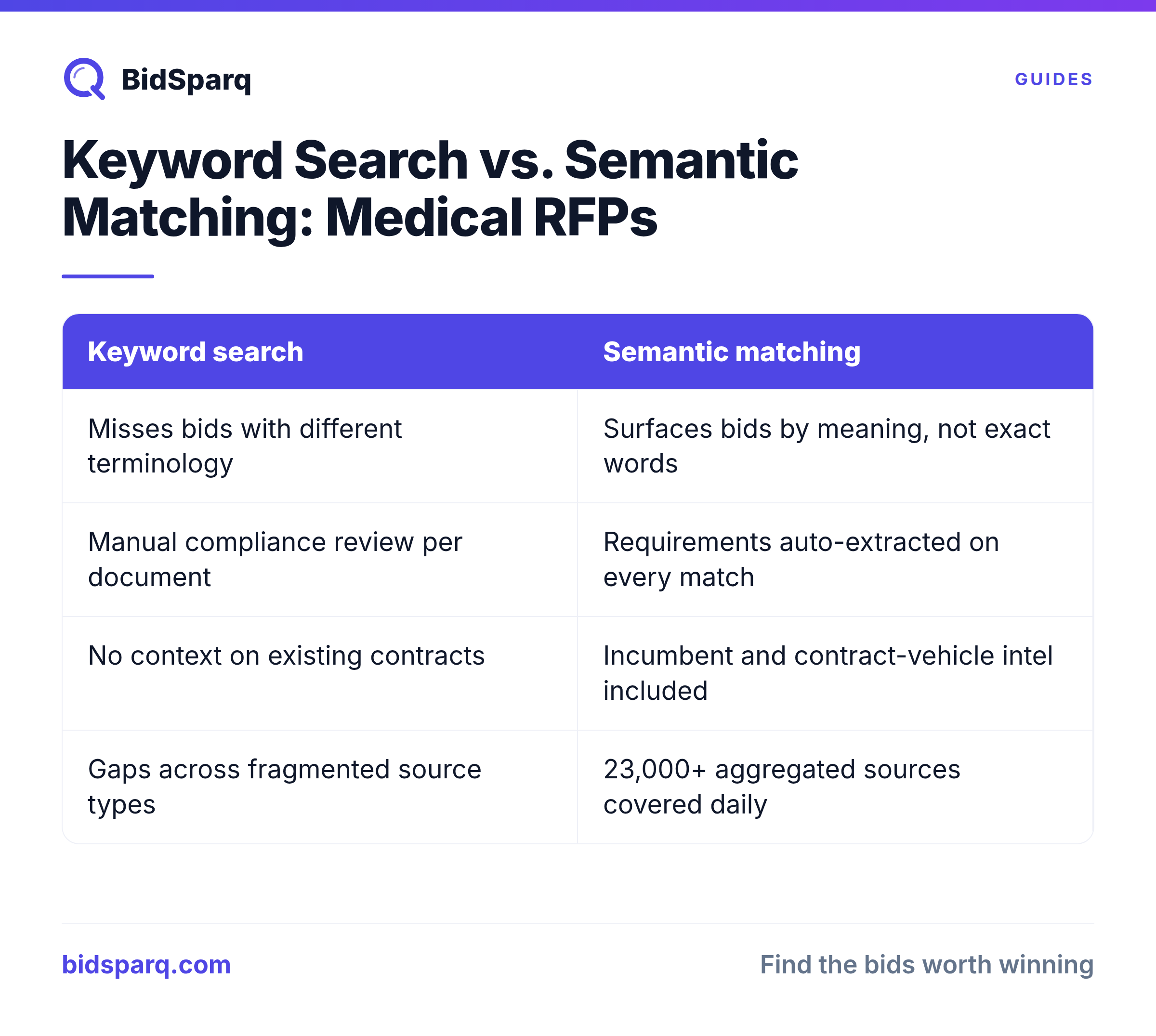
- Keyword searches miss real opportunities whenever buyer terminology diverges from your service descriptions, a gap that compounds across hundreds of active solicitations every month and cannot be solved with synonym lists alone.
- Compliance requirements and contract context are buried inside documents: surfacing HIPAA clauses, license thresholds, and insurance minimums automatically, alongside incumbent and contract-vehicle intel, turns multi-hour reviews into minutes and reveals renewal windows before a formal RFP is ever posted.
The short answer
The fastest path to daily RFP medical opportunities is a single feed that aggregates hospital systems, Medicaid programs, and federal health agencies simultaneously, scores each result for fit, and extracts compliance requirements before you open a single document. Healthcare procurement is fragmented by design: different buying entities use different portals, different terminology, and different posting schedules, so a team that monitors only one or two sources will structurally miss a large portion of the market. As of September 2026, BidSparq tracks 61,503 open solicitations across 23,000+ sources, giving medical vendors a complete picture of what is active right now. The teams that win consistently are not searching harder; they are seeing every relevant bid the day it posts.
Where daily medical RFPs actually come from
Hospital systems and integrated delivery networks are the starting point, not the whole picture. These organizations issue solicitations through their own vendor portals or through group purchasing organizations, including Vizient, Premier, and HealthTrust, whose contracting vehicles cover everything from daily clinical staffing to long-term supply agreements. State Medicaid agencies maintain procurement portals that are entirely separate from general state purchasing systems; California channels health services solicitations through Cal eProcure while Pennsylvania routes Medicaid procurement through PA eMarketplace, and both post frequently for managed care, home health, and behavioral health services. Federal health agencies publish solicitations on SAM.gov, including per-diem clinical services, daily home care contracts, and support services administered through HHS and the VA. Hospital system vendor portals such as Prodigo surface supply chain solicitations that never reach a public procurement board, covering clinical equipment and daily operational services for health systems that prefer closed supplier networks. As of September 2026, New York leads active daily solicitations with 613 open right now, followed by California with 74 and Pennsylvania with 71, confirming that state-level monitoring is as important as federal coverage. None of these sources overlap completely, which is why full coverage requires monitoring all of them.
Why keyword searches fail medical procurement teams
The gap between how your firm describes its services and how a buyer writes an RFP is where most missed opportunities live. A hospital may issue a solicitation for "per-visit nursing services" when your firm provides "home health staffing." A county health department might request "behavioral health crisis response" when your service category is "mobile mental health intervention." The fit is genuine in both cases, and a keyword search surfaces neither. Multiply that across hundreds of active medical solicitations and the cumulative miss rate is significant. Semantic matching resolves this by reading intent and meaning rather than matching exact strings, connecting your service profile to solicitations even when the vocabulary diverges. The result is a daily feed that surfaces real opportunities instead of a filtered version of obvious ones.
Get matched medical bids delivered daily, no credit card needed. Start your free medical RFP feed on BidSparq's discovery platform and see what the market is posting before your competition does.
What to look for in every medical RFP
Before committing pursuit resources to any medical solicitation, a team needs four things surfaced quickly: scope, compliance requirements, timeline, and existing contract context. Medical RFPs are among the densest documents in procurement. A home health solicitation might embed HIPAA data handling requirements on page 14, a state Medicaid license condition on page 22, and a minimum insurance threshold on page 31. Reading all of that manually for every prospect is not a sustainable workflow at any meaningful volume. Automatic compliance and requirement extraction pulls those conditions to the surface so teams can evaluate fit in minutes rather than hours. Adding incumbent intel and contract-vehicle data completes the picture: when a long-standing contract is approaching its renewal window, that is a structural pursuit opportunity with a defined timeline, not a reactive response to a posted RFP.
How to build a daily medical RFP monitoring routine
An effective daily routine covers all source types, applies fit scoring before any human review, and flags time-sensitive solicitations automatically. Start by mapping every relevant buying entity: federal health agencies, your state Medicaid office, state health department procurement portals, major hospital systems in your region, and GPO contracting vehicles from networks like Vizient and Premier. Then set a scoring threshold so only genuinely relevant bids reach a reviewer. An AI fit score running from 0 to 100 lets teams define a floor and skip everything below it without worrying about missed matches. As of September 2026, 567 solicitations with daily service requirements close within the next 14 days across the broader market, which illustrates exactly what ad-hoc checking costs. A daily digest that surfaces only high-scoring matches, with compliance requirements already extracted, compresses review to minutes per day rather than hours. This same routine transfers naturally to adjacent commercial health program and education pursuits as well.
FAQ
Where can I find daily RFP medical opportunities for free?
SAM.gov is the right starting point for federal medical solicitations, covering HHS programs, VA contracts, and CMS-related procurements at no cost. Your state Medicaid agency and state health department maintain their own procurement portals, accessible through systems like California's Cal eProcure or Pennsylvania's PA eMarketplace. For a consolidated daily view across federal, state, and health-system sources, a free tier on an aggregation platform gives you matched results without manual portal-by-portal searching and without a credit card required to get started.
How often are new medical RFPs posted?
New healthcare solicitations appear continuously, not in weekly or monthly batches. Federal health agencies, state Medicaid programs, hospital purchasing networks, and GPO contracting vehicles post on their own schedules throughout the month. As of September 2026, 1,285 new solicitations mentioning daily service requirements were posted in the last 30 days across 23,000+ tracked sources, which works out to roughly 40 or more new relevant postings every day. Checking less than daily in a market at this pace means missing early deadlines before you know they exist.
What is the best RFP software for medical procurement?
The most effective tool for medical procurement monitoring aggregates across federal, state, and health-system sources simultaneously, applies semantic matching so terminology differences do not create blind spots, and extracts compliance requirements automatically so teams spend time on fit decisions rather than document parsing. AI fit scoring from 0 to 100 lets teams define a meaningful threshold rather than reviewing every result by hand. Incumbent and contract-vehicle data is equally important, since knowing when an existing contract comes up for renewal is often more valuable than discovering a new solicitation cold.
Build your daily medical RFP monitoring routine today. Explore BidSparq's free RFP discovery platform and get matched results across 23,000+ sources without manual searching.
Find RFPs that match your business
BidSparq monitors 23,000+ procurement sources and uses AI to score every opportunity against your capabilities. Try it free for 14 days.
Start Free Trial →