Healthcare RFP Examples That Actually Win Contracts
Healthcare RFP examples span clinical technology, staffing, equipment, and managed care services. This guide covers what each category requires, how to read solicitations effectively, and how to find live bids before they close.
Healthcare procurement is one of the broadest and most active RFP markets in the economy, and most vendors entering it are either studying the wrong examples or finding the right solicitations too late to compete.
- Multiple buyer types, multiple compliance profiles: hospital systems, managed care organizations, ambulatory clinics, and public health agencies all issue RFPs, each with distinct accreditation and regulatory expectations.
- HIPAA obligations, credentialing mandates, and accreditation requirements live inside scope sections, not in dedicated compliance clauses. Vendors who scan only for a compliance heading miss them entirely.
- Volume exceeds what most teams expect: as of August 2026, 2,476 new healthcare solicitations posted in a single month across the sources we track.
- 589 healthcare solicitations close within the next 14 days. Vendors who find bids first gain a preparation advantage that late-arriving teams cannot recover.
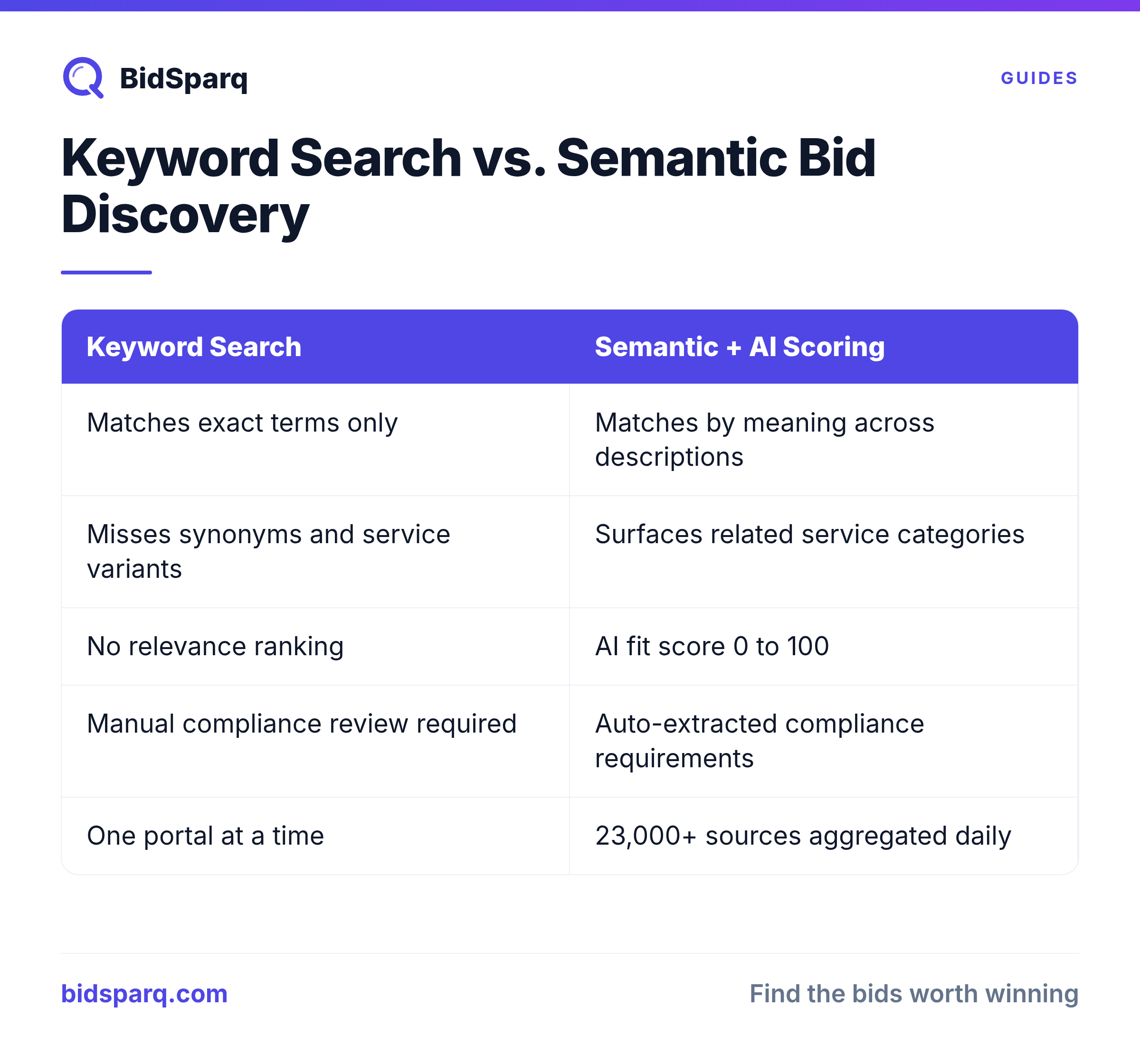
- Cut review time with a 0-to-100 fit score: AI relevance scoring against your capability profile ranks viable bids at the top and flags disqualifying requirements before you commit hours to a response.
- Incumbent intelligence changes your strategy: knowing who holds the current contract and what vehicle it sits on shifts your entire response and pricing approach.
The short answer
Healthcare RFPs are formal solicitations issued by hospital systems, health plans, public health agencies, and other buyers who open competition for contracts covering clinical technology, staffing, medical equipment, and managed care services. They follow a standard structure: background and scope, compliance and regulatory requirements, evaluation criteria, and submission instructions. The examples most worth studying are those in your specific service line, because the requirements inside a clinical software RFP look nothing like those in a travel nursing RFP. The fastest path to real, current examples is a discovery platform that draws from a broad range of buyer types, not a single portal.
The categories of healthcare RFPs you will actually encounter
Healthcare RFPs fall into five broad service categories, and the document structure inside each one differs enough that examples from the wrong category will actively mislead your preparation. Clinical technology RFPs cover electronic health records, telehealth platforms, interoperability middleware, and revenue cycle management tools; these carry the heaviest integration and security requirements, including HIPAA technical safeguards and often HITRUST or NIST alignment. Staffing and workforce RFPs cover travel nursing, allied health, locum tenens, and behavioral health positions; the compliance weight shifts to credentialing, licensure verification, and Joint Commission or DNV standards. Equipment and supply RFPs span imaging systems, surgical instruments, durable medical goods, and laboratory consumables, where evaluation criteria lean on technical specifications and service agreements. Facilities and support services RFPs include environmental services, food and nutrition, and biomedical equipment maintenance. Managed care and insurance RFPs, issued by employers, unions, and health programs, cover network design, pharmacy benefit management, and population health services.
Two categories account for the steepest learning curve because their internal structures diverge most sharply from general commercial procurement. Here is what those documents actually look like inside.
Clinical technology RFP: scope section and evaluation matrix. The scope section in this category does not merely describe what software should do; it embeds compliance tests directly into the deliverable description. A representative scope clause reads as follows: The selected vendor shall provide a cloud-hosted platform with bidirectional integration to the health system’s EHR via HL7 FHIR R4 APIs. The platform must maintain SOC 2 Type II certification and comply with all applicable HIPAA Security Rule technical safeguard requirements. A signed Business Associate Agreement is required prior to contract execution. Notice what that structure does: it buries SOC 2, HIPAA, and BAA obligations inside the scope of work rather than under a dedicated Compliance heading. Vendors who scan section headings miss all three scored requirements. The evaluation matrix in these solicitations typically allocates the heaviest weight to technical approach and integration capability, followed by security and compliance documentation, then implementation plan and project management, total cost of ownership over the contract term, and comparable health system references. Responses that address each criterion in the buyer’s listed order, using the buyer’s exact terminology, consistently outscore responses reorganized around a vendor’s own product narrative.
Staffing RFP: credentialing requirement language. In staffing solicitations, credentialing requirements most often appear under headings such as Workforce Standards, Placement Requirements, or Staffing Qualifications rather than Compliance, which is the first section most vendors examine. A representative credentialing section states requirements in this form: current state licensure in good standing verified through the applicable state board; Basic Life Support and Advanced Cardiac Life Support certifications current at the time of placement; completed background screening within the past 12 months; documentation of required immunizations per CDC healthcare worker guidelines; and competency assessments specific to the assigned unit or service line. Many staffing solicitations separately require Joint Commission Healthcare Staffing Services certification of the agency itself, distinct from the credentials of any individual being placed. Each credential type named in the solicitation should appear in your response as a direct, named confirmation. Grouping credentials under a general quality assurance statement creates an unresolved gap on the evaluator’s scoring matrix.
What the anatomy of a strong healthcare RFP response looks like
Every strong healthcare RFP response maps capabilities directly to each stated requirement, in the same order the buyer listed them. Buyers in this sector score proposals against a matrix, and any requirement left without a concrete answer is a scored gap. The compliance section deserves its own internal review pass: HIPAA Business Associate Agreement obligations, data breach notification timelines, and accreditation-specific requirements such as Joint Commission, URAC, or NCQA must be addressed explicitly, not buried in a general security narrative. Evaluation factors in healthcare solicitations frequently weight past performance and references heavily, so attaching service histories from comparable buyers strengthens any submission. Pricing sections in healthcare RFPs often require multi-year rate structures, volume tiers, or per-member-per-month formats, so reading the pricing instructions before drafting the financial exhibit prevents costly late-stage rewrites.
How to find real healthcare RFP examples before deadlines close them
The challenge with healthcare RFP examples is not that they are rare; it is that they are scattered across hundreds of buyer portals, and most close before a vendor scanning manually finds them. As of August 2026, 1,613 solicitations mentioning healthcare are open across the 23,000+ sources tracked here, and 589 of them close within the next 14 days.
Find healthcare RFPs before they close, no credit card needed.
Keyword search on individual portals misses solicitations that describe services in different terms: a behavioral health RFP may say mental health services or substance use disorder treatment, and a clinical staffing RFP may reference specific licensure codes rather than the word staffing. Semantic matching reads meaning rather than strings and surfaces bids that keyword filters drop. BidSparq aggregates that volume across 23,000+ sources, applies semantic matching, and delivers a scored, qualified list instead of an unfiltered firehose.
What AI fit-scoring reveals that manual review misses
A fit score against your profile does one thing manual review cannot: it ranks a list of healthcare RFPs in seconds so you can allocate bid/no-bid time where it is most likely to pay off. Scoring looks at alignment across service category, buyer type, geographic scope, contract size signals, and compliance requirements relative to your stated capabilities. Bids that score in the 70s and above tend to require less qualifying work in the response; bids that score below 40 often contain a disqualifying requirement that only surfaces deep in the solicitation. Automated compliance extraction pulls those requirements out of the body text before you commit to a response, which saves significant pre-proposal review time in a category where regulatory clauses are long and non-negotiable. Pair scoring with incumbent and contract-vehicle intelligence and you can assess not just whether you can win a bid but whether it is worth trying to unseat an entrenched vendor on a vehicle you do not hold.
FAQ
What are common healthcare RFP examples by service type?
The most common categories include clinical technology (EHR platforms, telehealth, revenue cycle management), workforce and staffing (travel nursing, locum tenens, allied health), equipment and supplies (imaging, surgical, laboratory), facilities and support services (environmental services, food and nutrition, biomedical maintenance), and managed care (pharmacy benefit management, population health, network design). Each has its own compliance weight and evaluation structure, so the most useful examples to study are those in your specific service line rather than healthcare RFPs in general.
How do I find healthcare RFPs to bid on right now?
Healthcare solicitations are issued by hospital systems, health plans, ambulatory networks, public health agencies, school health programs, and employer benefit plans, spread across hundreds of separate procurement portals. A discovery platform that aggregates those sources and applies semantic matching surfaces relevant bids that keyword searches on individual portals miss. As of August 2026, 2,476 new healthcare solicitations were posted in a single 30-day period, a volume that makes manual portal-scanning impractical for most bid teams.
What compliance requirements appear most often in healthcare RFPs?
HIPAA and Business Associate Agreement obligations appear in virtually every healthcare technology and staffing solicitation. Accreditation-related requirements (Joint Commission, NCQA, URAC, DNV) appear in clinical staffing and managed care RFPs. State licensure and credentialing verification requirements are common in workforce solicitations. Cybersecurity frameworks such as NIST and HITRUST appear frequently in technology RFPs. These requirements are often embedded in scope or technical specification sections rather than a dedicated compliance exhibit, which is why automated compliance extraction saves significant pre-proposal review time.
Start finding healthcare RFPs free, no credit card needed.
Find RFPs that match your business
BidSparq monitors 23,000+ procurement sources and uses AI to score every opportunity against your capabilities. Try it free for 14 days.
Start Free Trial →