Past the GovWin Login: Win Bids Across Every Market
If your team relies on a govwin login for bid discovery, you are seeing one slice of a market with 71,735 open solicitations. Here is what full-market RFP intelligence shows you that federal-only tools cannot.
Logging into a federal bid tool every morning feels like due diligence. The harder question is what that login cannot show you. Federal contracts are one segment of the public procurement market. Education, healthcare, construction, state and local agencies, and commercial buyers each post thousands of solicitations that never surface inside a system built around a single federal database. If your pipeline depends on one login, your pipeline has a ceiling.
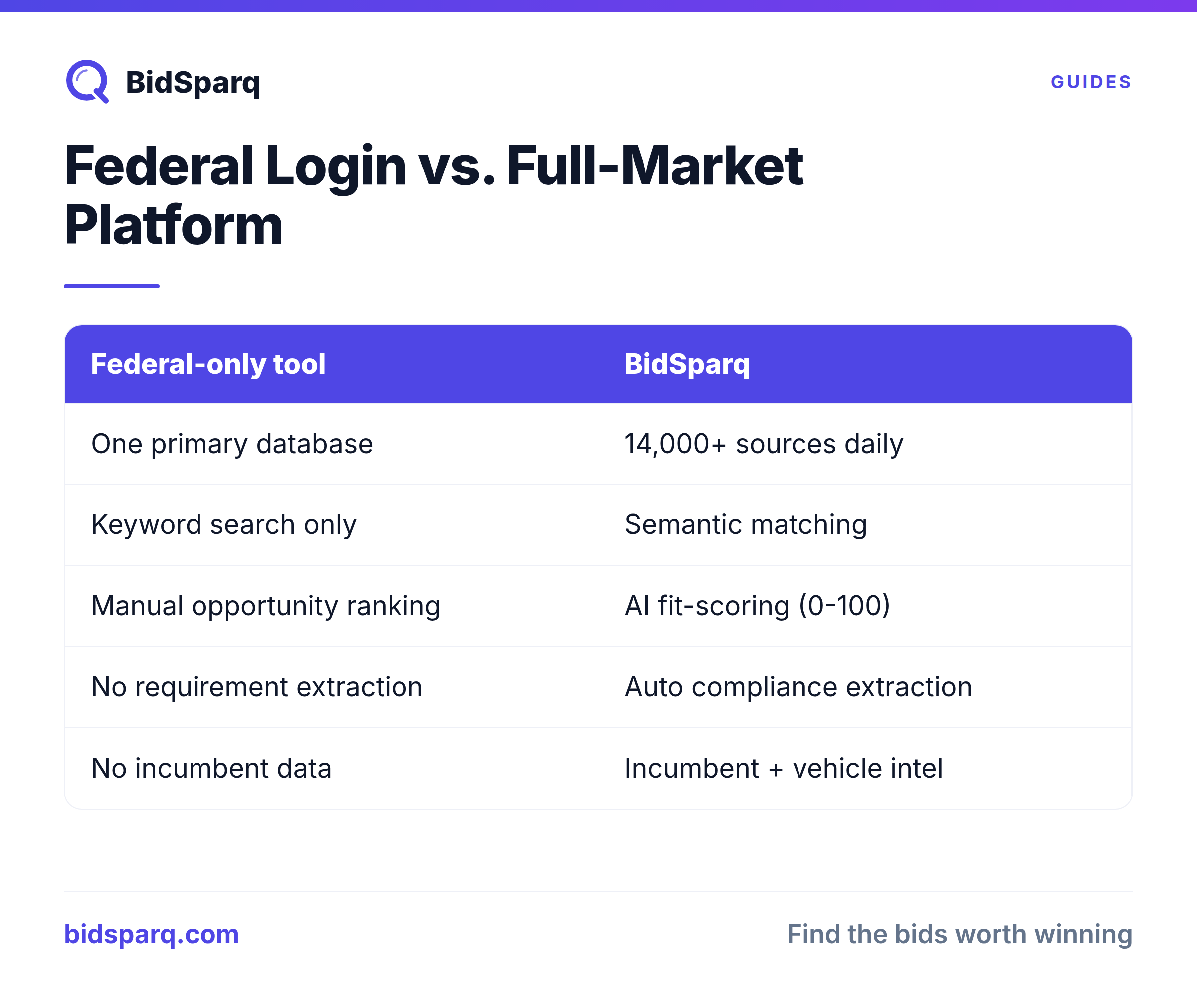
- Federal-focused tools leave entire markets uncovered: education, healthcare, construction, and commercial procurement add volume that no single federal database captures.
- As of July 2026, 71,735 solicitations are open across the 23,000+ sources tracked daily, spanning every major procurement vertical.
- Semantic matching surfaces bids by meaning, catching opportunities that keyword-only search routinely misses.
- AI fit-scoring from 0 to 100 replaces manual stack-ranking so you know which open bids are worth your time before you read a single page.
- Automated compliance extraction pulls requirements, deadlines, and set-aside clauses without anyone reading every document by hand.
- Incumbent and contract-vehicle intel shows who holds the current award before you commit a full proposal cycle to a long-shot bid.
What a Federal Login Cannot Show You
The opportunities your competitors win first are often the ones your current tool is not designed to surface. A federal-focused login gives access to a carefully defined slice of procurement activity. It cannot give you the large school district putting out a multi-year food-service contract, the regional hospital network issuing a medical-equipment RFP, the county transit authority soliciting a software platform, or the commercial enterprise running a formal competitive bid process. Those opportunities live in separate sourcing systems published across thousands of portals, with no connection to a federal contract database. A tool scoped to one level of government misses all of them by design, not by accident.
The Real Scale of the Open Market
Volume is the first thing that shifts when you look at the full procurement landscape instead of one database. As of July 2026, 71,735 solicitations are open across the 23,000+ sources tracked daily. That pool spans healthcare systems, K-12 and higher education, public construction, IT procurement, and state and local agencies alongside federal work. In the last 30 days, 600 new solicitations related to login and access-management requirements were posted across those sources, pointing to how actively agencies are procuring in this space right now. A pipeline built on a single-source login competes for a narrow fraction of that total. Teams that cover the full market consistently find categories with lower competition and higher win rates, because most rivals are watching the same narrow feed.
Why Semantic Matching Beats Keyword Search
Keyword search only finds what you already know to search for. When an agency uses different terminology, files a bid under an unexpected category code, or describes a scope that overlaps your capabilities without naming them directly, a keyword tool returns nothing. Semantic matching works on meaning: it reads what a solicitation is asking for and surfaces it based on relevance to what a vendor actually does. A contractor specializing in network infrastructure finds a school district technology-modernization bid. A healthcare services firm surfaces a clinic-staffing RFP filed under a code it has never monitored. The match happens because the platform understands relevance, not because a search term happened to align.
AI Fit-Scoring Replaces the Spreadsheet Stack
Ranking bid opportunities by hand is a research task dressed as strategy work. BidSparq scores every open solicitation from 0 to 100 against a vendor profile, so a business-development team starts each day with a sorted, prioritized list instead of a raw feed. As of July 2026, 233 login-related solicitations close within the next 14 days. Teams that triage in real time do not miss those windows. The score accounts for capability match, requirements overlap, and sourcing patterns across the full market, so the ranking reflects where a team can realistically compete, not just where bids happen to be posted.
Compliance Extraction and Incumbent Intel
Two tasks consume more proposal-prep time than almost anything else: parsing requirements and researching the incumbent. Automated compliance extraction pulls every set-aside clause, licensing requirement, submission deadline, and bonding condition directly from the solicitation document. A team can assess viability in minutes rather than hours. Incumbent and contract-vehicle intel extends that further: knowing who holds the current contract, what vehicle they used to win it, and when it expires tells a team whether a competitive pursuit makes sense before any proposal investment begins. These capabilities go beyond what a federal-only login typically provides, and they change a bid team's hit rate across any vertical.
FAQ
What is GovWin and who typically uses it?
GovWin IQ, published by Deltek, is a federal market-intelligence platform used primarily by defense contractors and IT integrators pursuing federal and defense work. It provides agency spending data, contract history, and federal opportunity tracking. Teams whose pipelines extend beyond federal procurement typically add broader platforms to cover state, local, education, healthcare, and commercial bids alongside their federal work.
How does a full-market RFP platform differ from a federal-only bid tool?
A full-market platform aggregates bid sources across every procurement vertical rather than one agency tier. It applies semantic matching to surface opportunities by meaning rather than keywords, scores each result so teams can prioritize without manual review, and includes compliance extraction and incumbent intelligence built in. The result is a single feed covering federal, state, local, education, healthcare, construction, and commercial procurement at once, rather than requiring a separate login for each vertical.
Is there a free way to search bids across all these markets?
Yes. A free tier is available with no credit card required, giving access to matches across 23,000+ sources. Pro Max costs $249 per month, or $199 per month billed annually, and unlocks full AI scoring, automated compliance extraction, and incumbent and contract-vehicle intelligence. Explore the full RFP discovery platform to see what the complete market looks like for your profile.
See your matches free, no credit card needed. Start searching the full market at BidSparq's bid discovery platform.
Find RFPs that match your business
BidSparq monitors 23,000+ procurement sources and uses AI to score every opportunity against your capabilities. Try it free for 14 days.
Start Free Trial →