Who Offers Reliable GovCon RFP Software for Contractors?
Not all govcon RFP software is built the same. Learn which features separate reliable platforms from keyword tools, and how contractors can find more of the bids they are actually qualified to win.
GovCon contractors lose bids they never knew existed. The solicitation posted, the deadline passed, and a competitor who found it earlier wins the award. That gap is almost always a sourcing problem, not a capability problem, and the right software closes it reliably.
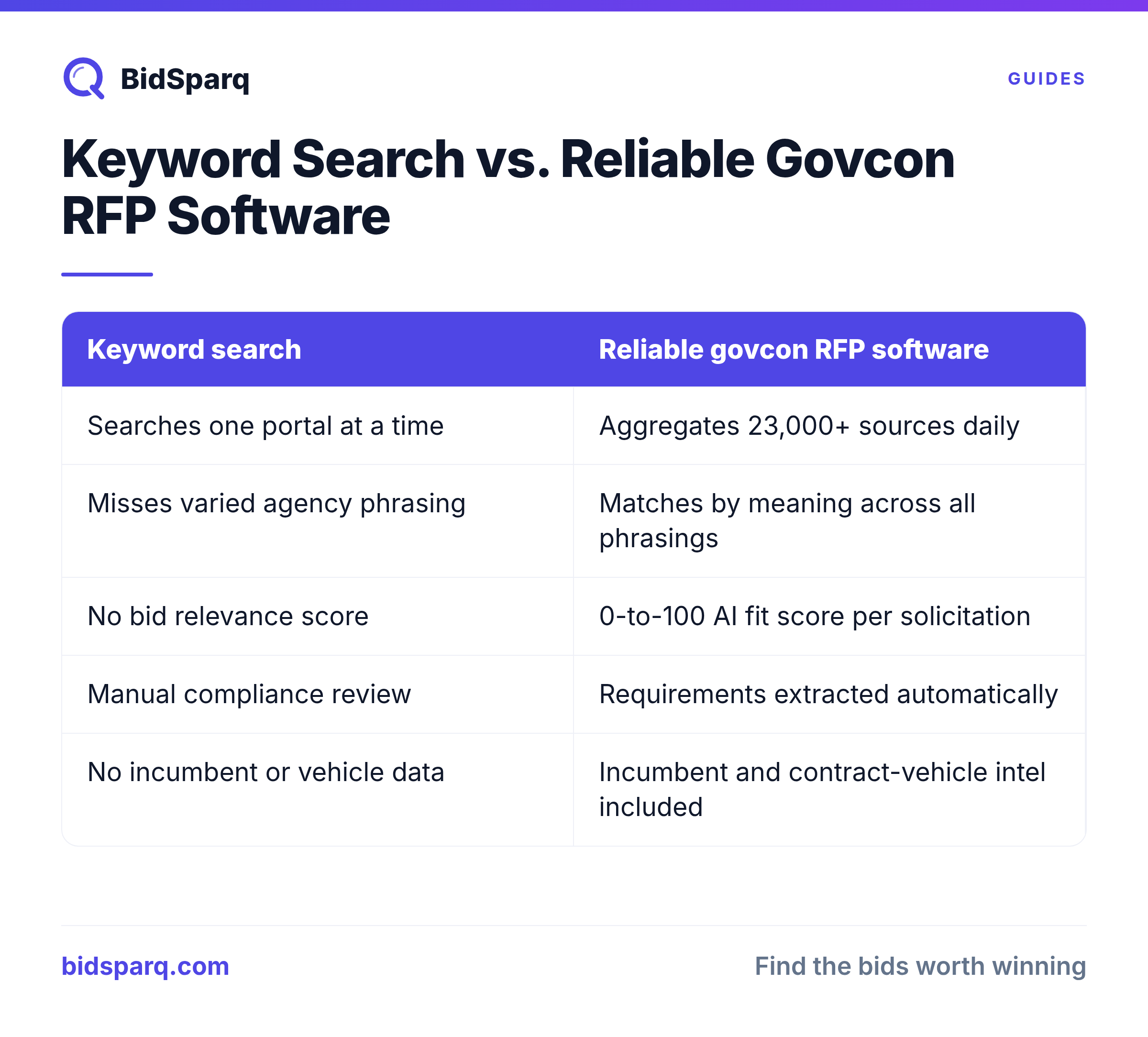
- Source coverage is the ceiling on your pipeline: govcon RFP tools that aggregate fewer sources guarantee missed bids, regardless of how polished the search interface looks.
- Semantic matching outperforms keyword search because agencies describe identical scopes of work in dozens of different ways across solicitation templates and contracting vehicles.
- A 0-to-100 fit score cuts BD triage from hours to minutes, letting capture teams focus effort on the pursuits worth winning rather than reading every synopsis.
- Automated compliance extraction surfaces set-aside requirements and submission deadlines from bid attachments before deadline pressure builds.
- Without incumbent and contract-vehicle intel, go/no-go decisions rely on guesswork rather than the data that shapes competitive positioning and teaming strategy.
- State and local solicitations often carry less competition than federal work at comparable contract values, making them a high-return complement to a federal-focused pipeline.
The short answer
Reliable govcon RFP software for contractors aggregates solicitations from thousands of sources, matches opportunities by meaning rather than exact keyword, and scores each bid for fit so BD teams know exactly where to spend their time. Tools that pull from only one or two portals, or that depend on exact-phrase search, miss a large share of available work. As of August 2026, more than 62,000 active solicitations are open across the 23,000+ sources BidSparq tracks. The right platform filters that volume down to the bids that genuinely fit your capabilities, certifications, and capacity.
The govcon search problem no portal solves alone
Start with SAM.gov for federal prime contracting under the FAR, then build your source list beyond it, because the govcon market is larger than any single portal covers. SAM.gov is free, authoritative, and essential for federal solicitations published under Part 15. But state and county agencies publish on their own eProcurement systems. Defense activities use specialized platforms for certain supply categories. Municipal procurement offices post notices on local government websites with no central index. FPDS.gov and USASpending.gov are valuable for understanding historical contract awards, incumbent relationships, and realistic contract values, but neither lists open solicitations. Contractors who build a source list spanning federal, state, and local procurement and check it consistently hold a structural pipeline advantage over those who rely on one database. A reliable govcon RFP tool automates that multi-source search daily rather than requiring your team to run it by hand.
What reliable govcon RFP software actually does differently
Evaluate any govcon RFP tool on three criteria before anything else: source breadth, match quality, and how it handles compliance requirements buried in bid attachments. Source breadth determines how much of the market you can actually see. Match quality determines whether the bids you surface are genuinely relevant, a test that keyword tools routinely fail because contracting officers phrase identical scopes of work differently depending on agency, template, and program. A solicitation titled "enterprise infrastructure modernization" and one titled "data center migration support" may describe nearly identical work, and a keyword search tuned to one misses the other. Software that matches by meaning rather than literal phrase closes that gap. Compliance requirements, including set-aside type, submission format, evaluation factors, and applicable contract clauses, are almost always buried in attached documents rather than the solicitation synopsis. Automated extraction of those requirements saves hours per bid and eliminates the risk of a procedural submission error that disqualifies an otherwise strong proposal.
Running a govcon BD operation at the scale the market demands
Automate daily bid monitoring before you optimize anything else, because the volume of new govcon solicitations makes manual checking a structural disadvantage. In the last 30 days, 5,288 new solicitations were posted across the sources we track, and 1,270 of those open solicitations close within the next 14 days. A BD team checking portals every few days is late to most of those opportunities before they even appear on the radar. Automated ingestion, AI scoring, and alert notifications on new matches above a relevance threshold convert that flow into a prioritized work queue. Contractors running BD this way arrive at pipeline reviews with a ranked list ready for discussion, not a search task still pending. The same automation advantage applies beyond federal govcon: education, healthcare, and commercial buyers also post on fragmented platforms at volume, and contractors who serve multiple sectors benefit from a single scored, multi-source feed.
Search 62,000+ active solicitations free on BidSparq's RFP platform, no credit card needed.
The incumbent and vehicle intelligence that changes bid strategy
Pull incumbent data and contract-vehicle information on every opportunity before your BD team makes a go or no-go decision, not after. Whether a recompete is held by a well-resourced incumbent with an entrenched relationship, or is a first-time award in an open field, determines how you price, whether you team, and how aggressively you weight the pursuit. Contract-vehicle intelligence tells you whether a solicitation flows through a GWAC, a state master agreement, or an open-market posting, which drives teaming requirements, small business set-aside applicability, and pricing ceiling expectations. State-level procurement is active and often less contested than equivalent federal work: as of August 2026, Pennsylvania and Virginia posted 320 and 209 open solicitations mentioning "offers" respectively, reflecting steady volume at the state level. Contractors who combine federal and state pipeline development using incumbent data on both sides are the ones who maintain steady revenue across administration changes, budget cycles, and federal funding shifts.
FAQ
What is the best govcon RFP software for small business contractors?
Small business contractors need govcon RFP software that treats set-aside filters as a first-class feature. SDVOSB, 8(a), HUBZone, WOSB, and small business set-aside filters should be available at the surface level, not buried in advanced search settings. Source breadth matters especially for small contractors pursuing state and local work alongside federal, since state agencies often have fewer competing bidders for comparable scopes. Semantic matching and fit scoring help small BD teams decide quickly without dedicating full-time analyst hours to opportunity research. BidSparq's Free tier is a practical starting point; Pro Max at $249 per month (or $199 per month billed annually) unlocks full scoring, compliance extraction, and incumbent-intel.
Is SAM.gov enough for finding government contracting opportunities?
SAM.gov is essential and non-negotiable for federal prime contracting under FAR Part 15, but it covers only one layer of the govcon market. Subcontracting opportunities, state and local solicitations, task orders on GWACs not publicly posted to SAM.gov, and agency-specific procurement portals all sit outside its scope. Contractors who limit their search to SAM.gov systematically miss a substantial portion of available work. The right approach treats SAM.gov as the federal anchor and supplements it with a multi-source aggregator covering state eProcurement portals and agency-specific sites.
How does AI fit scoring work in govcon RFP software?
AI fit scoring compares the full text of a solicitation, including attachments and requirements sections, against a contractor's capability profile: NAICS codes, past performance categories, certifications, and stated areas of expertise. The result is a numeric score, 0 to 100, reflecting semantic alignment rather than keyword overlap. A solicitation that uses none of your exact terminology but describes work you have performed extensively can score high; one that repeats your terms in an unrelated context scores low. The practical effect is that BD teams sort their daily match list by score rather than reading every synopsis, and time previously spent on irrelevant bids shifts to proposal work on the right ones.
Try BidSparq's RFP software free and see which govcon solicitations match your capabilities today.
Find RFPs that match your business
BidSparq monitors 23,000+ procurement sources and uses AI to score every opportunity against your capabilities. Try it free for 14 days.
Start Free Trial →