How to Find Government Subcontracts Before the Window Closes
Government subcontracts are scattered across dozens of channels and close fast. Learn how to find government subcontracts systematically using multi-source search, semantic matching, and fit scoring.

Government subcontracts are a legitimate growth path, but they are also among the most time-sensitive procurement opportunities in the market. Primes post subcontract notices on compressed schedules, often as part of existing solicitation documents rather than as standalone postings. If you are not watching the right sources at the right time, the window closes before you know it was open.
- The market moves fast: as of August 2026, 85 open solicitations mentioning subcontracts close within the next 14 days.
- New volume is steady: 211 new subcontracting-related solicitations were posted in the last 30 days alone.
- Fragmentation is the core problem: government subcontracts appear across federal portals, state procurement boards, and prime contractor channels simultaneously.
- Keyword searches miss context: semantic matching surfaces relevant scopes that exact-phrase tools skip entirely.
- Compliance requirements are buried in attachments: auto-extraction of subcontracting plan requirements cuts hours of manual document review.
- Geographic targeting sharpens focus: subcontract activity clusters in specific states, making location filters essential to any pipeline strategy.
The Problem With How Most Vendors Search
The single-portal approach to finding government subcontracts fails because the supply is distributed, not centralized. In construction, subcontract notices appear on general contractor project boards and public permit filings. In healthcare, they surface in institutional RFP attachments and teaming notices. In government work, that distribution gets more complex: a single subcontracting opportunity might be referenced in a SAM.gov attachment, posted separately on an agency small business site, and distributed through a prime contractor's vendor outreach program, all at once.
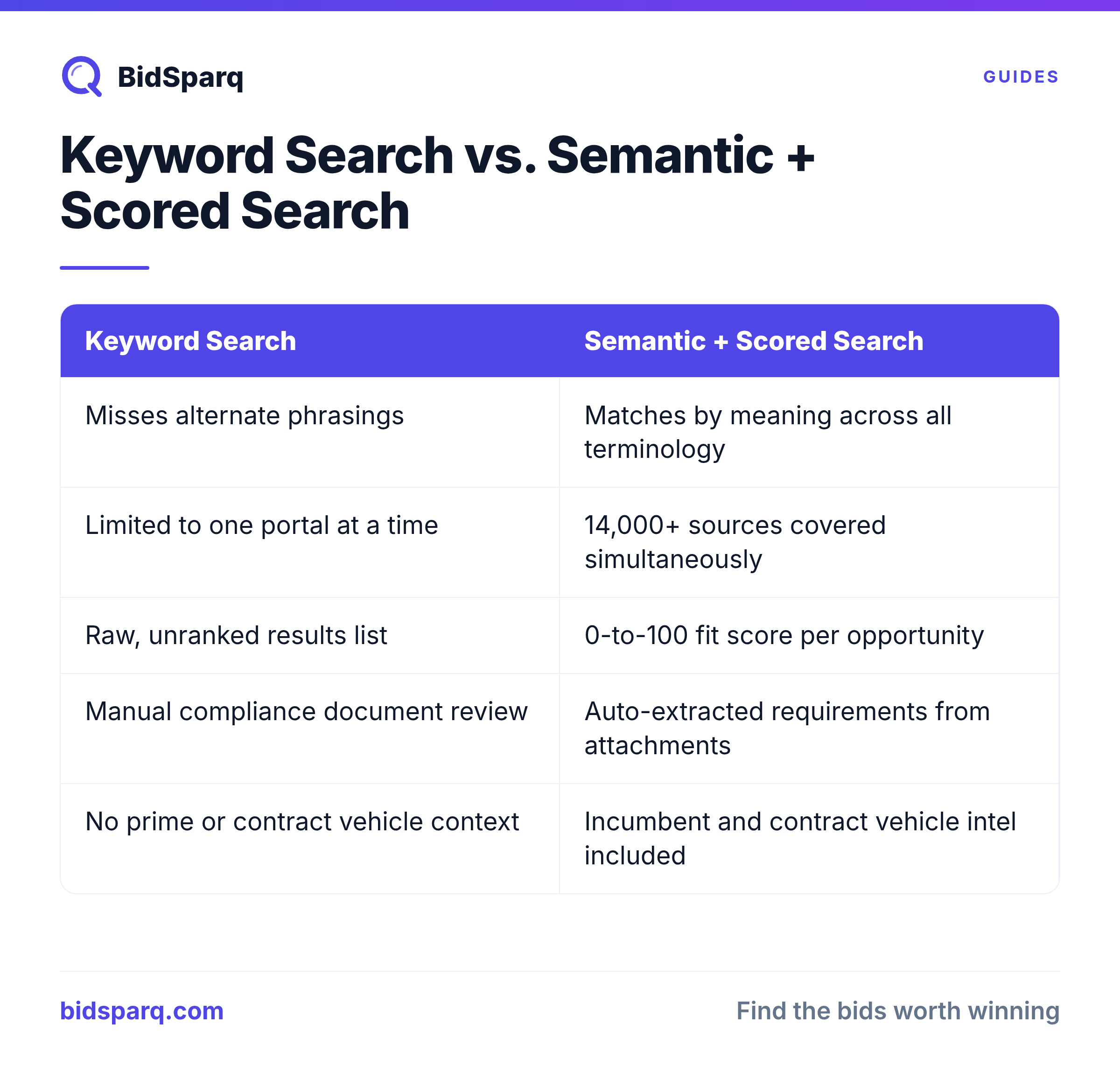
Keyword-based searches compound this problem. A search for "subcontract" misses opportunities phrased as "teaming arrangement," "small business subcontracting plan requirement," or "scope of work for subconsultants." The terminology is inconsistent by practice, not by accident.
How Government Subcontracts Are Actually Distributed
Understanding the distribution channels is the first step toward building a reliable search. At the federal level, subcontracting requirements appear inside prime solicitations as mandated subcontracting plans, and in agency small business outreach tools used to identify potential teaming partners. At the state and local level, construction and services subcontracts often flow through public procurement boards, where they sit alongside prime solicitations without special labeling. As of August 2026, across the 23,000+ sources BidSparq tracks, 175 open solicitations explicitly reference subcontracts, and 85 of those close within the next 14 days.
The implication is direct: a narrow search strategy is not a bandwidth problem, it is a coverage problem. Expanding source coverage is the highest-leverage change most subcontract hunters can make.
How to Find Government Subcontracts Systematically
A systematic approach replaces random portal checks with a monitored, multi-source pipeline. Source coverage comes first. No single portal holds all subcontracting activity. Federal portals cover federal work. State boards cover state work. Primes post on their own sites. A search strategy that misses any of these channels misses opportunities that may be directly relevant to your scope.
Matching logic comes next. Semantic search matches by meaning, not by exact phrase. A search for subcontracting work in a given sector surfaces solicitations that describe the scope using different terminology, as long as the underlying meaning aligns. This is the gap that keyword tools cannot close.
Fit scoring makes the pipeline usable. When 211 new subcontracting solicitations hit the market in a single month, a ranked list is more useful than a raw feed. A 0-to-100 fit score prioritizes the opportunities most aligned to your scope, so your team spends time on bids worth pursuing rather than ones to skip.
What to Do Before You Respond
Before responding to any subcontracting solicitation, extract the compliance requirements embedded in the document. Government subcontracting opportunities often include mandatory plan requirements: percentage targets, reporting obligations, small business certification requirements, and teaming agreement formats. These are frequently buried in attachments or referenced sections, not in the solicitation summary. Missing a compliance requirement late in the process is a common and avoidable reason bids are rejected.
Incumbent and contract vehicle intelligence matters at this stage too. Knowing who currently holds the prime contract, what vehicle it sits on, and when it expires gives context for whether a subcontracting opportunity is worth pursuing. A prime deep into a long-term contract has different teaming dynamics than one approaching recompete.
Building a Subcontract Pipeline That Compounds
A repeatable pipeline for finding government subcontracts turns a time-sensitive search into a durable competitive advantage. The mechanics are straightforward: set up monitored searches across federal, state, and local channels, score results by fit, extract compliance requirements for qualified opportunities, and respond with enough lead time to build relationships with primes before close dates.
The advantage compounds because past performance accumulates. Each won subcontract strengthens your position for the next, either as a teaming partner on a related bid or as a stronger candidate for a prime contract. Pennsylvania and Colorado are currently among the most active states for subcontracting solicitations, based on August 2026 data, making them natural starting points for firms building this kind of pipeline.
The pipeline builds itself once the search is right.
FAQ
How do I find government subcontracts in my state?
The most reliable method is a multi-source search that covers both federal portals and your state's own procurement board. Most state boards publish subcontracting opportunities alongside prime solicitations without distinguishing them clearly, so filtering by terms like "subcontract," "teaming," and "subconsultant" is a starting point. A platform that aggregates both federal and state sources with semantic search reduces the manual work significantly and ensures you are not missing opportunities because of terminology variation.
Do I need to be a small business to pursue government subcontracts?
Not always. Many government subcontracts are open to businesses of any size, and small business requirements typically apply to the prime contractor's overall plan rather than to each individual subcontractor. That said, holding relevant certifications such as HUBZone, 8(a), WOSB, or SDVOSB can make you a more attractive teaming partner for primes who need to meet their own subcontracting plan targets.
What is the difference between a prime contract and a subcontract in government work?
A prime contract is a direct agreement between a government agency and a contractor. A subcontract is an agreement between that prime contractor and a smaller firm performing part of the work. Subcontractors do not contract directly with the government agency. They contract with the prime, who remains responsible to the agency. For firms building past performance in a specific sector, subcontracts are often the fastest entry point before competing for prime contracts directly.
Find your first government subcontract match for free. Search open solicitations on BidSparq's RFP discovery platform, no credit card needed.
Find RFPs that match your business
BidSparq monitors 23,000+ procurement sources and uses AI to score every opportunity against your capabilities. Try it free for 14 days.
Start Free Trial →