How Do I Choose the Best GovCon RFP Software?
Trying to choose the best govcon RFP software? This guide breaks down what source coverage, semantic matching, fit scoring, and compliance extraction actually mean for your pursuit pipeline.
Most govcon BD teams miss winnable opportunities not because they work too little, but because their search tools match words rather than meaning and their source coverage stops well short of the market they are pursuing. The right RFP software changes the math: it surfaces solicitations your competitors miss, scores each for fit before you invest a single hour, and extracts compliance requirements automatically so nothing slips past a first read. Those capabilities sound like table stakes until you realize how few platforms deliver all three at once, which is why knowing what to test before you sign protects both your pipeline and your proposal budget.
- Semantic matching surfaces bids keyword tools bury: govcon solicitations rarely use your exact service terminology, so matching by meaning changes what your pipeline looks like.
- Fit scores from 0 to 100 make pursuit decisions faster because ranking a large pipeline takes minutes instead of an afternoon when each result already carries a relevance score.
- Most teams never see the compliance requirements before committing to a pursuit, since extracting bonding thresholds, certification requirements, and page limits by hand from each solicitation takes too long to do consistently.
- Incumbent and contract-vehicle data belongs at the top of the pipeline, not the bottom: knowing who holds the current contract changes whether you compete, partner, or pass, and that decision is far cheaper to make early.
- What you never see costs more than what you lose on a bid you entered: narrow source coverage means missed pre-solicitation notices, agency-specific portals, and set-aside postings your competitors already track.
The short answer
The best govcon RFP software finds relevant solicitations before your competitors do and tells you whether each one is worth pursuing before you spend time on it. That requires match quality that works by meaning rather than keywords, automated extraction of what a solicitation actually demands of you, and a calibrated relevance score on every result. Tools that skip any of these create hidden costs: either you miss opportunities because search is too narrow, or you waste proposal hours on pursuits you should have declined at the outset. Source breadth, match quality, and pursuit intelligence are the three dimensions that separate platforms capable of improving win rates from ones that simply collect and republish links.
Why keyword search fails govcon business development teams
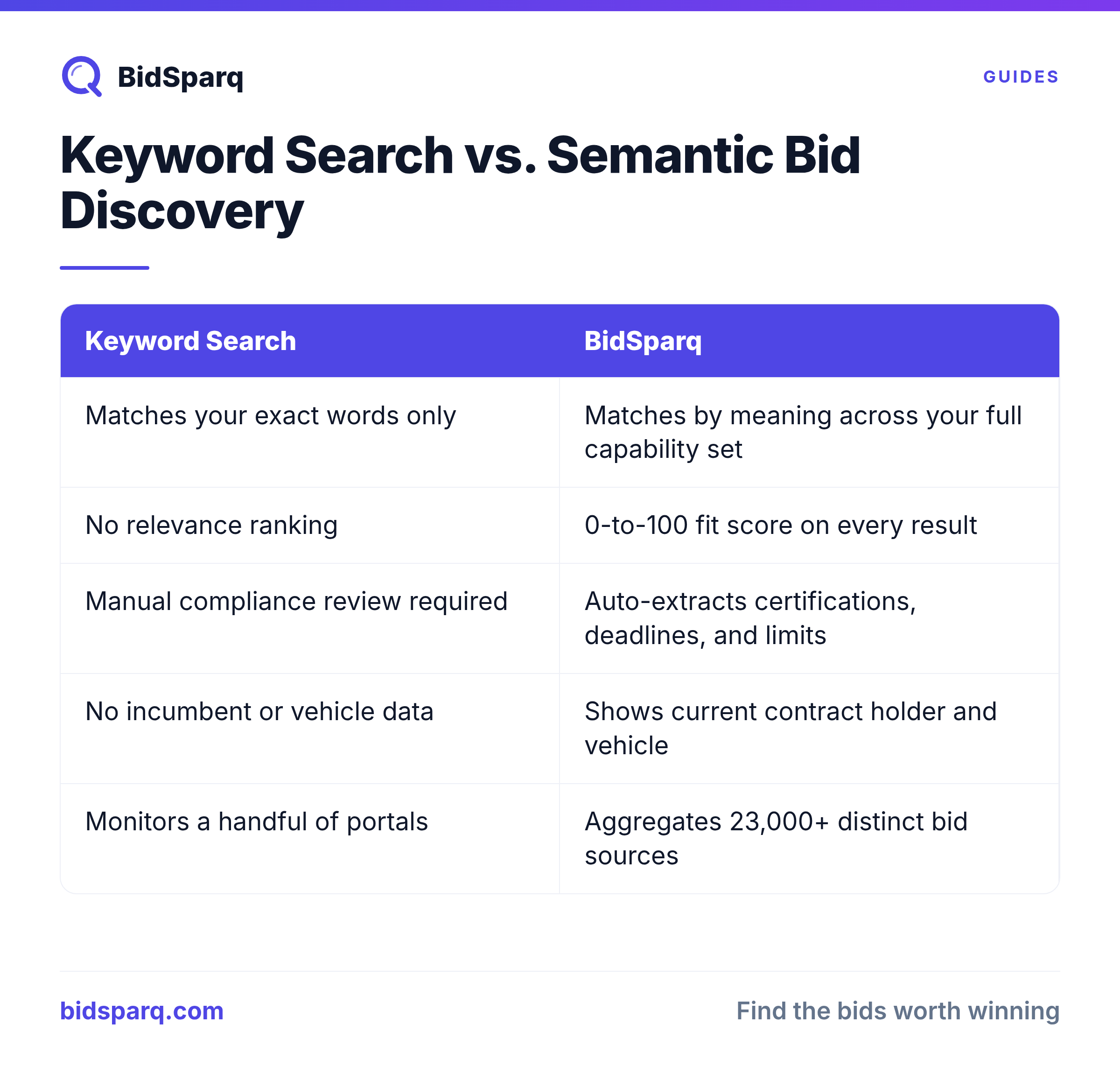
The core problem with keyword-based bid search in govcon is that the language of solicitations and the language of your capabilities rarely match. A defense IT services firm might use "cybersecurity operations" or "zero-trust architecture" internally, while the solicitation references "information assurance," "STIG compliance," or "ATO support." A keyword alert tuned to your vocabulary misses those bids entirely. The same disconnect hits facilities management contractors: a firm describing its work as "building operations" or "janitorial services" will miss solicitations written around "O&M support," "custodial services," or "facility support services." Semantic matching works from the meaning of your capability profile and the meaning of each solicitation, closing that gap automatically rather than requiring you to guess every synonym a contracting officer might use.
One edge case that basic aggregators handle poorly is IDIQ task-order search behavior. Most tools index the base IDIQ vehicle award but miss the individual task orders posted later, often on agency-specific portals rather than SAM.gov. For contractors already holding a vehicle, missing those task orders means leaving revenue your contract was designed to capture on the table. A capable platform tracks both the vehicle award and downstream task-order activity so your team never works off an incomplete picture of what your existing vehicles are generating.
Source coverage: why SAM.gov is the floor, not the ceiling
SAM.gov is the mandatory starting point for federal solicitations, but it covers only part of the govcon opportunity landscape. State and local agency portals, GSA eBuy postings, pre-solicitation announcements, sources sought notices, and agency-specific procurement systems each require separate monitoring. Tracking them manually means dedicated staff time every day and the near-certain risk of missing a fast-moving opportunity. FPDS.gov and USASpending.gov are valuable for understanding contract history and incumbent data, but neither is a bid discovery tool. As of September 2026, 57,692 solicitations are open across the 23,000+ sources BidSparq tracks. No manual monitoring process covers that.
See which of those solicitations fit your team's capabilities, free with no credit card required. Search govcon bids on the free tier and get a live view of what your pipeline is missing.
Five features that separate capable govcon bid software from basic aggregators
Evaluate any govcon RFP platform on five specific capabilities before committing your team to it.
- Semantic matching: Run a search on a niche capability your firm offers and check whether the results reflect your actual work, not just documents that contain a matching word. This test reveals immediately whether the platform understands your market or just scans for strings.
- Fit scoring: Look for a numeric score on every result. A 0-to-100 score gives your BD team a consistent threshold to apply across the pipeline rather than relying on subjective judgment for each entry, which makes prioritization repeatable and fast.
- Compliance and requirement extraction: The platform should surface mandatory certifications, set-aside eligibility, submission formats, and deadlines without requiring you to open the full solicitation first. Missing a bonding threshold or page limit late in a pursuit wastes proposal hours that extraction at discovery time would have saved.
- Incumbent and contract-vehicle intelligence: Knowing whether a contract is a recompete, who holds it, and which vehicle it rides changes bid-or-no-bid decisions before your team invests proposal hours. This data belongs at the top of your pipeline review, not buried in a separate research step.
- Source breadth and refresh rate: Ask the vendor directly how many distinct sources they monitor and how often each is refreshed. That number is the ceiling on your pipeline visibility. A platform monitoring 23,000+ sources finds what a SAM.gov-only tool structurally cannot.
How to evaluate a govcon bid platform before you commit
Run a structured trial rather than relying on a demo alone. Load a sample of past wins and past no-bids into the platform and check whether the fit scores align with your team's actual pursuit decisions. Verify that solicitations posted in the last 30 days appear in the results, and confirm that compliance data extracted from a known solicitation matches what is actually in the document. SAM.gov and USASpending.gov make useful ground-truth references: if a federal award or active solicitation you can verify on those sites does not appear in the platform's results, ask why. The strongest govcon RFP platforms cover all government levels and many also serve teams pursuing opportunities in healthcare, construction, and other sectors for buyers who want a single system across their entire market. The right tool fits your pursuit volume, your source requirements, and your team's workflow today, with room to grow.
FAQ
These questions come up in most govcon RFP software evaluations. Here are direct answers to each.
What is the difference between govcon RFP software and a government bid aggregator?
A bid aggregator collects and republishes solicitations from public sources. GovCon RFP software goes further by matching opportunities to your specific capabilities, scoring each for fit, extracting compliance requirements automatically, and surfacing incumbent and contract-vehicle data. The distinction matters because aggregation alone does not help your team prioritize or qualify. The best platforms treat discovery and intelligence as inseparable functions, not separate products.
Is SAM.gov enough for govcon bid discovery?
SAM.gov covers federal solicitations above the simplified acquisition threshold and is the right place to start. It does not include GSA eBuy postings, state and local contracting opportunities, pre-solicitation notices from agency-specific portals, or sources sought that may shape future solicitation requirements. A complete govcon BD process requires monitoring well beyond SAM.gov, which is why source breadth is one of the most important criteria when evaluating a discovery platform.
How do I know if a govcon RFP platform's fit scores are reliable?
Test them against your own history. Take a set of solicitations your team pursued and a set you declined, load both into the platform, and compare the scores to your internal pursuit decisions. A reliable scoring system assigns high scores to your historical wins and lower scores to the bids you passed. If the scores do not correlate with your team's judgment, the underlying model is not calibrated to your actual capabilities, and a different platform will serve you better.
Start your search free and see live govcon matches across 23,000+ sources. Explore BidSparq's RFP software free, no commitment needed.
Find RFPs that match your business
BidSparq monitors 23,000+ procurement sources and uses AI to score every opportunity against your capabilities. Try it free for 14 days.
Start Free Trial →