OGA Contractor: Stop Missing Cross-Agency Bids
OGA contractors miss relevant solicitations every day because bids are scattered across hundreds of portals with inconsistent language. This guide shows how to build a cross-agency discovery process that actually covers your market.
Most OGA contractors already have a primary customer. The real challenge is scaling beyond it. Relevant solicitations from other government agencies are scattered across hundreds of portals, procurement systems, and eProcurement platforms, and standard keyword search cannot surface everything that fits your capabilities. Missing a bid you could have won is not a research failure. It is a discovery infrastructure problem.
- Scale is the core problem: contractor solicitations across government run into the tens of thousands at any moment, distributed across federal, state, and local portals with no single source covering all of them.
- Keyword search misses context: agencies describe identical scopes in different language, so a search for your exact service title will routinely skip bids your firm could win.
- Sorting by semantic fit rather than posting date puts the right opportunities at the top of your queue, not the most recently posted.
- Requirements come automatically with compliance extraction: set-aside types, teaming mandates, and bonding thresholds surface before your team opens the document.
- Incumbent intel and contract vehicle data reveal who holds the current work and which vehicles an agency uses, giving you time to position before the RFP posts.
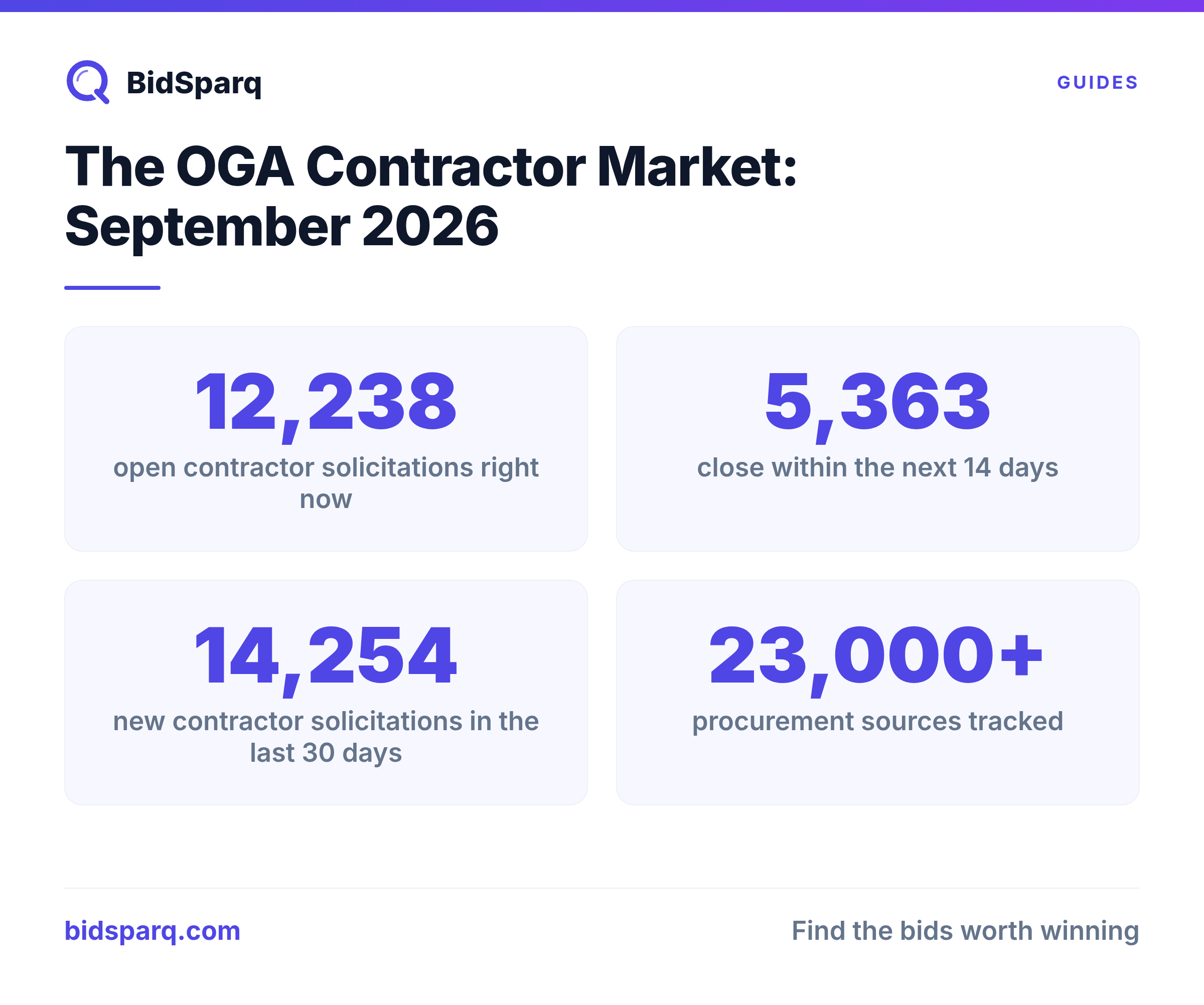
- As of September 2026, 5,363 contractor solicitations close within 14 days across the sources we track, making slow discovery a direct path to missed deadlines.
The short answer
OGA contractors win across agencies by treating bid discovery as a data problem, not a manual research task. The volume of contractor-relevant solicitations in government is large enough that monitoring portals by hand leaves meaningful opportunity uncovered. Platforms that match bids by meaning rather than keyword find work described in agency-specific language that a search string would miss entirely. Layering AI fit-scoring and automated compliance extraction on top of that means your capture team spends time on pursuit decisions rather than on document triage.
What “OGA” means for your pipeline
Build your OGA market coverage before you need it, not after your primary contract vehicle ends. OGA, short for “other government agency,” names every contracting entity outside your established customer base. For a federal contractor, that might mean pursuing work at a different department, a civilian agency, or a state entity running a procurement under a cooperative agreement. For a state-level firm, it might mean watching adjacent agencies, counties, or special districts that post work through separate systems. As of September 2026, 12,238 open solicitations across the 23,000+ sources BidSparq tracks mention “contractor,” with 14,254 new ones posted in the last 30 days alone. Covering that market manually is not a realistic strategy.
Why keyword search fails OGA pursuits
Every agency writes its solicitations in its own language, and keyword search only finds the words you already know to use. A general contractor might search for “construction management” and miss a bid filed under “owner’s representative services” or “facilities program delivery.” An IT services firm searching “cybersecurity” misses solicitations tagged “information assurance” or “security operations support.” This fragmentation is not an edge case. It is the norm across thousands of distinct procurement sources, and it grows worse as your OGA target list expands. Firms relying on keyword alerts from a handful of portals are not seeing the market. They are seeing the portion of it that uses their vocabulary.
The portals worth checking directly: SAM.gov covers federal solicitations. Your state’s official eProcurement portal handles most state-level work. Individual agency procurement pages often post solicitations that never reach either system. Tracking all three layers simultaneously across dozens of target agencies is what turns business development into a full-time research operation, and it still leaves gaps.
See your matched OGA bids free, no credit card needed.
What high-performing OGA contractors track beyond the bid itself
The bid document is the last thing a well-positioned contractor reads, not the first. By the time an RFP posts, the scope is set, the incumbent has had months to position, and the evaluation criteria are locked. High-performing OGA contractors track the signals that precede the solicitation: which agencies are increasing spending in a given category, which contracts are approaching expiration, which vehicles an agency uses, and who currently holds the work. Incumbent intelligence and contract vehicle data are the layer most keyword-search tools skip entirely, yet they often determine whether a pursuit is worth the proposal investment. Knowing that an agency has relied on the same firm under a specific IDIQ vehicle for several consecutive terms is information. Knowing that vehicle expires in the next fiscal year is a strategy prompt.
Building a sustainable OGA capture process
A repeatable OGA pipeline needs three layers: coverage, fit scoring, and compliance readiness. Coverage means monitoring enough sources that relevant solicitations actually reach your team. Fit scoring means ranking each opportunity against your past performance, NAICS codes, and certifications before a human reads the full document. Compliance readiness means understanding set-aside type, small business designation, bonding, and teaming obligations before committing capture resources. Without all three, your pipeline fills with noise or stays too thin to support growth. The same discovery infrastructure that works for government contracting also applies to commercial and education procurement, so the investment compounds well beyond OGA work. BidSparq’s 0 to 100 AI fit score ranks every matched bid so your capture team opens the queue sorted by opportunity quality, not posting date.
FAQ
What does OGA contractor mean?
OGA stands for “other government agency.” An OGA contractor is any firm that pursues or holds contracts with government entities beyond its primary or established customer. The term is common in federal contracting but applies equally to state and local work. Expanding into OGA work typically means entering new agency relationships through competitive bids, existing contract vehicles, or cooperative purchasing programs.
Where do OGA contractors find solicitations across agencies?
Federal solicitations are centralized on SAM.gov. State-level work runs through each state’s official eProcurement portal, which varies by state. Many agencies also post solicitations directly on their procurement pages, outside the main state system. Because no single source covers all government procurement, contractors doing serious OGA business development typically rely on aggregated platforms that pull from thousands of sources simultaneously rather than checking portals one by one.
How do I know which OGA bids are worth pursuing?
Pursuit value typically depends on scope alignment with your past performance, set-aside eligibility, bonding and certification requirements, vehicle access, and the competitive landscape including incumbent information. Manual review of every solicitation is not scalable at OGA volume. AI fit-scoring that ranks each opportunity against your firm’s profile lets your capture team focus review time on the bids with the highest probability of fit, rather than reading documents to determine whether they qualify at all.
Explore contractor opportunities across agencies, free with no credit card required.
Find RFPs that match your business
BidSparq monitors 23,000+ procurement sources and uses AI to score every opportunity against your capabilities. Try it free for 14 days.
Start Free Trial →