SAM.gov Alternatives: What Free Really Costs You
SAM.gov is free but federal-only, with no semantic matching or fit scoring. Compare the best SAM.gov alternatives, from GovWin and BidNet to aggregators, for federal, state, local, and education contracts.
If your entire bid pipeline runs through SAM.gov, you are competing for a fraction of the work you could win. The portal is free and official, which is exactly why it is easy to mistake it for enough. It is federal only, it searches by keyword, and it does nothing to tell you which opportunities are worth your time. The question worth answering is not whether SAM.gov is useful. It is what a search built only on SAM.gov never shows you, and which SAM.gov alternatives close that gap.
- SAM.gov is genuinely free and the official system of record for federal contracts, so keep using it for registration and federal search.
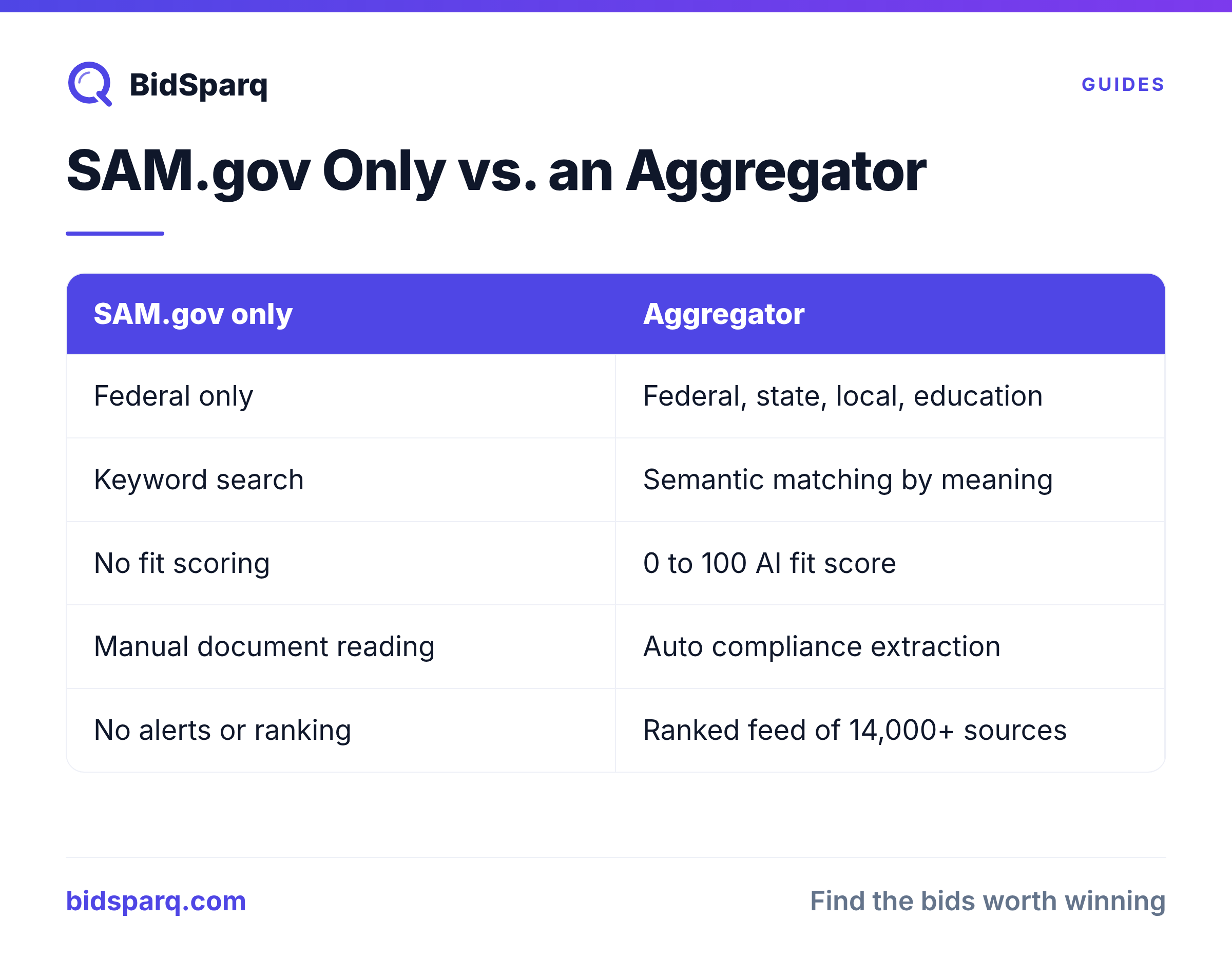
- Free is not the same as complete: SAM.gov is federal only, with no semantic matching, fit scoring, or smart alerts.
- Most contractors sell to more than one buyer, and state, local, education, and healthcare work never lands on a federal portal.
- Keyword search misses meaning, so a strong-fit bid titled in unfamiliar language simply never surfaces.
- Named alternatives differ sharply: GovWin, BidNet, GovTribe, and Govology each solve a different slice of the problem.
- Aggregators consolidate 23,000+ sources into one ranked feed, so the real cost of free is the winnable bids you never saw.
Free and official does not mean complete
Free and official are two real strengths, and neither one means complete. There is no subscription and no paywall for searching federal opportunities, viewing solicitations, or keeping the entity registration that makes you eligible for federal awards. For federal work, SAM.gov is the system of record, and any serious contractor belongs there. The trouble starts when teams read free and official as the whole market. It is not. Across the broader procurement landscape, government is one vertical among many, and SAM.gov covers only the federal layer of that one vertical.
What SAM.gov was never built to do
SAM.gov stores federal opportunities well, yet it was never built to bring the right ones to you. Its search matches the words you type, not what you actually do. Picture a facilities contractor searching janitorial services. A county posts a solicitation titled Custodial and Building Maintenance Support with no mention of the word janitorial anywhere in the summary. On SAM.gov, and on any keyword tool, that bid stays invisible, so a perfect-fit contract dies because of vocabulary. Semantic matching reads for meaning instead of exact strings, so the same bid surfaces because the work matches, not because the title does. Beyond that gap, SAM.gov gives you no fit score, no automated reading of the requirements buried in attachments, and no intelligence on the incumbent or the contract vehicle in play. And it is still federal only, so every state agency, county, city, school district, and hospital network posting through its own portal stays off your radar.
The named SAM.gov alternatives, compared
No single alternative wins for everyone, so match the tool to the buyers you actually chase. Here is how the most common options line up:
- GovWin (Deltek): deep federal and SLED coverage with pre-RFP intelligence, aimed at large teams with enterprise budgets and a research analyst to work it.
- BidNet Direct: strong on state and local government postings through its purchasing-group network, lighter on federal and on any matching intelligence.
- GovTribe: useful federal market and competitor research, contract and agency tracking, but narrow if your pipeline reaches beyond federal.
- Govology: primarily training and education for government contractors rather than a live opportunity feed, so it complements a discovery tool instead of replacing one.
- AI-driven aggregators: platforms that pull federal, state, local, and education sources into one place and rank each opportunity by fit rather than keyword count.
The pattern is clear once you see it. The legacy tools trade on volume and manual research, while the newer category competes on automated matching. That distinction, automated discovery versus a keyword database, is where the real time savings live.
How aggregators turn a dozen logins into one feed
Aggregators earn their place by replacing manual portal-hopping with one intelligent, ranked feed. Instead of logging into a dozen sites and reading past mismatched titles, a platform like BidSparq's bid discovery software pulls from 23,000+ distinct sources every day across federal, state, local, and education. Two moats do the heavy lifting, and both trade manual effort for automated results. Semantic matching surfaces the differently-titled bids a keyword search buries, which means fewer perfect-fit contracts lost to wording. AI fit scoring then rates each opportunity from 0 to 100, so you triage by relevance in minutes instead of skimming hundreds of links by hand. Requirement and compliance details get extracted from the documents automatically, and incumbent and contract-vehicle intelligence tells you who holds the work now and how it is bought. That is the shift from a static database to automated discovery: less time hunting, more time bidding what you can win.
Choosing an alternative that fits your pipeline
The right alternative is the one that scores fit, not the one that lists the most results. A feed of thousands of undifferentiated links is just a bigger haystack. Judge any option on three questions. Does it cover the buyer types you genuinely sell to, or only federal? Does it rank opportunities by real fit rather than raw keyword hits? Does it surface the requirements and incumbent context you would otherwise dig for by hand? Run it against your own pipeline before you commit, and confirm it works alongside SAM.gov rather than pretending to replace the registration you still need. Coverage plus intelligence is the goal, so the market reaches you already sorted.
FAQ
Is SAM.gov really free to use?
Yes. Searching federal opportunities and registering your entity on SAM.gov carries no fee, and it is the official government source for federal contracting. Be cautious of third parties that charge to register you, because the registration itself is free directly on the site.
What are the best SAM.gov alternatives for state and local bids?
BidNet Direct is strong for state and local postings, GovWin covers SLED at the enterprise level, and AI-driven aggregators consolidate all of it while adding matching and scoring. Because state, local, and education buyers each post separately, look for a platform that covers 23,000+ sources and ranks opportunities by fit rather than keywords alone.
Do I still need SAM.gov if I use an aggregator?
Yes. You still need active SAM.gov registration to be eligible for and to receive federal awards. An aggregator complements it by widening discovery across federal, state, local, and education work and by adding intelligence the federal portal does not provide.
See the bids SAM.gov never shows you. Get your matched opportunities across federal, state, local, and education work in one ranked feed. Start your free bid search on the free tier, no credit card needed.
Find RFPs that match your business
BidSparq monitors 23,000+ procurement sources and uses AI to score every opportunity against your capabilities. Try it free for 14 days.
Start Free Trial →