GFE Computer Clauses: What Every Bidder Must Know
GFE computer provisions in solicitations transfer hardware liability and compliance duties to the contractor. Here is how to read them, price them correctly, and find more opportunities before competitors do.

Misreading a GFE computer clause is one of the quietest ways to win a contract and lose money on it. The government provides the hardware, you provide the performance, and with that performance comes custody, liability, and compliance obligations that directly affect your cost structure from day one.
- GFE computers reduce your upfront hardware cost, but they transfer custody, liability, and property-reporting duties to your firm for the life of the contract.
- The governing clause at the federal level (FAR 52.245-1) dictates how you track, protect, and return furnished equipment; state and local contracts use similar but varied property language.
- Pricing a GFE bid without adjusting for stewardship overhead is a common error that quietly erodes margin after award.
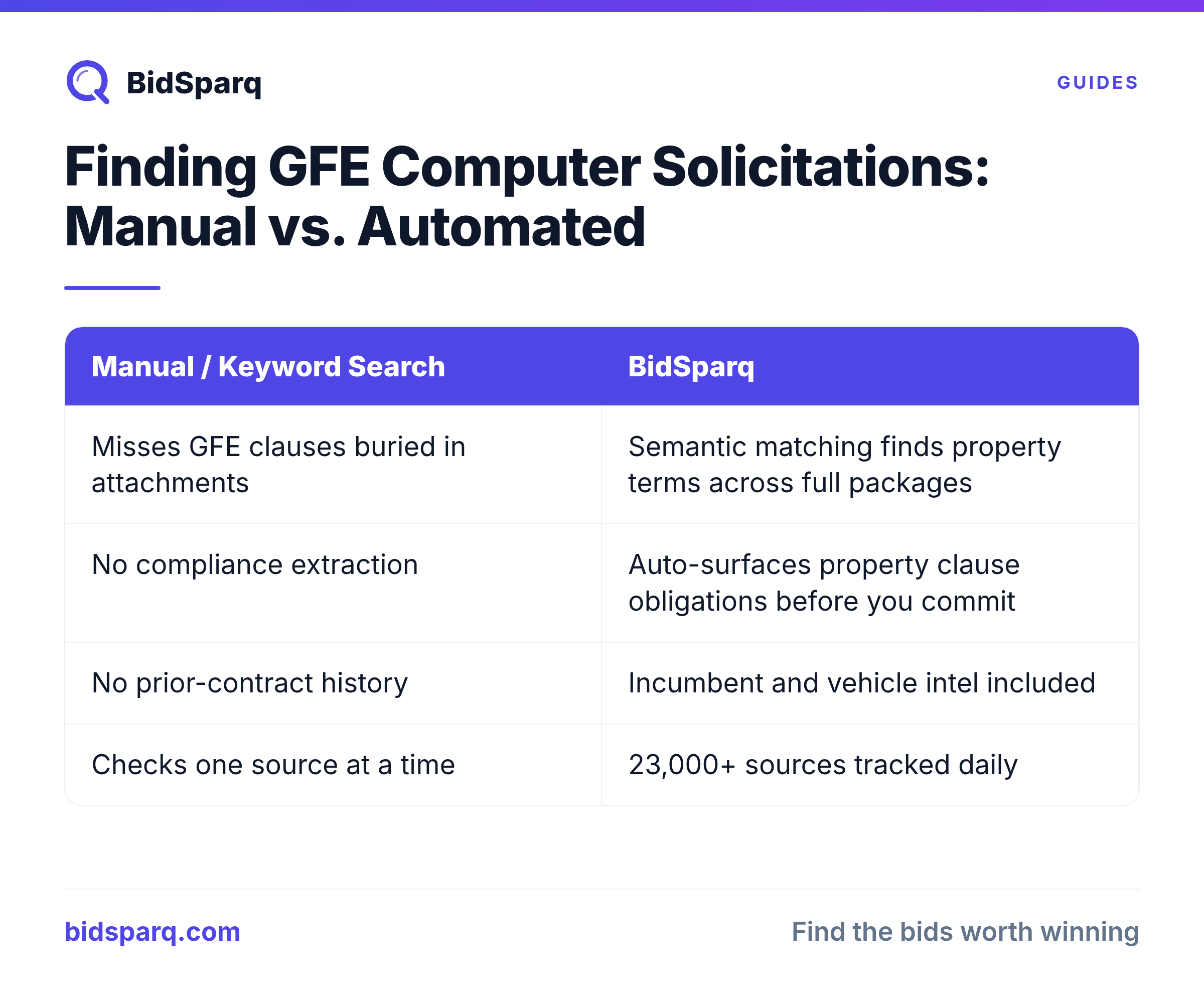
- GFE provisions are often buried in performance work statements and attachments, not the main solicitation body, so manual and keyword-based review consistently misses them.
- Without incumbent intelligence, you cannot know whether GFE was part of the prior award or at what scale, which leaves accountability assumptions unverified going into performance.
The short answer
A GFE computer is a computer the government furnishes to a contractor for performing work under a specific contract, at no hardware purchase cost to the vendor. When a solicitation includes GFE computers, you exclude the hardware from your cost proposal but accept custody, liability, and property-accounting obligations under the applicable government property clause. Spotting these provisions before you price your bid, and reading every line of the property clause alongside the furnished-property list, determines whether your cost structure reflects the true obligations of performance. Similar furnished-equipment arrangements appear in some commercial contracts under different names, so the discipline of reading property terms before pricing has value across the broader market as well.
What a GFE Computer Means in a Solicitation
Read the GFE list and the property clause together, treating them as a single set of obligations rather than two separate documents. A solicitation that furnishes computers will typically include a list of specific assets, often called the Government Furnished Property list or GFP list, and a clause defining your legal obligations for those assets. At the federal level, FAR 52.245-1 is the standard vehicle; state and local contracts use their own property clauses, often following similar principles. The GFP list tells you what you receive and when; the clause tells you what you owe in return: how you store and secure the equipment, how you account for it, how you report loss or damage, and how you handle return at contract end. Both documents must inform your bid strategy, your staffing model, and your subcontract flow-downs if you use teaming partners.
How GFE Terms Reshape Your Bid Pricing
Remove hardware costs from your proposal, then add the full cost of stewardship before you finalize any line item. GFE computers lower your direct-cost line, but they introduce indirect costs many bidders underestimate: property management systems or logs, periodic physical inventory requirements on some contract types, loss-and-damage liability, cybersecurity configuration compliance for furnished endpoints, and the administrative burden of return at contract end. IT services contracts that include furnished workstations for personnel working on sensitive networks carry especially high stewardship exposure, because a security incident involving a GFE asset can far exceed the value of the machine itself. Factor those obligations into your overhead or general-and-administrative rates before submission, or your winning price will underfund performance from the outset.
Where GFE Computer Clauses Are Buried
Do not stop reading at the main solicitation body if you want to find the provisions that actually bind you. GFE terms appear in several locations that keyword searches and quick reads consistently miss: the Performance Work Statement or Statement of Work, where the government describes what equipment will be available and under what conditions; Section H of FAR-based solicitations, which covers special contract requirements; and standalone attachments labeled GFP List, Property Management Plan Requirements, or similar. State and local solicitations bury equivalent language in scope-of-work narratives or supplemental terms. When pursuit teams scan dozens of solicitations manually, or rely on tools that only surface the main solicitation body, mispriced bids on GFE-heavy contracts become a predictable pattern rather than an occasional mistake.
Search open computer solicitations free at BidSparq RFP Software, no credit card needed, and surface compliance terms across the full solicitation package before you commit to a pursuit.
Tracking GFE Computer Solicitations at Scale
Build a repeatable process for monitoring computer solicitations across all the sources relevant to your firm, not just the handful that are easiest to check manually. As of September 2026, 620 new computer solicitations were posted in a single month and 526 remain open right now across the 23,000+ sources we track; 146 of those close within the next 14 days. No pursuit team reviews that volume with enough depth to catch GFE provisions in every statement of work and every attachment through manual effort alone. BidSparq's semantic matching surfaces solicitations by meaning rather than exact phrase, so a GFE computer requirement embedded in a technical requirements section registers the same as one called out in a title. The 0-to-100 AI fit score lets your team prioritize pursuits before opening the full package. Automated compliance extraction pulls key requirements, including property-related clauses, to the surface so you see your obligations before you commit. Incumbent and contract-vehicle intel completes the picture by showing who held the prior contract and whether GFE was a feature of that award.
FAQ
What does GFE computer mean on a government contract?
GFE stands for Government Furnished Equipment. A GFE computer is a computer the government provides to the contractor for use during contract performance at no hardware cost to the vendor. The contractor assumes custody and accountability under the applicable government property clause, typically FAR 52.245-1 for federal contracts and equivalent provisions for state and local awards.
How does GFE affect my bid price for a government IT contract?
When a solicitation includes GFE computers, exclude hardware acquisition costs from your cost proposal. You should still account for property administration, periodic physical inventory on applicable contract types, cybersecurity configuration compliance for furnished endpoints, and potential loss-and-damage liability. Omitting these stewardship costs is one of the most common pricing errors on GFE-bearing IT contracts and leads to margin erosion after award.
How do I find government computer solicitations that include GFE provisions?
Start with SAM.gov for federal opportunities; most solicitations include the full package with attachments where GFE terms appear. Your state's official procurement portal is the primary source for state-level computer contracts. BoardDocs board agendas surface technology procurements from school districts and other public entities. For broader automated coverage across 23,000+ sources with compliance-term extraction, start searching open GFE computer solicitations free at BidSparq RFP Software, no credit card needed.
Find RFPs that match your business
BidSparq monitors 23,000+ procurement sources and uses AI to score every opportunity against your capabilities. Try it free for 14 days.
Start Free Trial →