Government Contract Types Explained: FFP, T&M, IDIQ, BPA, and More
Understand the major government contract types, Fixed-Price, Time & Materials, IDIQ, BPA, and GSA Schedule, and how each one affects your pricing, risk, and proposal strategy.
When you see a government RFP, one of the first things you should check is the contract type. It determines how you get paid, how much risk you carry, and how you should structure your pricing. Getting this wrong can mean the difference between a profitable contract and one that loses money.
This guide covers every major government contract type, when each is used, and what it means for your bid strategy.
Why Contract Type Matters
The contract type defines three critical things:
- Risk allocation. Who absorbs cost overruns: you or the government?
- Payment structure. Are you paid a fixed amount, by the hour, or per deliverable?
- Pricing strategy. Do you compete on lowest price, best value, or hourly rates?
Bidding an FFP contract requires a completely different approach than bidding a T&M contract. Your proposal, pricing, and risk management all change based on the contract vehicle.
Fixed-Price Contracts (FFP / FPI)
Firm Fixed-Price (FFP)
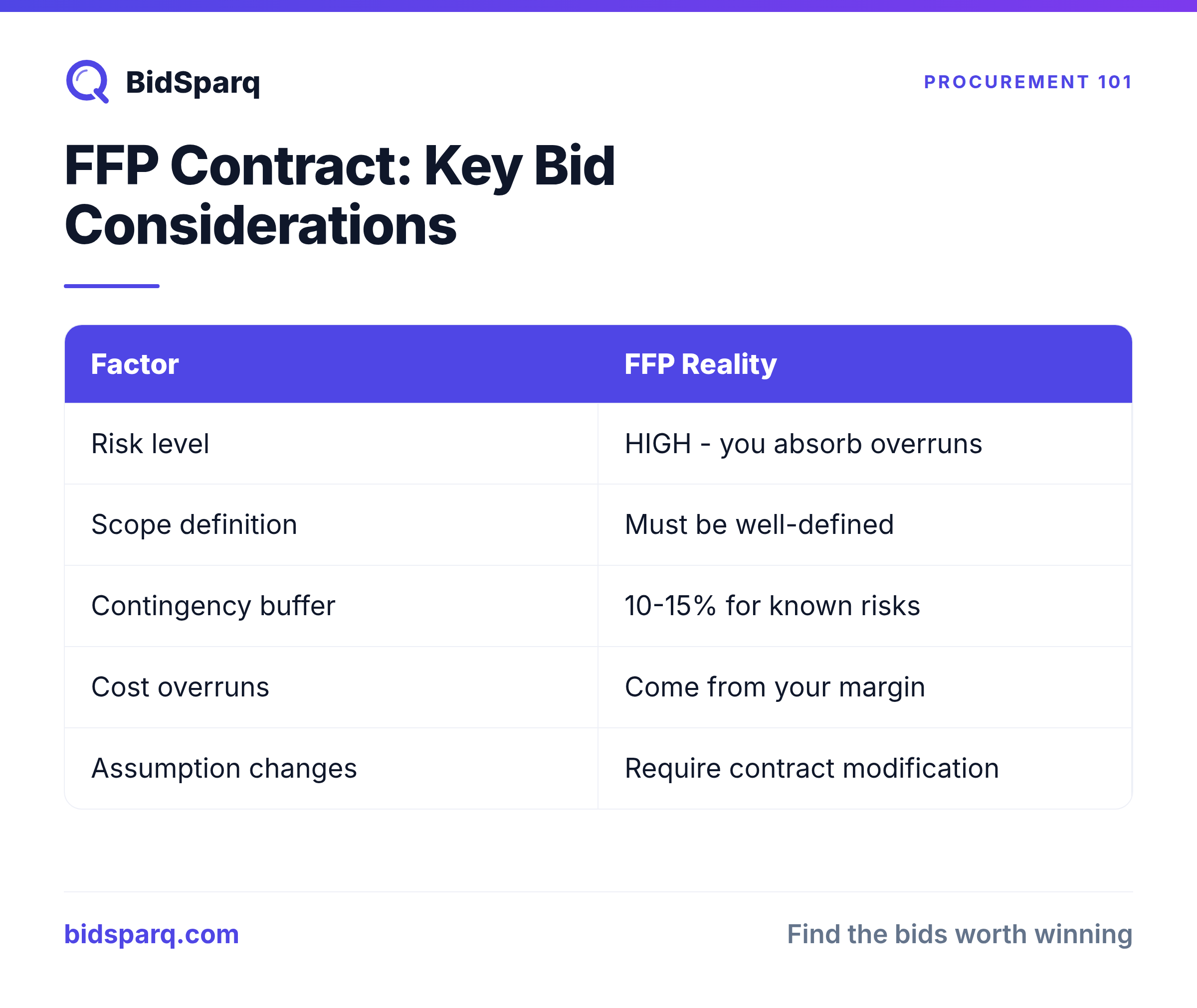
You agree to deliver a defined scope of work for a set price. Period. If it costs more than you estimated, you absorb the loss. If it costs less, you keep the profit.
When it's used: Well-defined requirements with predictable scope. Most common for products, construction, and routine services.
Your risk: HIGH. Cost overruns come directly out of your margin. Scope creep is your enemy.
Pricing strategy:
- Build in contingency (10-15% for known risks)
- Define scope boundaries precisely in your proposal
- Document assumptions explicitly: if an assumption changes, you need a contract modification
- Research prior award amounts on USASpending to calibrate your pricing
Fixed-Price Incentive (FPI)
A fixed-price base with an incentive structure that rewards performance. If you deliver under the target cost, you share savings with the government. If you go over, you share the overrun.
When it's used: Large, complex procurements where some cost uncertainty exists but the government wants to motivate efficiency.
Cost-Reimbursement Contracts (CPFF / CPIF / CPAF)
Cost-Plus-Fixed-Fee (CPFF)
Under CPFF, the government reimburses your allowable costs plus a fixed fee (profit). Your fee doesn't change regardless of actual costs.
When it's used: R&D, studies, and work where the scope can't be precisely defined upfront.
Your risk: LOW for costs (government pays), but you need an approved accounting system and must comply with FAR cost principles.
Key requirement: You generally need an adequate accounting system approved by DCAA (Defense Contract Audit Agency) for cost-reimbursement contracts. Small businesses without this system are typically limited to fixed-price and T&M contracts.
Cost-Plus-Incentive-Fee (CPIF)
Under CPIF, costs are reimbursed, but the fee adjusts based on whether you hit cost and performance targets. Good performance earns a higher fee.
Cost-Plus-Award-Fee (CPAF)
CPAF is similar to CPIF, but the award fee is determined by a subjective evaluation of your performance. Common in defense contracts where the government wants flexibility to reward quality.
Time & Materials (T&M) and Labor-Hour Contracts
You're paid for hours worked at negotiated hourly rates, plus materials at cost. There's usually a ceiling price (not-to-exceed amount).
When it's used: When the government can't define the exact scope or level of effort. Common for IT support, consulting, and staff augmentation.
Your risk: MODERATE. You need to manage hours carefully against the ceiling. If the ceiling is reached before the work is done, you need a modification: which the government may or may not approve.
Pricing strategy:
- Set competitive but sustainable hourly rates by labor category
- Research prevailing rates using GSA Schedule pricing as a benchmark
- Include all indirect costs (fringe, overhead, G&A) in your loaded rates
- Don't underprice to win: you'll be stuck with those rates for the contract period
Indefinite-Delivery Contracts (IDIQ / BPA)
Indefinite Delivery/Indefinite Quantity (IDIQ)
An IDIQ is a contract vehicle, not a single contract. The government awards an IDIQ to one or more vendors, establishing terms, pricing, and scope boundaries. Then they issue individual task orders or delivery orders as work is needed.
When it's used: When the government knows they'll need a type of service but can't predict exact quantities or timing. Very common for IT, professional services, and construction.
Key terms:
- Minimum/Maximum: The contract specifies a minimum guaranteed amount and a maximum ceiling. Minimums can be as low as $2,500.
- Single-award vs. multiple-award: Single-award IDIQs give all work to one vendor. Multiple-award means several vendors are on the contract and compete for each task order.
- Period of performance: Typically 5 years (1 base + 4 option years), sometimes longer.
Strategy: Winning an IDIQ is a two-step game. First, win a spot on the vehicle. Then, compete for (or be selected for) individual task orders. Getting on the vehicle is the hard part: once you're on, the competition is much smaller.
Blanket Purchase Agreement (BPA)
A BPA is a simplified version of an IDIQ for repeat purchases. The government establishes terms with one or more vendors and places orders as needed, usually for supplies or simple services under a certain dollar threshold.
GSA Schedule (Multiple Award Schedule)
A GSA Schedule contract is a long-term (20-year) government-wide contract vehicle that pre-negotiates your pricing with GSA. Once you're on schedule, any federal agency can purchase from you without running a full competitive procurement.
Why it matters:
- Dramatically simplifies the buying process for agencies
- Opens access to task orders on GSA eBuy
- Your pricing is pre-negotiated: agencies can buy without additional price competition for orders under the micro-purchase threshold
- Required for many IT and professional services opportunities
Getting on schedule: The application process through GSA's eOffer system takes 3-6 months. You need established pricing, relevant past performance, and financial stability. It's an investment, but one that pays off through streamlined access to federal buyers.
Which Contract Type Is Right for You?
| If you... | Best contract types | Why |
|---|---|---|
| Sell products or well-defined services | FFP, BPA | Clear scope, predictable costs |
| Provide IT or professional services | T&M, IDIQ, GSA Schedule | Flexible scope, hourly billing |
| Do R&D or consulting | CPFF, T&M | Uncertain scope needs cost reimbursement |
| Want recurring government revenue | IDIQ, GSA Schedule, BPA | Multi-year vehicles with ongoing task orders |
| Are new to government contracting | FFP, T&M | No DCAA-approved accounting system needed |
How to Identify Contract Type in an RFP
Look in these sections:
- Section B (Supplies or Services and Prices/Costs): states the contract type explicitly
- Section I (Contract Clauses): the FAR clauses included indicate the type (e.g., FAR 52.232-7 is for T&M payments)
- Cover page or solicitation header: many RFPs state the contract type in the first few lines
How BidSparq Helps You Navigate Contract Types
BidSparq's AI extracts contract type information from every RFP so you can filter and prioritize:
- Contract type identification in the AI Summary: know immediately whether it's FFP, T&M, or IDIQ
- Filter by contract type in search to find opportunities that match your preferred vehicles
- Competitive Intelligence shows award amounts and contract vehicles used by incumbents
- AI Chat can explain any contract type or clause you're unfamiliar with
Next Steps
- Start your free trial: browse real RFPs filtered by contract type
- Learn about NAICS codes: the other critical classification that affects which RFPs you see
- Read our guide on how to read an RFP to quickly identify contract type and other key details
- Understand set-aside programs and how they interact with different contract vehicles
- Explore FPDS federal procurement data to research historical award amounts by contract type
Find RFPs that match your business
BidSparq monitors 23,000+ procurement sources and uses AI to score every opportunity against your capabilities. Try it free for 14 days.
Start Free Trial →