COR Letter Explained: What Vendors Must Know
A COR letter formally designates the agency official who monitors your contract performance. This guide covers what Contracting Officer Representatives do, why it matters for proposals, and how to find government solicitations where COR oversight shapes the work.
- A COR letter designates a specific person for a specific contract, not a general standing authority; every contract has its own COR with its own documented limits.
- Reading the COR clause before you price an opportunity reveals how tightly the agency plans to monitor performance, which directly affects your staffing model and risk reserves.
- When a solicitation attaches a Quality Assurance Surveillance Plan, every metric in it should be addressed explicitly in your technical approach, not just acknowledged.
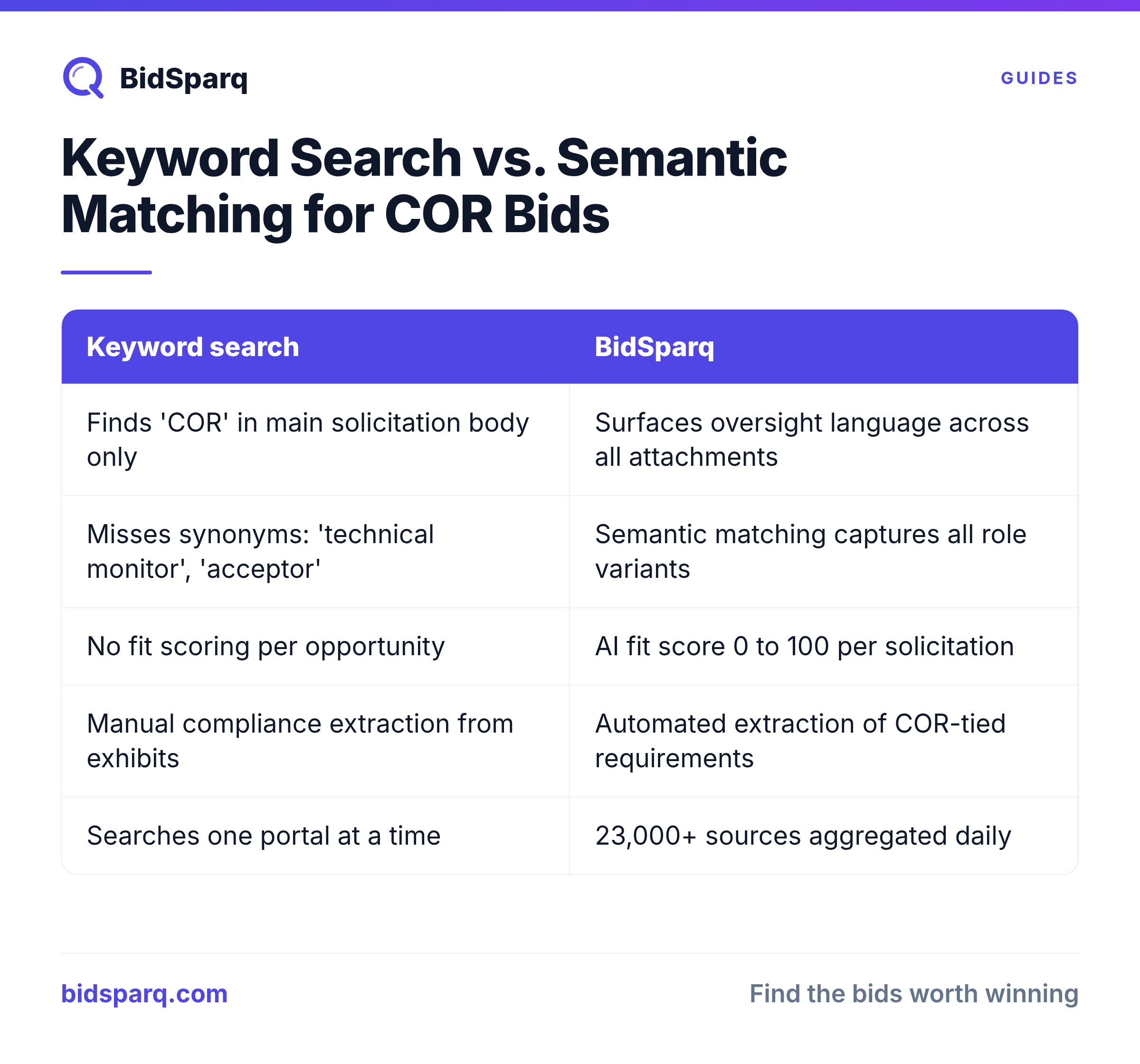
- Compliance items tied to COR oversight routinely appear in solicitation attachments and exhibits, not the main body, where keyword-only searches miss them entirely.
- Incumbent COR relationships are real advantages that challengers can systematically narrow using publicly available CPARS ratings and contract modification records on SAM.gov.
The short answer
A COR letter is the formal written document through which a Contracting Officer appoints a Contracting Officer's Representative to oversee day-to-day performance on a specific contract. The COR reviews deliverables, documents performance issues, and certifies invoices before the Contracting Officer authorizes payment. The role exists across federal, state, and local contracts, though titles vary widely: Technical Monitor, Contract Administrator, and Project Representative all fulfill the same oversight function. As of October 2026, 1,700 of the 57,762 open solicitations across the 23,000+ sources BidSparq tracks mention "letter" requirements, which shows how frequently formal correspondence and designation protocols shape procurement submissions at every level of government.
What a COR letter actually contains
The COR designation letter is an internal agency document, not a contract modification, but its contents shape your daily performance obligations more than almost any single contract clause. A standard COR letter names the designated official, cites the specific contract number, defines the scope of inspection and acceptance duties, and states explicitly what the COR cannot do. That last section matters most for vendors. The COR cannot direct out-of-scope work, agree to a schedule change, or waive a contract requirement. Any verbal direction from a COR that falls outside the existing contract is not binding on the government; vendors who act on informal COR direction without a formal modification from the Contracting Officer can end up performing work with no legal basis for compensation. The Federal Acquisition Regulation at FAR 1.602-2 requires agencies to designate CORs in writing on contracts above the simplified acquisition threshold; the full regulatory text is freely available at acquisition.gov. Many state procurement codes establish equivalent requirements under their own administrative rules, using the same structural logic: one official monitors, one official has authority to change.
Why COR oversight signals contract complexity
When a solicitation references a COR designation or attaches a Quality Assurance Surveillance Plan (QASP), read both documents before you price the effort or scope the team. The QASP defines every deliverable the COR will inspect, the inspection frequency, the sampling method, and the acceptable quality level at which a performance issue is formally recorded. Proposals that mirror QASP language and map each deliverable directly to an acceptance criterion give evaluators a clear line of sight from your offer to the oversight framework that will govern post-award performance. Federal information technology contracts, defense professional services awards, and program management contracts at the state level routinely attach QASPs as exhibits. If a solicitation includes a QASP, the agency has invested significant effort defining exactly how it will measure performance, and your technical approach should answer every metric in that document. Contracts without a QASP are not necessarily simpler; they often mean the COR has broader discretion to evaluate performance subjectively, which introduces a different kind of risk that a strong management approach section should address directly.
Where COR requirements hide in solicitations
The most common mistake vendors make with COR-related requirements is treating them as contract administration details rather than proposal writing inputs. COR clauses appear in the Statement of Work, the Contract Administration Data section, the QASP exhibit, and sometimes in separate attachments labeled "Contractor Responsibilities" or "Reporting Requirements." A keyword search for "COR" surfaces the obvious references, but the practical obligations often appear under different headings: "government technical representative," "authorized representative," "acceptor," and "project officer" all describe the same oversight function in different agency styles. Solicitations routinely bury mandatory reporting formats, inspection cycles, and correspondence protocols in attachments that a surface-level read misses entirely. As of October 2026, 1,795 new solicitations mentioning "letter" requirements were posted in the last 30 days, and 685 of them close within the next 14 days. For proposal teams managing multiple active pursuits simultaneously, manually extracting every COR-related requirement across that volume is a genuine capacity problem, not a research inconvenience.
See your active solicitation matches free on BidSparq's RFP discovery platform, where semantic matching and automated compliance extraction surface the oversight language buried in solicitation attachments. No credit card needed.
Using public data to overcome the incumbent advantage
The incumbent's working relationship with the COR is a real advantage, but most of the information you need to narrow that gap is publicly available before the solicitation closes. Federal contractors can review Contractor Performance Assessment Reporting System (CPARS) ratings through SAM.gov, which often reveal how the COR and Contracting Officer evaluated the incumbent's technical quality, schedule performance, and management responsiveness over the prior contract term. Contract award data and modification histories are accessible through USASpending.gov, where patterns in scope changes and schedule adjustments tell a more complete performance story than CPARS narrative summaries alone. State and local contracts are subject to open records laws; procurement offices release prior contracts, performance evaluations, and sometimes correspondence logs under public records requests. When you combine those inputs with a close reading of the new solicitation's COR designation framework, you can identify specific gaps in the incumbent's performance history and write a technical approach that addresses them by name. Commercial and education procurement uses analogous performance oversight structures, and the same discipline of studying the evaluation environment before you submit applies across every market where formal acceptance authority is defined in a contract.
FAQ
What is a COR letter in government contracting?
A COR letter is the written designation issued by a Contracting Officer that formally appoints a Contracting Officer's Representative to monitor performance, review deliverables, and certify invoices on a specific contract. The document defines the COR's authority and its limits, and is required under FAR 1.602-2 for most contracts above the simplified acquisition threshold at the federal level, with equivalent requirements in many state and local procurement codes.
Can a COR change the scope of a contract?
No. A COR does not have authority to change contract scope, authorize additional work, or agree to price or schedule adjustments. Only the Contracting Officer can issue contract modifications. Any direction from a COR that falls outside the existing scope is not binding on the government, and vendors should request a formal modification before acting on it to avoid performing uncompensated work or creating an unauthorized commitment.
How do I find government solicitations that involve COR oversight?
Federal solicitations are posted on SAM.gov and often include the COR designation clause and any attached QASP as part of the solicitation package. State and local solicitations appear on agency-specific portals and official state eProcurement systems. Procurement platforms that aggregate thousands of sources and apply semantic matching can surface COR and oversight language across the full public sector market more reliably than searching individual portals, with free tiers available for initial research.
Start your free government RFP search on BidSparq's procurement discovery platform and see which active solicitations match your capabilities before the next deadline window closes.
Find RFPs that match your business
BidSparq monitors 23,000+ procurement sources and uses AI to score every opportunity against your capabilities. Try it free for 14 days.
Start Free Trial →