E-Rate RFP Look Up: Find Form 470 Bids Before They Close
How to do an e-rate rfp look up that covers the Form 470 package, the applicant's own portal page, and the program calendar before the 28-day window closes.

The 28-day E-rate competitive bidding window is usually running before a vendor knows the Form 470 exists. The federal filing sits in USAC's system, the addenda and question responses that change the bid sit on the school or library's own procurement page, and neither shows up in a keyword alert that is watching for the phrase "E-rate". By the time a vendor finds the solicitation, reads it, and asks the first clarifying question, a quarter of the window is gone.
Looking E-rate RFPs up is really two lookups. The first is the Form 470 package on USAC's side, which under FCC rules must carry the RFP and every RFP document. The second is the applicant's own posting on its district page or the state portal, where addenda, Q&A responses, deadline changes, and the board agenda behind the purchase live. Most vendors check one and assume it covers the other. This post covers how to do both quickly, when in the year the volume arrives, and when a manual process stops being worth the hours.
- The Form 470 must carry the RFP. FCC rules require the applicant to upload the RFP and all RFP documents to the form, and to file a new Form 470 if an RFP is issued later.
- Addenda and Q&A live on the applicant's page. Changes made after certification are posted under the district's or library's own purchasing rules, not refiled with USAC.
- The 28-day clock starts the moment the Form 470 is certified, so a weekly search routine already costs you a quarter of the window.
- Volume peaks in fall and winter because applicants must close their window and sign contracts before the Form 471 application window closes in late winter.
- Keyword filters miss E-rate work described as a wireless refresh or a fiber WAN without the program's name anywhere in the title.
- Incumbent providers are public record on funded Form 471 requests, so you can know who you are displacing before you price.
The short answer
To look up E-rate RFPs, search USAC's certified Form 470 records for applicants inside their 28-day competitive bidding window, open the RFP documents the applicant was required to upload with the form, then check the applicant's own procurement page or state portal for addenda and Q&A responses. FCC rules require the applicant to attach the RFP and all related documents to the Form 470, and to file a new Form 470 if an RFP is issued after the original filing, so the federal record is the primary source for scope and bid format. The local posting is where changes land after certification, including deadline extensions, clarifications, and the board agenda that explains the budget behind the request. An aggregator that indexes both layers and matches on the services requested rather than the phrase "E-rate" is the fastest way to see the whole market at once.
Why keyword search misses most E-rate work
Stop searching for the phrase "E-rate" and start searching for the services the program funds. Category One covers the connection to the building: internet access and wide area network circuits. Category Two covers what happens inside the building: switches, wireless access points, structured cabling, firewalls, and the managed services around them. An applicant writing an RFP title describes the project, not the funding source. A suburban school district asks for a wireless LAN refresh across its campuses. A county library system asks for dark fiber between branches. Neither title contains the word your alert is watching for, and both are E-rate eligible.
Semantic matching solves this by reading what the solicitation asks for and comparing it to what you actually sell. A vendor whose profile says managed Wi-Fi and switching gets matched to the wireless refresh even when the posting never mentions the program. As of October 2026, 1,046 open solicitations across 23,000+ tracked bid sources mention "e-rate" by name. The ones that describe the same work without naming the program are the ones a keyword alert never shows you, and the same gap exists across the wider network and infrastructure market, where a hospital system, a community college, or a commercial campus describes a cabling or wireless job in exactly the same project language.
Where to look E-rate RFPs up yourself
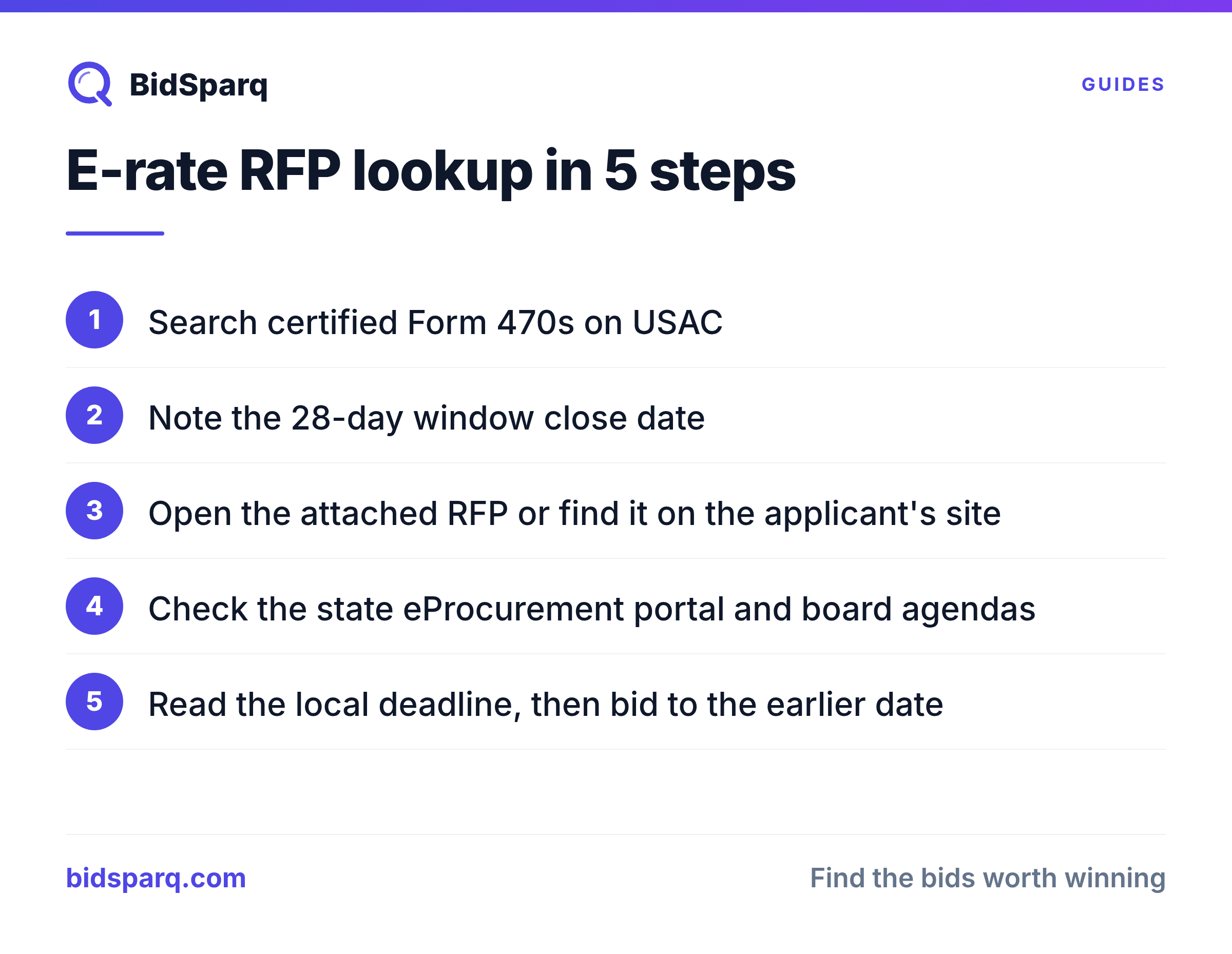
Check three places for every pursuit: USAC, the applicant's own site, and your state's official eProcurement portal. USAC's E-Rate Productivity Center (EPC) is where Form 470s are filed, and service providers can search certified forms there. USAC also publishes Form 470 and Form 471 data on its open data site, which is the quickest way to pull every open window in a state into a spreadsheet. Under FCC competitive bidding rules, the applicant must upload the RFP and all RFP documents to the Form 470 itself, and if the applicant issues an RFP after certifying the form, it must file a new Form 470 that carries it. That makes the 470 package the first place to read scope, evaluation criteria, and submission instructions. The second place is the applicant's purchasing page or the state portal, because addenda, written Q&A responses, deadline extensions, and pre-bid meeting notes are posted there under local procurement rules and are rarely refiled with USAC. Board agendas on BoardDocs are worth a look too, because technology purchases above a board's approval threshold get discussed in public session weeks before the Form 470 is certified, and the agenda packet often shows the budget and the incumbent.
When E-rate RFPs post
Form 470 filings concentrate in fall and winter, and the reason is the program calendar. An applicant must certify the Form 470, wait out the full 28-day competitive bidding period, evaluate bids, and sign a contract before it can file the Form 471 funding request, and the Form 471 application window closes in late winter. Working backward from that close, most applicants certify their Form 470s between early fall and January. The earliest day an applicant can commit is the allowable contract date, which USAC sets at 28 days after the Form 470 is posted, or 28 days after a later RFP release date if the RFP came after the form. No provider can be selected and no contract signed before that date, so the allowable contract date is the earliest moment a pursuit can turn into a win and the latest moment your pricing can still change.
Timing is the part most vendors get wrong. The applicant's own RFP often sets a submission deadline inside the 28-day window, sometimes with a question period that closes earlier still. If you only look up the Form 470, you can be on time for the federal window and still miss the local due date.
The manual effort problem
Count the hours before you commit to doing this by hand. E-rate is a national program, which means the lookup is a national job. As of October 2026, 1,112 new "e-rate" solicitations were posted in the last 30 days, and the states posting the most right now are Illinois (108), Texas (101), and Michigan (91). A vendor covering a few states is checking USAC, dozens of district purchasing pages, and several state portals every business day just to find the postings that name the program. Add the postings that describe the work without naming it and the search widens to every K-12 and library solicitation in the territory. Then every candidate has to be opened, read for category and scope, checked against the allowable contract date, and checked against the local deadline. That is a full-time role, and its output is a list, not a bid.
See every open E-rate match in your territory free, no credit card needed, with the free tier of BidSparq's RFP discovery platform.
What an automated lookup does in the first hour
Let the tools do the first read so your people can do the second. An aggregator that pulls from district pages, library systems, state portals, and USAC filings turns the two-layer lookup into one feed, and the triage happens before anyone opens a document. A 0 to 100 fit score ranks each solicitation against what you sell and where you deliver, so the wireless refresh in a state you cover scores high and the long-haul circuit you cannot provide scores low, which a keyword alert can never do because it only knows whether a word appeared. Requirement extraction pulls the terms that decide eligibility, including the SPIN, FCC registration, Lowest Corresponding Price compliance, bid format, allowable contract date, and local due date, into a checklist instead of leaving them buried on page nine. Incumbent intelligence reads the public Form 471 history to show who held the last contract and whether the applicant bought through a state contract or cooperative vehicle, which changes how you price before you spend a day on the response. The same mechanics apply well beyond E-rate, because a hospital network refresh or a commercial campus cabling job is described the same way by the buyer and missed the same way by a keyword alert.
The window is fixed. Your lookup time is the only part you control.
FAQ
How do I look up open E-rate RFPs?
Search certified Form 470s in USAC's E-Rate Productivity Center or on its open data site, filter to applicants whose 28-day window is still open, open the RFP documents attached to the form, then check the applicant's purchasing page or state portal for addenda and Q&A. An aggregator that indexes all of those sources and matches on services rather than the program name surfaces the same postings in one place, plus the ones that never say "E-rate".
Is the Form 470 the same as the RFP?
No, but they travel together. The Form 470 is the federal notice that opens competitive bidding and lists the service categories requested. The RFP is the applicant's own solicitation with scope, evaluation criteria, and submission instructions, and FCC rules require the applicant to upload it and all related documents to the Form 470, or to file a new Form 470 if the RFP is issued later. Some applicants rely on the Form 470 alone, while many, especially for larger Category Two projects, issue a full RFP that governs how you must respond.
How long is the E-rate bidding window?
The Form 470 opens a minimum 28-day competitive bidding period, and the applicant cannot sign a contract or select a provider until the allowable contract date, which falls 28 days after the form is posted or after a later RFP release. The applicant's own RFP may set an earlier submission deadline inside that window, so read both dates and plan to the earlier one.
Rank the 486 "e-rate" solicitations that close within the next 14 days as of October 2026 by fit score before each local deadline passes: start on BidSparq's free tier, no credit card and no setup call required.
Find RFPs that match your business
BidSparq monitors 23,000+ procurement sources and uses AI to score every opportunity against your capabilities. Try it free for 14 days.
Start Free Trial →