How to Win Government Contracts Without Guesswork
A practical guide on how to win government contracts across every market, from qualification to requirements to competitive intel, without the guesswork that sinks strong teams.

Most teams lose government contracts long before a proposal is ever written. They lose at discovery: chasing opportunities they cannot win, missing the ones they can, and reading the real requirements too late to shape a competitive bid. Winning is less about better writing and more about better selection, earlier intelligence, and a process you can run every week.
- Win rate is a selection problem before it is a writing problem.
- Requirements are scoring lines, so extract and answer every one on purpose.
- Incumbent and vehicle intel tells you whether a bid is winnable at all.
- Semantic matching surfaces relevant work that keyword alerts miss.
- A 0 to 100 fit score lets you rank opportunities in minutes, not days.
- Consistent discovery beats occasional heroics on any single bid.
Winning starts with what you choose to bid
Qualify ruthlessly before you commit a single hour to writing. A hospital system publishing a services contract, a large school district sourcing technology, or a commercial developer soliciting subcontractors all reward the same discipline: bid only where your capabilities, past performance, and pricing genuinely fit. The fastest way to raise your win rate is to stop spending effort on work you were never positioned to win, and to redirect that time toward the handful of opportunities where you are a credible favorite.
Read the requirements the way evaluators score them
Treat every requirement as a scoring line item, not fine print. Evaluators award points against explicit criteria, and the bids that win are the ones that answer each criterion clearly and in order. Manual review misses mandatory clauses, certifications, and formatting rules that quietly disqualify otherwise strong proposals. Automated compliance extraction pulls each requirement into a checklist you can assign, track, and answer, so nothing that carries points goes unaddressed and nothing that triggers rejection slips through.
Know the incumbent and the vehicle before you bid
Map who holds the current contract and how the buyer actually purchases. An incumbent with strong performance is hard to unseat, and a contract you cannot access through the right vehicle is not a real opportunity no matter how good the fit. Understanding renewal timing, past awards, and the purchasing vehicles a buyer uses tells you where to invest and where to walk away. Incumbent and contract-vehicle intelligence turns that from guesswork into a decision you can defend.
Find winnable work faster than keyword tools allow
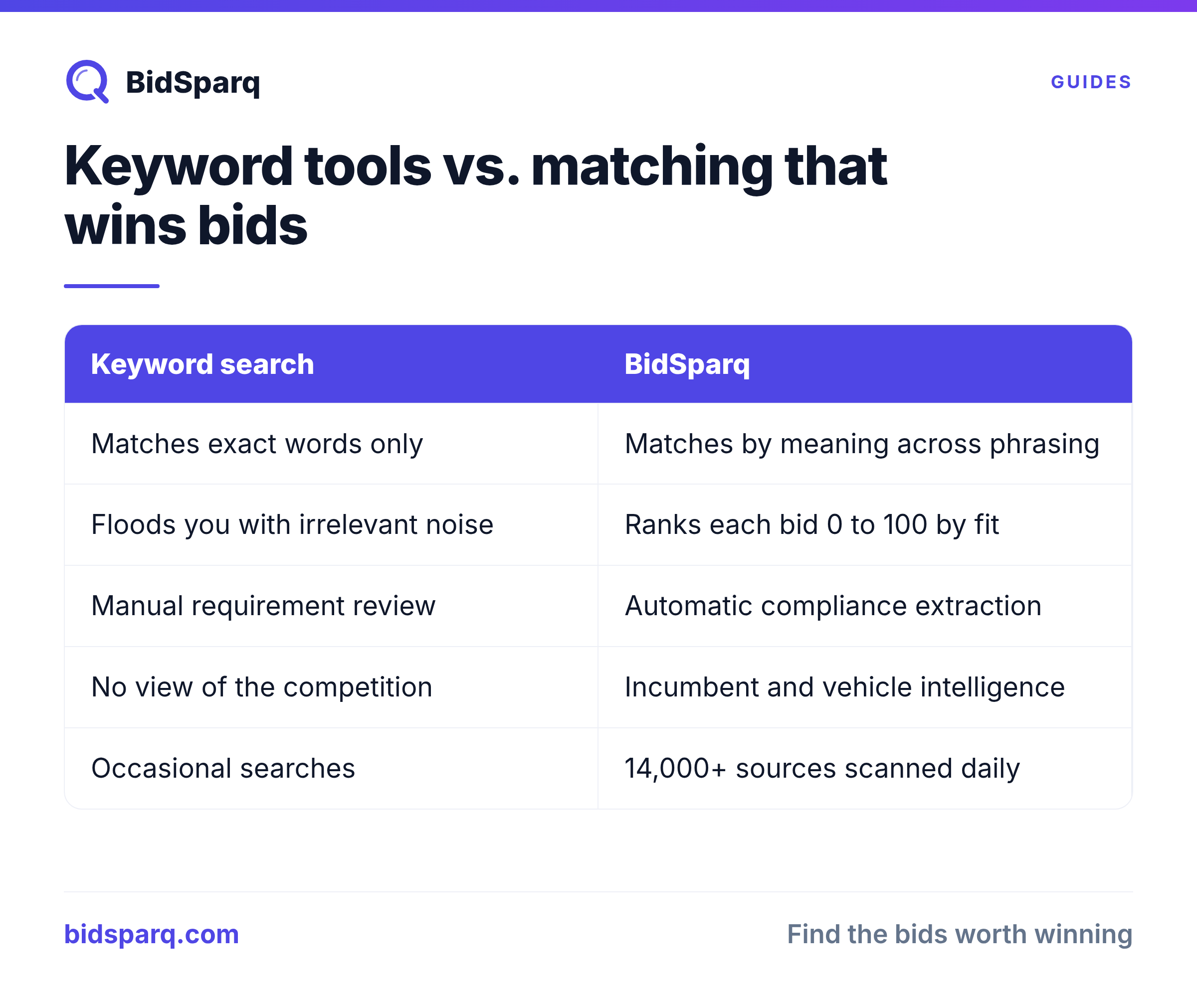
Replace keyword alerts with matching that understands what you do. Keyword filters miss opportunities described in different terms and flood you with irrelevant noise, which is how good bids get lost. Semantic matching reads for meaning, so a solicitation that never uses your exact phrasing still reaches you if it fits. BidSparq aggregates more than 23,000 distinct bid sources every day and scores each match from 0 to 100, so a procurement lead can open a ranked list and know within minutes which opportunities deserve a proposal team and which do not.
Build a bid pipeline you can run every week
Make discovery a standing habit, not a quarterly scramble. Government buyers, like buyers in education, healthcare, and construction, post on their own timelines, and the teams that win are simply present when the right work appears. A repeatable rhythm is straightforward: review new high-scoring matches, qualify against real capacity, and extract requirements the moment you decide to pursue. Do that consistently and your pipeline stops depending on luck and starts compounding.
FAQ
How do you win government contracts as a small business?
Focus on fit over volume. Target opportunities where your size is an advantage, such as set-aside eligibility, niche capabilities, or local presence, and answer every scored requirement precisely. Small teams win by qualifying hard and competing only where they are genuinely strong, not by bidding everything that appears.
Where can I find government contract opportunities to bid on?
Opportunities are spread across thousands of federal, state, local, education, and healthcare portals, which is why manual searching is so slow. A discovery platform that aggregates many sources and matches by meaning surfaces relevant bids in one place, ranked by how well they fit what you do.
What makes a winning government contract bid?
A winning bid answers every evaluation criterion in order, proves relevant past performance, prices competitively, and is fully compliant with mandatory requirements. Most losses trace back to missed requirements or weak fit, and both are avoidable with disciplined qualification and requirement extraction.
Winning is a process, and the process starts with seeing the right opportunities. See your best-fit contract matches free, with no credit card required.
Find RFPs that match your business
BidSparq monitors 23,000+ procurement sources and uses AI to score every opportunity against your capabilities. Try it free for 14 days.
Start Free Trial →