RFP Aggregator: Stop Missing the Right Bids
An RFP aggregator collects solicitations from thousands of procurement sources into one place. Learn how semantic matching, fit scoring, and compliance extraction turn raw volume into a focused pipeline across healthcare, education, construction, and more.

Across healthcare, education, construction, IT, and government procurement, the majority of solicitations your team qualifies for will never reach your inbox. They close on portals you were not watching, with language that did not match your keyword search. The fix is not working harder. It is using an RFP aggregator that covers the full market.
- Most relevant bids are invisible to keyword search because solicitation titles rarely match the terms you use to describe your own services.
- An RFP aggregator consolidates thousands of procurement sources so your team monitors the full market without checking every portal by hand.
- Semantic matching surfaces bids by meaning, not exact words, capturing opportunities a keyword tool would never return.
- A fit score from 0 to 100 turns a large result set into a ranked shortlist your team can act on without hours of manual triage.
- Compliance extraction and incumbent data give you the context to qualify or pass before you commit proposal hours to the wrong bid.
The short answer
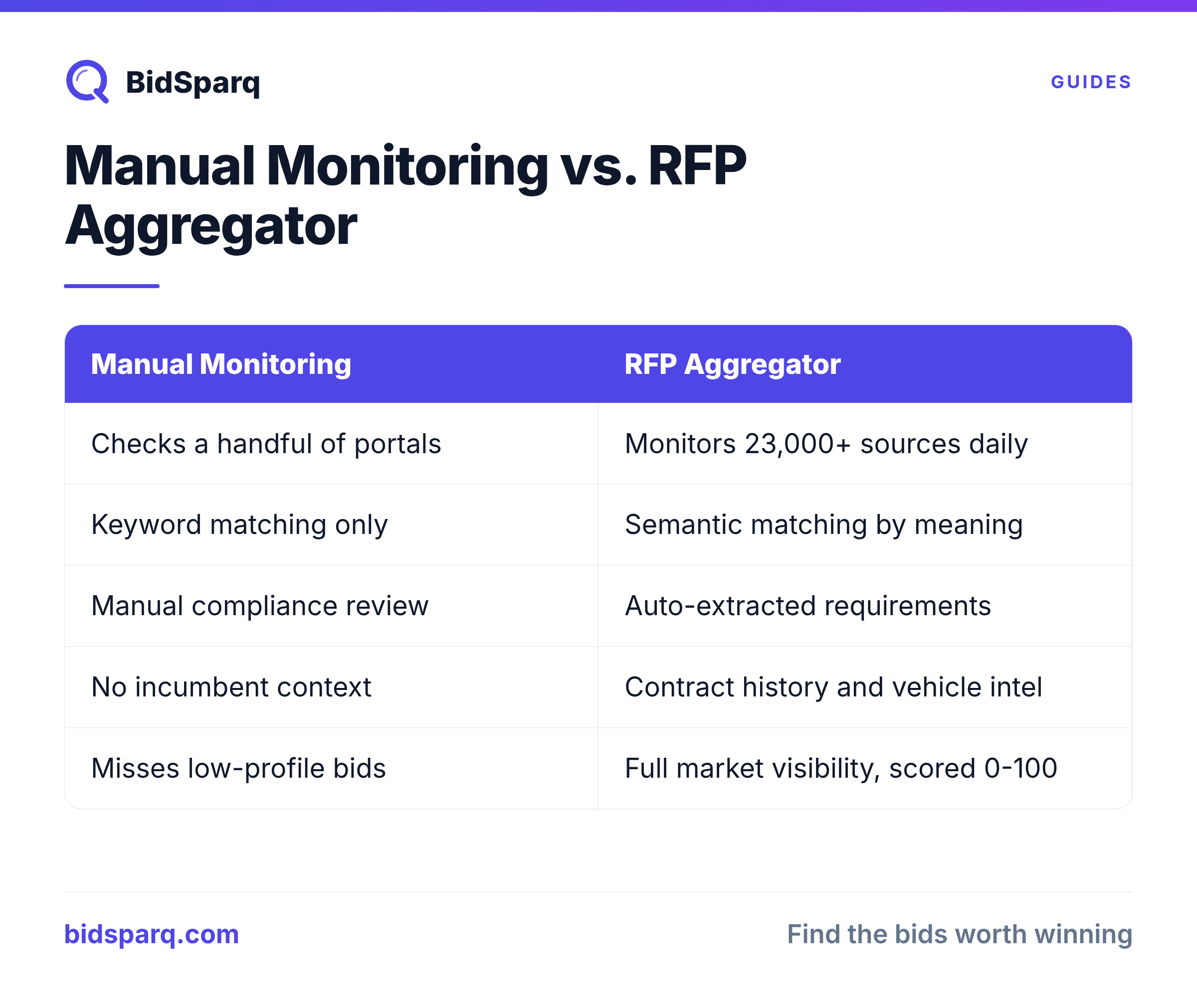
An RFP aggregator replaces manual portal monitoring with continuous, automated coverage across thousands of procurement sources, and the difference in outcomes is material. Teams with a capable aggregator maintain a pipeline that reflects actual market conditions rather than what happened to surface on the portals they remembered to check; they recover hours otherwise spent on portal-by-portal searching and shift that time to proposal strategy; and they gain early visibility into opportunities before deadlines compress decision time. As of September 2026, BidSparq tracks 55,776 open solicitations across 23,000+ distinct sources, spanning healthcare, education, construction, IT, commercial, and government markets. A team without an aggregator sees only a fraction of that market, which means win decisions are made against an incomplete picture.
Why scattered bid sources cost you real opportunities
Procurement is fragmented across thousands of portals: hospital systems, school districts, transit authorities, and commercial buyers each post solicitations on their own platform, in their own format, on their own timeline. A facilities contractor tracking renovation work might need to monitor dozens of county procurement boards and state construction portals simultaneously. A healthcare IT vendor pursuing clinical systems contracts faces the same sprawl. No team has the bandwidth to check every relevant source daily, which means opportunities close before anyone on your team realizes they were open.
The practical cost is not just missed bids. It is a distorted picture of the market: your pipeline reflects what you happened to find, not what you were best positioned to win. A quality RFP aggregator closes that gap by monitoring sources continuously on your behalf, across every market segment you care about.
What semantic matching changes
Keyword search finds bids that contain your exact terms; semantic matching finds bids that describe work you do, even when the buyer uses entirely different language. Here is what that gap looks like in practice. A school system posts an RFP titled 'Integrated Learning Environment Upgrade.' A corporate campus posts one called 'Workplace Technology Refresh.' Both solicitations describe structured cabling, audiovisual systems, and network infrastructure. An AV integration firm searching for 'AV installation' returns zero results for either solicitation, because that phrase appears nowhere in either document. Semantic matching surfaces both, because the engine reads the underlying scope of work and recognizes that the described capabilities match what an AV integration firm provides, regardless of what the buyer called it.
This distinction matters most in markets like education, healthcare, and construction, where procurement language varies widely across buyer types and geographies. The same service can appear as 'systems integration,' 'technology infrastructure,' 'digital transformation,' or a dozen other phrases depending on who wrote the RFP. Semantic matching also reduces noise: instead of returning every document that contains a common word, the engine ranks results by how closely the underlying scope of work matches your capabilities. That ranking is the foundation of fit scoring.
How fit scoring and compliance extraction work together
A fit score from 0 to 100 tells you, at a glance, how closely a bid aligns with your profile before you read a single page of the solicitation document. High-scoring bids surface at the top of your feed; low-scoring ones stay in view but do not compete for your attention. Paired with automatic compliance extraction, which pulls bonding requirements, certifications, minority-business designations, and submission deadlines directly from the document, fit scoring gives your team a complete first-pass picture in seconds rather than hours.
Incumbent and contract-vehicle intelligence adds a third layer. Knowing who held a contract previously, what vehicle it was awarded on, and when the current term expires turns a promising bid into an informed go or no-go decision, before you draft a word of the proposal.
What to verify before choosing an RFP aggregator
Before committing to any RFP aggregator, verify that it actually covers the markets where you compete, not just the sources that are easiest to ingest. Free public resources like SAM.gov for federal contracting, your state's official eProcurement portal for state-level work, and public bid boards maintained by state comptrollers are useful benchmarks for coverage. School districts often post on board-agenda platforms like BoardDocs, while healthcare systems and commercial buyers post on proprietary supplier portals. A robust aggregator should span all of these source types. Evaluate source count, data freshness, and whether the platform relies on keyword search or genuine semantic intelligence before you sign.
FAQ
What is an RFP aggregator?
An RFP aggregator is a platform that automatically collects requests for proposals and other bid solicitations from multiple procurement sources, including government portals, education systems, healthcare organizations, and commercial buyers, and presents them in a unified, searchable feed. The goal is to replace the manual work of monitoring dozens or hundreds of individual portals every day.
How is an RFP aggregator different from a keyword search tool?
A keyword search tool returns documents that contain your exact search terms. An RFP aggregator with semantic matching returns bids that describe work you do, regardless of the specific words the buyer used. That distinction is significant in markets like healthcare, construction, and education, where procurement language varies widely by buyer type. The best aggregators also add fit scoring, automatic compliance extraction, and incumbent intelligence, capabilities that go far beyond search.
Which markets and industries do RFP aggregators cover?
Coverage varies significantly by platform. The broadest aggregators span federal, state, and local government; K-12 and higher education; healthcare; construction; information technology; and commercial procurement. Narrower tools focus on a single sector and may miss the majority of your total addressable market. When evaluating an aggregator, ask which source types it indexes, how frequently it updates them, and whether it uses keyword or semantic matching to surface relevant results.
Find RFPs that match your business
BidSparq monitors 23,000+ procurement sources and uses AI to score every opportunity against your capabilities. Try it free for 14 days.
Start Free Trial →