Bid Management Software for Small Contractors That Wins Work
How to choose bid management software for small contractors that surfaces winnable work instead of just filing paperwork, plus what the tiers should cost.
You have eleven portal tabs open, a county site that logged you out again, and a general contractor's plan room email buried three days deep in your inbox. Somewhere in that mess is a paving package you could actually win, but you will not find it before the walk-through, and you already know it. This is how most small contractors lose work: not on price, but on visibility.
Bid management software gets pitched as the cure. A lot of it only tidies the paperwork after you have already found the job, which is the easier half of the problem. Here is how to judge a tool by the half that actually costs you money.
- Bid management is two jobs: finding the right work and responding to it, and most tools only help with the second.
- Discovery is the bottleneck for small teams that cannot watch every portal, plan room, and inbox every day.
- Keyword alerts miss money because they match words, not the meaning of the work you do.
- Fit scoring saves hours by ranking opportunities before you open a single PDF.
- Compliance requirements hide in attachments, and one missed line can disqualify a strong bid.
- Price should match your volume: a free tier to test, then a flat plan that does not punish a busy season.
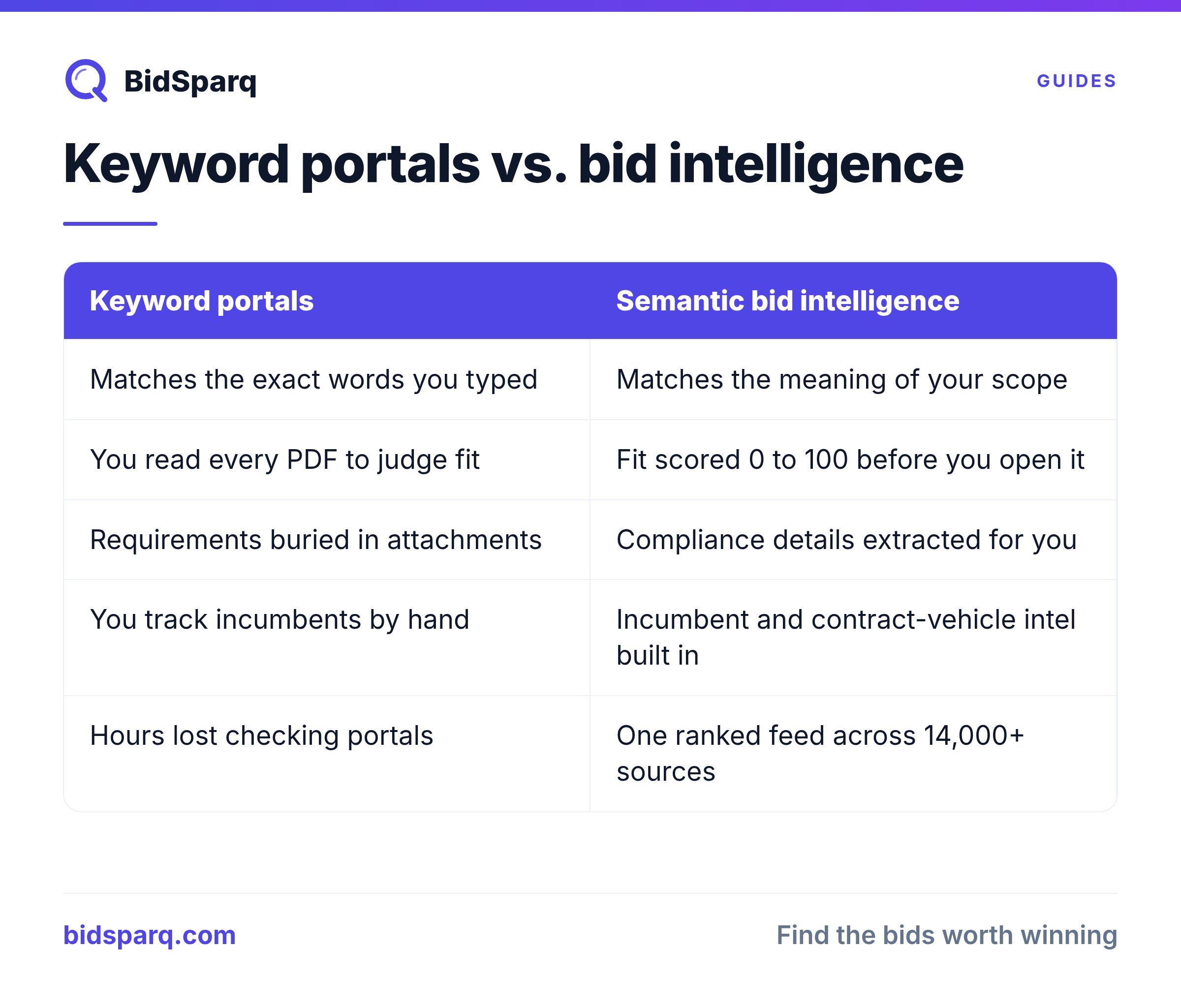
Bid management is really two different jobs
Separate finding work from winning work before you shop for anything. Discovery means knowing which opportunities exist and whether they are worth your attention. Response means assembling the proposal, tracking deadlines, and staying compliant.
Most products sold to contractors are response tools with a calendar bolted on. They are useful. But if opportunities are not landing in front of you, a tidy proposal workflow just organizes the few bids you stumbled onto. For a small electrical sub or a regional site work crew, the constraint is rarely storage or templates. It is time and visibility, and that is where the cheaper tools do the least.
Why finding the right bids is the hard part
Treat discovery as your first constraint, not an afterthought. Procurement is enormous and fragmented. Work worth bidding is scattered across private owners, general contractors, plan rooms, hospital systems, universities, school districts, and government agencies at every level, each with its own login and its own posting quirks. Government is only one vertical inside a much larger market, and no small team can check all of it by hand.
So most crews set up keyword alerts and hope. The trouble is that keywords are literal. Take a single earthwork package for a school expansion. The county lists it as "grading and drainage." The general contractor's plan room calls it "mass excavation." A state portal files it under "site utilities and earthwork." Same scope, three vocabularies, and a keyword filter built around the one word you happen to use catches maybe one of the three.
Semantic matching is the fix. Instead of matching the exact words you typed, it reads the meaning of a scope and surfaces work that fits what you actually build, even when the language is different. Set against manual portal checking and keyword tools, that is the difference between reviewing a short, ranked list and choosing between false alarms and silence.
The features that actually move your win rate
Judge every feature by whether it gets you to a go or no-go decision faster. A small crew wins by spending its limited hours only on bids it can realistically take. Three capabilities do the heavy lifting, and each one replaces something you now do by hand:
- Semantic matching across 23,000+ sources: it reads scopes the way an estimator does and pulls in work that keyword alerts never surface, so your addressable market stops hiding behind other people's vocabulary.
- Fit scoring from 0 to 100: every opportunity is ranked before you open it, so you work the top of the list instead of reading full solicitations you will only reject.
- Automatic compliance extraction: bonding, licensing, insurance, and certification requirements get pulled out of the attachments, so you learn you are ineligible in seconds rather than on submission day.
The pattern is consistent: the software does the reading and the triage, and your people do the judgment and the pricing. BidSparq combines all three so a small office can qualify opportunities at a pace that used to require a dedicated bid desk. Its matching engine is built and tuned full time against real procurement scopes across construction, healthcare, education, and government, which is why it reads an unfamiliar posting the way a seasoned estimator would.
How to choose, and what it should cost
Match the software to your trade, geography, and capacity, not to a feature list. Start with one number: how many bids can you actually pursue in a month? If the honest answer is five, you need ruthless filtering, not a firehose.
Then check three things. Does it cover sources well beyond your one regional portal? Does it explain why a match ranked high, or is it a black box you will quietly stop trusting? And does the price track your volume rather than your headcount?
On price, look for a free tier so you can confirm the matches are real before you spend anything. BidSparq's Free plan lets you do exactly that, and Pro Max runs $249 a month, $199 on annual billing, all flat, so a busy season does not inflate the bill. The honest test after a week is simple: are you seeing winnable work you would have missed, and are you spending less time deciding what to skip? If yes, the tool is doing the two jobs that matter. If not, it is just filing.
FAQ
What is the best bid management software for small contractors?
The best option solves discovery and qualification, not just document storage. Prioritize semantic matching that finds work by meaning, fit scoring that ranks opportunities, and automatic requirement extraction, then confirm coverage across your trade and region. A free tier lets you verify the matches are relevant before you pay.
How is bid management software different from a plan room or bid board?
A plan room or bid board is mostly a place to view postings you already know to look for. Bid management software with semantic matching and fit scoring actively surfaces relevant work across thousands of sources and tells you which jobs are worth your time, so you spend fewer hours hunting and more hours estimating the bids you can win.
Is there affordable bid management software on a tight budget?
Yes. Start with a free tier to prove the value, then choose a flat monthly plan rather than per-seat or per-bid pricing that punishes a busy season. Predictable cost matters more than a long feature list when your bid volume rises and falls through the year.
See your free bid matches, no credit card required.
Find RFPs that match your business
BidSparq monitors 23,000+ procurement sources and uses AI to score every opportunity against your capabilities. Try it free for 14 days.
Start Free Trial →