Security Services RFP: The Compliance Gap Costs You
A security services RFP is won or lost at the compliance screen, long before evaluators read your proposal. Learn how qualified firms get eliminated early and what to do about it.

Security services firms submit qualified teams, experienced supervisors, and competitive pricing, and still lose before a single evaluator reads their work. The most common reason is a compliance screen that catches a licensing gap, an undersized insurance certificate, or a missing bonding document before scoring begins. Understanding that screen, and the sourcing problem that precedes it, is the difference between a firm that wins consistently and one that spends proposal budget on pursuits it was never positioned to win.
- Compliance comes before scoring: licensing, bonding, and insurance thresholds are pass-fail criteria that eliminate proposals automatically in most procurement systems.
- Scope is what separates shortlisted firms from the rest, because buyers use best-value scoring that weighs staffing ratios, technology integration, and incident response protocols alongside price.
- The real competition starts before the RFP drops, and firms tracking incumbent contracts and rebid cycles can shape their positioning weeks ahead of a formal notice.
- Healthcare, education, and corporate facilities generate a significant share of security services solicitations, yet many firms focus narrowly on government work and leave the pipeline thin.
- Semantic bid discovery matters because buyers describe the same need as "guard services," "physical security management," "armed patrol," or "access control services," and keyword searches miss those variations.
The short answer
A security services RFP is a formal competitive solicitation used by hospitals, school systems, corporate campuses, transit authorities, and government facilities to hire firms for guard staffing, patrol, access control, or integrated physical security programs. Winning requires clearing a compliance screen on licensing, bonding, and insurance before evaluators read a word of your proposed service model. Once past that screen, buyers score on scope fit: whether your staffing structure, technology stack, and response protocols match the specific site and risk profile in the solicitation. Firms that identify opportunities early, extract every requirement before writing, and tailor their proposals to the individual solicitation win at a meaningfully higher rate than those reacting to keyword searches.
Why Qualified Firms Get Eliminated Before Scoring Starts
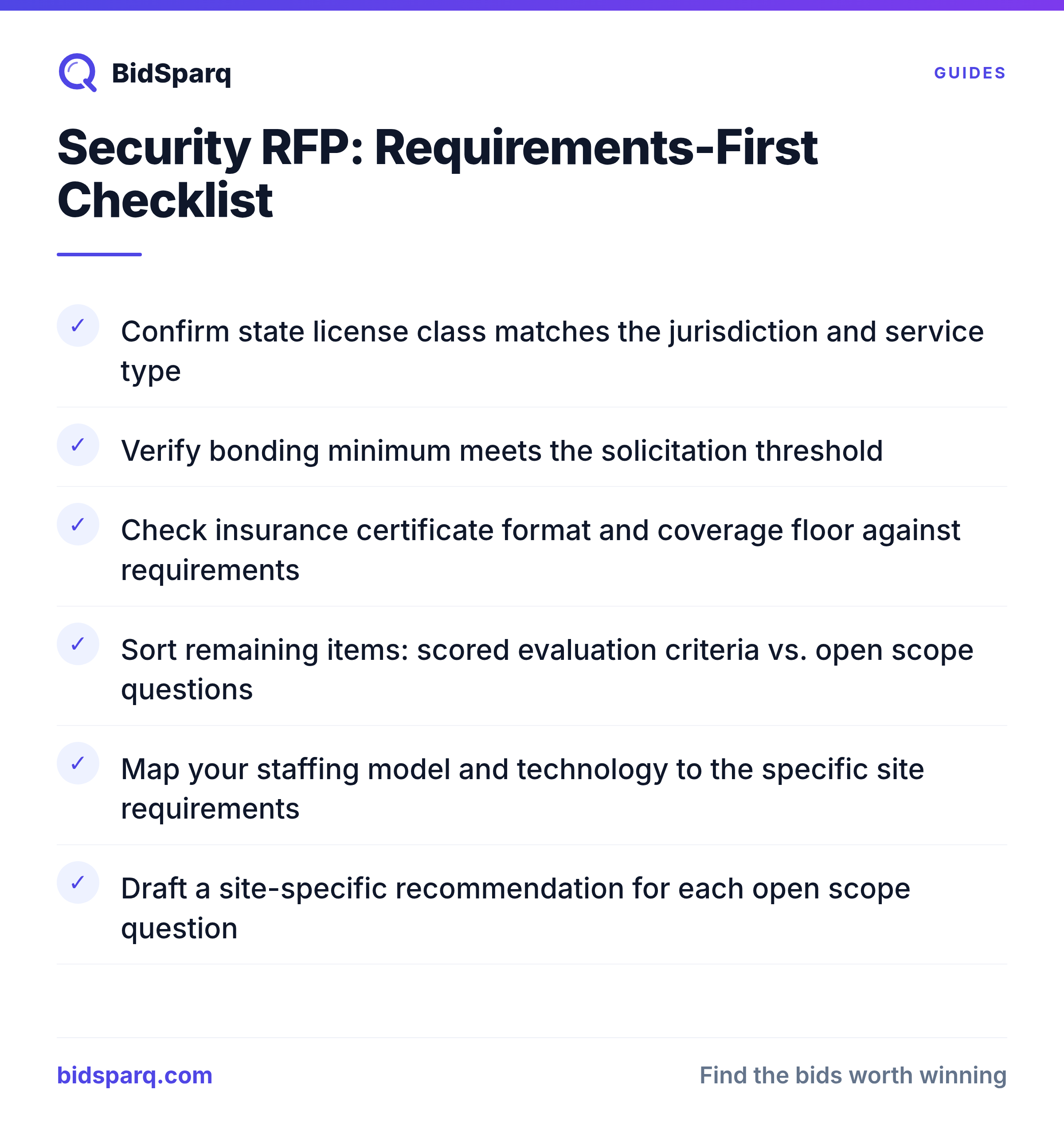
Build a compliance checklist for every security services RFP before writing a single word of proposal copy. State licensing requirements vary by jurisdiction and service type: armed versus unarmed guard services, mobile patrol versus fixed post, and technology-integrated programs each carry different license classifications in most states. Bonding minimums and insurance certificate formats differ between a hospital network and a transit authority, and a corporate campus may add technology certification requirements that a government facility does not. Healthcare sites frequently layer in access control protocols tied to sensitive area designations. School district solicitations add background check standards and sometimes require specific clearance documentation. An automated scoring system in most modern procurement platforms will return or zero-score a submission that fails any of these thresholds before an evaluator reads it. Mapping every pass-fail requirement at the start, checking each against your current credentials, and resolving gaps before committing to the pursuit is not extra work. It is the minimum required to reach the scoring stage.
Where Security Services Solicitations Actually Come From
Stop treating security bids as a single market with one source: they are posted across dozens of procurement systems under names that vary widely, on schedules that do not align. A large school district may post through its state eProcurement system. A private hospital network may use its own vendor portal or a regional group purchasing organization. A corporate real estate firm may advertise through a third-party procurement marketplace. On the public side, federal opportunities appear on SAM.gov; state and municipal notices live on state-run eProcurement portals; school board solicitations often appear alongside board agendas on platforms like BoardDocs. As of September 2026, 4,810 new security solicitations were posted in a single 30-day period across the 23,000+ sources BidSparq tracks, and 3,884 open solicitations mention security right now. Of those, 1,719 close within the next 14 days. Tracking that volume manually is the clearest bottleneck in a security firm's business development pipeline, and the cost shows up not in hours logged but in bids missed entirely.
See your matching security services RFPs free, no credit card needed. Semantic matching surfaces solicitations by meaning across all those sources, so you catch opportunities phrased as "guard services," "armed patrol," or "physical security management" without running separate searches on every portal.
How to Read a Security RFP Before You Commit to Writing
Pull every requirement out of the document and sort it into three categories: pass-fail compliance items, scored evaluation criteria, and open scope questions where the buyer has described a need but not a solution. Pass-fail items include the license class required for the state and service type, bonding floors, insurance certificate format, and submission deadline. Scored criteria cover pricing structure, staffing model, supervision ratios, past performance, and technology capabilities, each usually weighted explicitly in the evaluation rubric. Open scope questions are where differentiation lives. A healthcare campus RFP that leaves access control technology undefined, or a school district solicitation that does not specify after-hours patrol protocols, is giving you a place to make a recommendation. A firm that answers those open questions with a well-reasoned, site-specific proposal moves from technically compliant to genuinely preferred. Firms tracking incumbents and contract vehicle expirations before the RFP drops have an additional edge: knowing what drove the rebid shapes how they frame their positioning before writing starts.
Winning on Scope, Not Just Price
Match your proposed staffing model, technology, and incident protocols precisely to the specifics in the solicitation, not to your standard service catalog. Most security services RFPs issued by healthcare networks, school systems, and corporate facilities today use a best-value or qualifications-based scoring model where price is one factor among several. Scope fit, typically weighted heavily, means your guard-to-site ratio, shift structure, and escalation plan need to reflect what the buyer described for that specific facility, down to the post type and coverage hour. Technology integration is increasingly scored in corporate and healthcare bids: access control platforms, visitor management systems, and real-time incident reporting tools appear as requirements or preferences in a growing share of solicitations. Incumbent intelligence shapes the differentiation strategy. If the current contract is ending, understanding what drove the rebid shapes how you frame your positioning, whether the issue was cost, service quality, or a scope change. AI fit-scoring tools that assign a 0-to-100 match score and automatically extract compliance requirements cut hours from the pre-proposal phase, freeing time for the scope analysis and positioning that evaluators actually remember.
FAQ
What does a security services RFP typically include?
A security services RFP typically includes a scope of work describing the facility, service hours, and post requirements; compliance thresholds covering licensing, bonding, and insurance; an evaluation rubric showing how responses will be scored; a pricing template or rate card format; and submission instructions with a deadline. Larger solicitations often include site survey schedules, incumbent contract details, and addenda processes for questions from prospective bidders.
How do I find security services RFPs across multiple markets?
Start with the public sources: SAM.gov for federal solicitations, your state's official eProcurement portal for state and municipal notices, and BoardDocs or similar platforms for school board bids. Private-sector opportunities, including hospital networks and corporate campuses, often appear on group purchasing organization portals or the buyer's own vendor registration system. Platforms that aggregate 23,000+ sources and apply semantic matching surface security services bids by meaning across all those channels, including opportunities phrased as "guard services," "access control services," or "physical security management" that a single keyword search would miss.
What is the most common reason security firms lose RFPs?
Compliance failures are the most common eliminator: missing or undersized insurance certificates, incorrect license class for the state or service type, and incomplete bonding documentation. After compliance, scope mismatch is the next most frequent cause, where the proposed staffing model or technology does not align with what the buyer described for that specific site. Firms that build a compliance checklist before writing, read the evaluation rubric carefully, and tailor the service model to the individual solicitation consistently outperform those using generic proposal templates.
Find security services bids matched to your firm's scope and market, free. No credit card required.
Find RFPs that match your business
BidSparq monitors 23,000+ procurement sources and uses AI to score every opportunity against your capabilities. Try it free for 14 days.
Start Free Trial →