How to Write a Capability Statement That Gets Noticed
Your capability statement is your resume for government contracting. Learn how to write one that contracting officers actually read, with structure, examples, and the pre-RFP strategies that turn it into a competitive advantage.
A capability statement is a one-to-two page document that summarizes what your company does, who you've done it for, and why an agency should consider you for their next contract. Think of it as your company's resume for government buyers.
Most capability statements are forgettable. They look the same, say the same things, and end up in the same pile. The ones that work: the ones that lead to sole-source awards, teaming invitations, and shortlists, follow a specific structure and serve a specific strategic purpose.
Why Your Capability Statement Matters More Than You Think
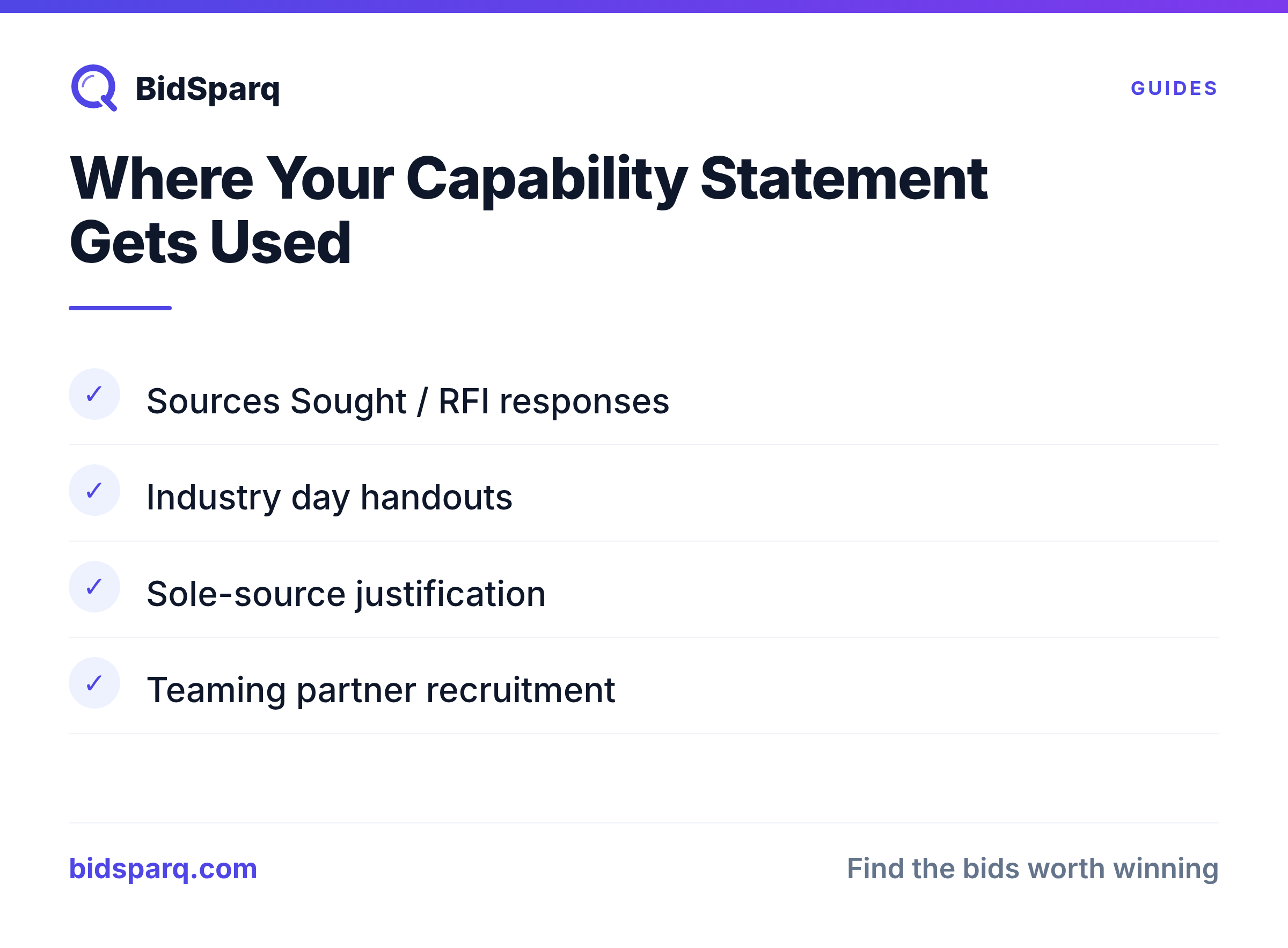
A capability statement isn't just a brochure. In government contracting, it serves as a pre-RFP positioning tool:
- Sources Sought / RFI responses. When an agency issues a Sources Sought notice, they're asking "who can do this?" Your capability statement is often the primary document you submit.
- Industry day handouts. At pre-solicitation conferences, contracting officers collect capability statements to build their vendor awareness.
- Sole-source justification. If an agency wants to award to you without competition, they need documented evidence of your capabilities. Your capability statement is Exhibit A.
- Teaming partner recruitment. Primes looking for subcontractors evaluate capability statements to decide who to team with.
"The vendors who take the time to respond professionally to Sources Sought often end up shaping the actual Statement of Work." (Federal COR insider, r/GovernmentContracting)
"Sole Source isn't luck. It's engineering. They responded to the RFI. They showed up to the industry day. They submitted a capability statement. When the CO needed to justify the award, there was a documented trail." (r/GovernmentContracting)
The Standard Capability Statement Structure
Keep it to one page if possible, two pages maximum. Contracting officers review dozens of these: brevity wins.
1. Company Overview (2-3 sentences)
Who you are, what you do, and where you do it. Be specific, not generic.
Bad: "ABC Solutions is a full-service technology company providing innovative solutions to government and commercial clients."
Good: "ABC Solutions provides cybersecurity assessment and continuous monitoring services to federal civilian agencies. We've completed 47 FISMA assessments for 12 agencies since 2020, specializing in cloud security for AWS GovCloud and Azure Government environments."
The difference: specificity. The second version tells a contracting officer exactly what you do, for whom, and how much experience you have.
2. Core Competencies (4-6 bullet points)
List your primary service areas. Use the language the government uses: match the terminology in NAICS code descriptions and common SOW language:
- Cybersecurity Assessment & Authorization (A&A)
- FISMA/FedRAMP Compliance Consulting
- Cloud Migration and Security (AWS GovCloud, Azure Gov)
- Continuous Monitoring and Incident Response
- Security Operations Center (SOC) Staffing
3. Past Performance (3-5 contracts)
This is the most important section. List your most relevant past performance contracts with:
- Client name (agency and office)
- Contract number (shows it's verifiable)
- Period of performance
- Contract value
- Brief scope description (2 sentences max)
If you're new and don't have federal past performance, include state/local government contracts, subcontracting work, or commercial contracts with similar scope. Label them honestly.
4. Differentiators (2-3 bullet points)
What makes you different from the other 50 vendors with similar NAICS codes? Be concrete:
- "98.7% SLA uptime across all managed security contracts since 2021"
- "Average 23-day delivery on A&A packages vs. industry standard of 45 days"
- "All senior staff hold active Secret clearances and CISSP/CISM certifications"
Avoid empty differentiators like "customer-focused" or "innovative approach." Everyone says that. Numbers and specifics stand out.
5. Company Data Block
This section gives contracting officers the administrative data they need to determine your eligibility:
- DUNS / UEI Number
- CAGE Code
- NAICS Codes (list your primary 3-5)
- Small Business Certifications: 8(a), HUBZone, SDVOSB, WOSB, SDB
- GSA Schedule number (if applicable)
- Clearance level (facility clearance, if applicable)
- Point of contact: name, email, phone
Design and Formatting Tips
- Use your company colors and logo. This is a branding document.
- Use columns. A two-column layout fits more information on one page while remaining readable.
- Use a header banner with your company name, tagline, and logo.
- Put the data block in a sidebar or footer. It needs to be visible but shouldn't dominate.
- Save as PDF. Never send a Word document: formatting will break.
- Keep it under 2MB. Many government email systems reject large attachments.
How to Use Your Capability Statement Strategically
Creating the document is step one. Using it to win work is the real game:
Respond to Every Relevant Sources Sought Notice
When an agency issues a Sources Sought or RFI on SAM.gov, they're doing market research before writing the RFP. Responding with your capability statement puts you on their radar and can influence how the eventual RFP is written.
Attend Industry Days and Pre-Bid Conferences
Bring printed copies. Introduce yourself to the contracting officer and program manager. Follow up with an email attaching your capability statement within 24 hours.
Connect with Prime Contractors
Large primes are always looking for qualified small business subcontractors to meet their subcontracting plan requirements. Your capability statement is your pitch to potential teaming partners.
"Subcontracting before trying to prime. They used sub work to learn the agency, build past performance, and get their name into CPARS before ever competing on their own." (r/GovernmentContracting)
Proactive Outreach to Contracting Officers
You can email your capability statement to contracting officers in agencies that buy what you sell. Look up their contact information in SAM.gov award notices or agency small business office directories. This is completely legal and expected: agencies want to know about capable vendors.
Common Capability Statement Mistakes
- Too long. If it's more than 2 pages, it won't be read. Ruthlessly cut.
- Too generic. "Full-service solutions provider" tells the reader nothing. Be specific about what you do.
- No past performance. Even if you're new, include relevant commercial work or subcontracting experience.
- Missing data block. Without your UEI, NAICS codes, and certifications, a contracting officer can't determine if you're eligible. This is a dealbreaker.
- One version for everyone. Tailor your capability statement for each opportunity or agency. Emphasize the past performance and competencies most relevant to them.
- No call to action. End with your contact information prominently displayed and a clear invitation to discuss opportunities.
How BidSparq Helps Your Pre-RFP Strategy
Your capability statement works best when you're targeting the right agencies with the right opportunities. BidSparq supports your pre-RFP positioning:
- Sources Sought alerts: BidSparq scrapes SAM.gov Sources Sought notices so you can respond early with your capability statement
- Competitive Intelligence: See who holds current contracts at your target agencies, potential teaming partners or competitors to differentiate against
- Agency tracking: AI Chat can pull profiles on agencies you're targeting, including their buying history and upcoming recompetes
- NAICS-matched opportunities: Ensure your capability statement NAICS codes align with the RFPs you're actually seeing
Next Steps
- Start your free trial: find Sources Sought notices and RFPs that match your capabilities
- Review your NAICS codes to make sure your capability statement covers the right ones
- Learn about set-aside programs and which certifications to highlight
- Read how to win your first government contract using your capability statement as a starting point
Find RFPs that match your business
BidSparq monitors 23,000+ procurement sources and uses AI to score every opportunity against your capabilities. Try it free for 14 days.
Start Free Trial →