Build a Bid Compass That Points to Winnable RFPs
A bid compass is a weighted bid/no-bid scoring framework for fit, requirements, incumbents, and timing, so your team pursues fewer, more winnable RFPs.
Plenty of bids are lost before anyone writes a word. When an RFP lands, most teams have no consistent way to decide whether it deserves the next few weeks of effort. So pursuit goes to whatever is loudest, newest, or closest to closing, and the win rate pays for it. A bid compass fixes that: a fixed set of readings and a scoring rule that tell you which way to go before you spend the effort.
- Fewer, stronger pursuits: every RFP faces the same four readings, so effort goes where you can win.
- Cleaner shortlists: matching on meaning instead of keywords removes the noise from shared words.
- Disqualifiers caught early: mandatory requirements show up in minutes, before anyone starts drafting.
- Faster go/no-go meetings: one 0 to 100 score replaces debate and works across verticals.
- Sharper intelligence: cooperative contracts, GPO portals, and plan rooms show what your feed misses.
The short answer
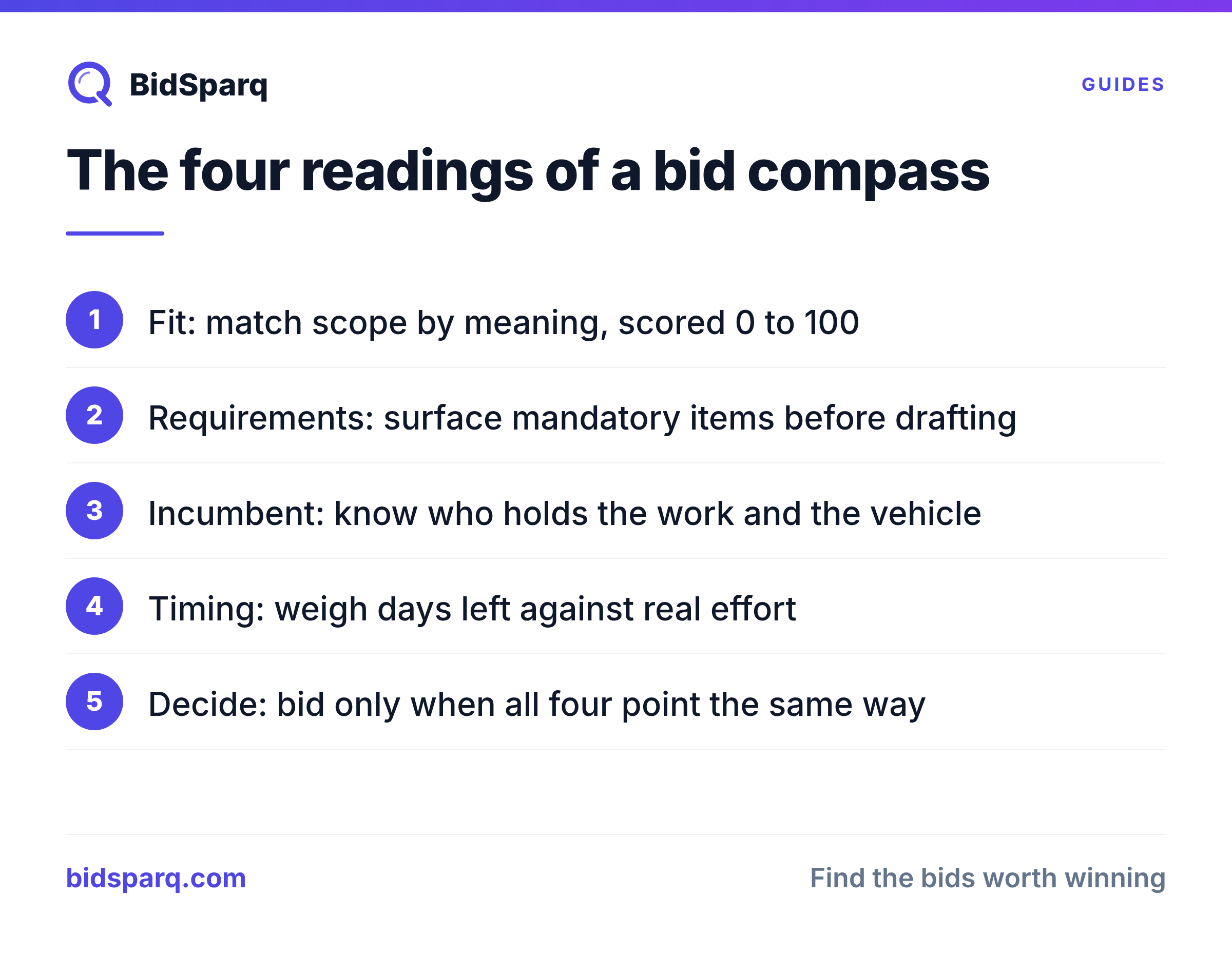
A bid compass is a repeatable bid/no-bid framework that scores every RFP on four weighted readings before your team commits effort: scope fit, mandatory requirements, incumbent and contract vehicle, and time to respond. A practical starting weighting is 35, 25, 20, and 20, with one hard stop: any mandatory requirement you cannot meet means no-bid, whatever the total. Opportunities scoring 70 or higher are a go, 50 to 69 get a short review, and anything below 50 is a pass. The method only holds up if the readings are fast enough to run on hundreds of RFPs a week, which is where automated scoring replaces manual triage.
Why keyword alerts and manual triage point the wrong way
A shared word is a weak signal, so treat keyword matches as leads to verify, never as answers. Take the word "compass" itself. As of November 2026, 401 open solicitations in our database mention it. The word can name a program, describe surveying or navigation equipment, or turn up in scope language that has nothing to do with either. A keyword alert would hand a K-12 curriculum vendor and a land surveying firm the same list, and both would lose time sorting it.
Semantic matching reads solicitations by meaning instead. A health system asking for patient navigation services and a university asking for student success coaching may share almost no vocabulary with your capability statement and still fit you well. When matching runs on meaning, those opportunities surface, and the ones that only share a word drop away.
Volume makes the problem worse. As of November 2026, 52,938 solicitations are open across the 30,000+ sources BidSparq tracks. They come from school districts, health systems, general contractors, universities, IT buyers, commercial firms, and public agencies, each on its own portal with its own format. Even a narrow slice moves fast: of the open solicitations that mention "compass," 163 close within the next 14 days.
Reviewing by hand means opening each document, finding the actual scope, scanning for mandatory forms and certifications, and guessing at the competition. Across a full week of new postings, most teams end up triaging by title alone. That is how good opportunities get skipped and poor ones get pursued.
See which open RFPs actually fit your business with a 14-day free trial. No credit card needed.
Take four readings before you commit
Before anyone opens a drafting template, put the opportunity through the same four readings in the same order. Order matters because each reading can end the pursuit before the next one costs you time.
- Fit. Does the scope match what you deliver, judged by meaning instead of shared keywords? An automated 0 to 100 fit score turns that judgment into a number you can compare across verticals and across weeks, instead of relying on whoever skimmed the RFP.
- Requirements. Bonding, insurance minimums, licensure, mandatory site visits or pre-bid conferences, and certifications decide eligibility. Automated compliance extraction pulls them into a checklist, so a disqualifier shows up in minutes rather than deep in an appendix after the team has started writing.
- Incumbent and vehicle. Find out who holds the work now, how long they have held it, and whether the buyer could use a cooperative contract or existing vehicle instead of a new award. Incumbent intel tells you whether you are trying to unseat an entrenched vendor or entering an open field, which is a key input alongside scope.
- Timing. Weigh the days remaining against the effort a compliant, competitive response really needs, including questions deadlines and required site visits. A strong fit with too little runway can still be a no-bid.
Score the readings with a bid/no-bid matrix
Give each reading a fixed weight, and let the total make the first call instead of the loudest voice in the room. The matrix below is a starting point. Once you have a few quarters of your own win and loss history, adjust the weights to match what actually predicts your wins.
| Reading | Weight | Full points when | Low points when |
|---|---|---|---|
| Fit | 35 | The core scope is work you deliver today, with relevant past performance | The fit is partial or depends on subcontracting the core work |
| Requirements | 25 | Every mandatory item is met with no new spend or paperwork | Items are met only with new insurance riders, certifications, or partners |
| Incumbent and vehicle | 20 | No entrenched incumbent and an open, full competition | A long-tenured incumbent, or the buyer can use a contract you do not hold |
| Timing | 20 | The runway comfortably exceeds your typical response effort | The deadline forces shortcuts on compliance or pricing |
Hard-stop rule: if any mandatory requirement cannot be met by the due date, the answer is no-bid, regardless of the total. A high score cannot rescue a proposal that will be rejected as nonresponsive.
Threshold bands:
- 70 to 100: Go. Assign a capture lead and start the compliance matrix.
- 50 to 69: Review. Hold a short meeting focused on the weakest reading and decide whether it can be fixed in time.
- 0 to 49: No-go. Pass, log the reason, and move the effort to a stronger opportunity.
Here is how a generic RFP might run through it. A regional health system posts a facilities maintenance contract. The scope matches your core services, but one building type is outside your past performance, so fit scores 28 of 35. You meet every mandatory item, but the insurance minimum requires adding a rider, so requirements score 20 of 25 and the hard stop does not trigger. The work has been held by the same vendor for several years, and the system belongs to a GPO with an existing agreement, so incumbent and vehicle score 8 of 20. There are 18 days left against a response you normally need about two weeks for, so timing scores 12 of 20. The total is 68, which lands in review. The meeting then has one clear question: is there a reason the buyer wants to replace the incumbent? If the answer is yes, the pursuit moves to go. If nobody can name one, it is a pass.
When these readings are produced automatically, the bid/no-bid meeting stops being a debate about whether anyone read the RFP and becomes a short conversation about strategy.
Calibrate your compass with sources beyond your feed
Your readings are only as good as the evidence behind them, so verify incumbents and upcoming demand where buyers actually publish. Each market leaves a different trail.
- Public sector. For federal work, SAM.gov lists active opportunities and USAspending.gov shows past award history, which helps confirm the incumbent. School district board agendas and minutes, often published through platforms like BoardDocs, reveal renewals and planned purchases before the RFP posts. State eProcurement portals and local budget documents show what buyers plan to spend next fiscal year.
- Cooperative purchasing. Contracts awarded through cooperatives such as Sourcewell and OMNIA Partners let member agencies, schools, and nonprofits buy without running a new solicitation. Check them to see whether a competitor already holds a vehicle the buyer can use, and whether holding one yourself would open doors.
- Healthcare. Health systems often buy through group purchasing organization (GPO) agreements and run their own supplier registration portals. Registering directly and understanding which GPO a system uses tells you a lot about your vehicle reading before an RFP appears.
- Construction. Owner and general contractor plan rooms publish drawings, addenda, and bidder lists, and many GCs require prequalification before you can bid their subcontract packages. Getting prequalified early protects your timing reading.
- Higher education and commercial buyers. Universities and large companies frequently run supplier portals with their own onboarding steps, and those steps belong in your requirements reading.
Geography is part of the calibration too. As of November 2026, the states posting the most "compass" solicitations are Pennsylvania (70) and California (32). Demand for any niche clusters in ways a national keyword feed hides, so look at where your opportunities actually come from before deciding where to invest pursuit effort.
A compass will not shorten the trip, but it will keep you from heading the wrong way.
FAQ
What is a bid compass in procurement?
A bid compass is a consistent bid/no-bid framework. Before resources are committed, it scores every solicitation on fit, mandatory requirements, incumbent and contract vehicle, and time to respond, then compares the weighted total to fixed go, review, and no-go bands.
How do I decide whether to bid on an RFP?
Check mandatory requirements first, because any you cannot meet end the pursuit. Then score scope fit by meaning, research the incumbent and any contract vehicle the buyer could use, and confirm you have enough time for a compliant, competitive response. Add the weighted scores and let the threshold band guide the call.
What score should trigger a no-bid?
A practical starting point is to pass on anything below 50 out of 100, review anything from 50 to 69, and pursue 70 and above. Any unmet mandatory requirement is an automatic no-bid regardless of score. Adjust the bands once you have enough win and loss history to see where your real cutoff sits.
Who should own the bid/no-bid decision?
Name one accountable owner, usually the capture manager, business development lead, or the executive responsible for the revenue line. Proposal, operations, and finance should supply the readings, but one person makes the final call so decisions stay consistent and fast.
Are keyword alerts good enough for finding RFPs?
Usually not. Keyword alerts miss relevant solicitations that describe your work in different words, and they flood you with irrelevant ones that happen to share a term. Semantic matching compares meaning instead of exact words, giving you a cleaner, more complete list to score with your bid/no-bid matrix.
Start your 14-day free trial of automated fit scoring and compliance extraction and point your team at the RFPs worth winning. No credit card required.
Find RFPs that match your business
BidSparq monitors 30,000+ procurement sources and uses AI to score every opportunity against your capabilities. Try it free for 14 days.
Start Free Trial →