How to Find Government Subcontracts Before They Close
Government subcontracts scatter across prime contractor sites, agency portals, and teaming boards with no central registry. Follow this five-step discovery workflow using semantic search, automated fit-scoring, and daily coverage across 23,000+ sources to find subcontract opportunities before they close.
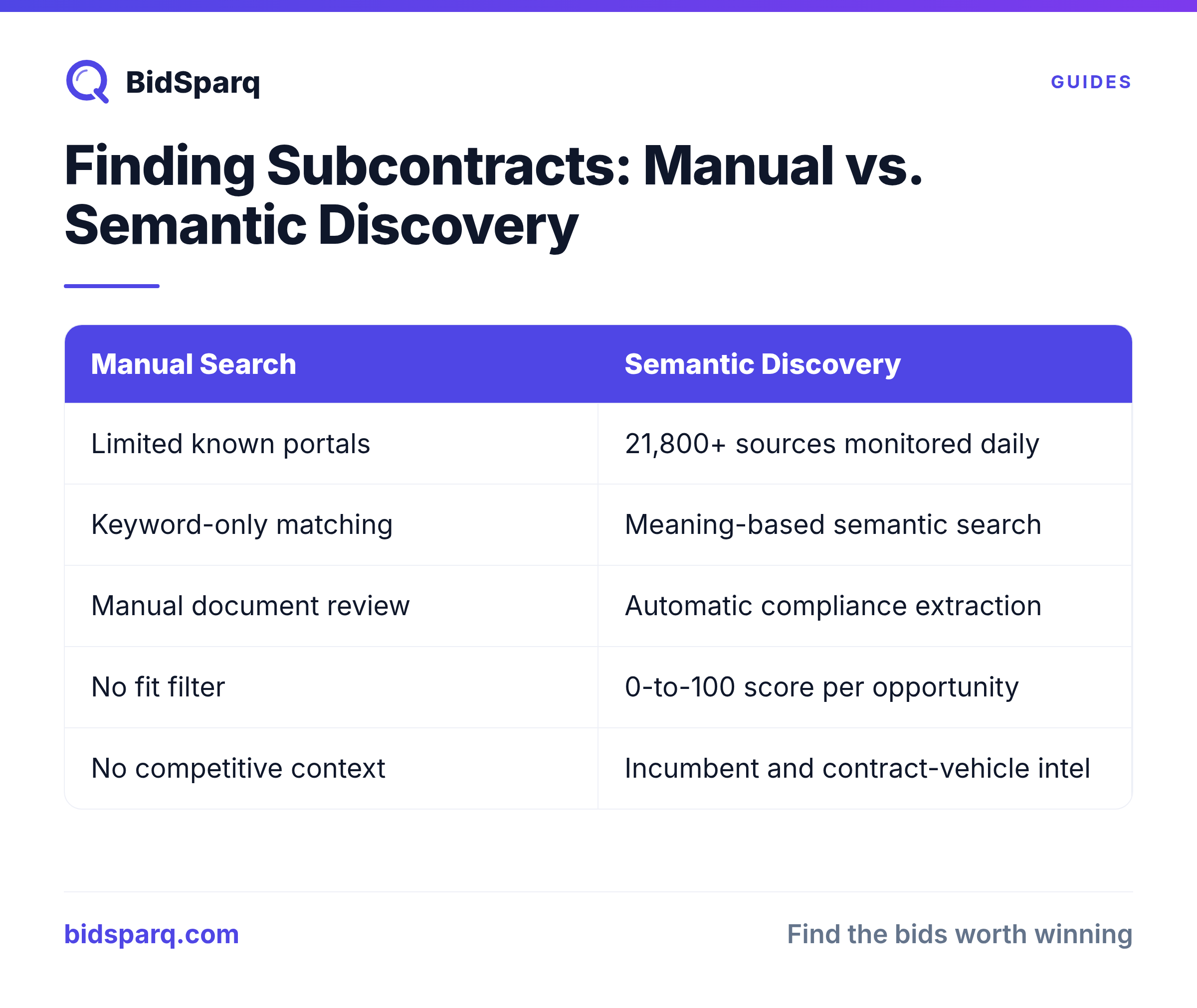
Government subcontracts do not have a central registry. They scatter across prime contractor outreach pages, agency portals, solicitation documents, and teaming boards that most vendors never monitor. Small businesses miss these opportunities not from lack of interest but from lack of a systematic discovery process.
Subcontracting scales across every industry where large prime contracts get broken into specialized work: construction, IT services, professional services, logistics. Government follows the same model but adds regulatory complexity and source fragmentation that makes the discovery problem worse than in any commercial vertical. BidSparq applies the same discovery workflow across construction, healthcare, education, and IT procurement, not only government.
Key Takeaways
- No central registry exists: subcontract opportunities scatter across prime sites, agency portals, teaming boards, and solicitation documents at every level of government.
- Semantic search captures what keywords miss: notices often use "teaming partner sought" or "small business participation plan" rather than the word "subcontract."
- Deadlines compress fast: as of August 2026, 111 open subcontract solicitations close within 14 days.
- A 0-to-100 fit score narrows the field so your team pursues subcontracts matched to your actual capabilities, not every loosely related notice.
- Compliance extraction surfaces subcontracting plan clauses and participation goals before you invest time in pursuit, so the decision is made on complete information.
- Incumbent and contract-vehicle intel reveals who holds the prime and when it expires, letting you time teaming outreach before the window closes.
Step 1: Map Your Capabilities to NAICS Codes and Service Categories
Before you can monitor for subcontracts reliably, you need a precise capability map that matches how procurement systems classify work. NAICS codes are the shared taxonomy across federal, state, and local solicitations. Without the right codes, even the strongest semantic engine returns mismatches. Start with the codes that fit your core services, then add adjacent categories where you hold relevant past performance.
Subcontract notices cluster by scope type as well. Construction work uses CSI divisions. IT services reference specific labor categories. Professional services appear under program-specific language. Mapping at this granularity gives your monitoring layer the signal it needs to return relevant results rather than noise. This step determines everything downstream. Do it first.
Step 2: Monitor Government Subcontracting Opportunities Across All Source Types
A keyword alert set to "subcontract" returns a fraction of relevant opportunities in any market. Notices use dozens of phrasings: "teaming partner sought," "small business participation plan," "section 8(a) set-aside with subcontracting goals," or simply a participation requirement buried inside a 300-page solicitation. Keyword tools match strings. Semantic monitoring matches meaning.
As of August 2026, 209 open solicitations explicitly mention subcontracts and 267 new subcontract solicitations were posted in the last 30 days across the 23,000+ sources BidSparq tracks. That volume is unreachable by keyword alerts or manual review alone. Your monitoring must cover every source type simultaneously: federal portals, state procurement platforms, local government sites, prime contractor outreach pages, and agency small business boards. Gaps in source coverage are gaps in your pipeline. Daily cadence is the minimum.
Step 3: Apply Fit-Score Thresholds to Triage Subcontract Opportunities at Volume
Finding subcontract opportunities is only half the problem; knowing which ones to pursue is the other half. A broad semantic sweep across federal, state, and local sources returns hundreds of results each week. Reviewing each one manually is not viable for a small business team under tight timelines. Automated fit-scoring changes the math.
Each opportunity receives a score from 0 to 100 based on alignment with your capability profile, past performance categories, and target geographies. Scores in the upper range signal genuine matches worth a closer read. Scores in the lower range are safe passes before you ever open the document. The score does not replace judgment. It protects your time so judgment goes where it matters.
As of August 2026, 70,180 solicitations are open across those sources. Most are not for you. Fit scoring is what makes that volume manageable without adding headcount.
Step 4: Extract Compliance Requirements Before First Contact
Subcontract solicitations embed participation requirements deep inside long documents, and missing them before your first teaming conversation is a serious mistake. Subcontracting plan clauses, small business participation goals, FAR Part 19 reporting obligations, and mentor-protege conditions can appear on page 87 of a 150-page solicitation. Automatic compliance extraction surfaces subcontracting plan clauses and participation goals first, before FAR reporting requirements and teaming restrictions, so you assess fit on complete information rather than a surface read.
Knowing the prime's required subcontracting percentage tells you whether the opportunity is genuinely open or a compliance checkbox. Knowing the reporting obligations tells you whether your team has the administrative capacity to perform. These are go/no-go factors. They belong in triage, not proposal review. Surface them early or pay for it late.
Step 5: Use Incumbent Intel to Time Your Teaming Outreach
Reaching out to a prime contractor six weeks before a recompete closes is almost always too late. Teaming decisions that determine subcontract access are made months earlier, during the capture phase before solicitation release. Incumbent intelligence closes that gap.
Knowing who currently holds the prime contract, which vehicle it was awarded under, and when the base period expires tells you three things: whether the incumbent is likely to re-team with the same subcontractors, how far out you are from a genuine recompete window, and whether to pursue the relationship now or wait. As of August 2026, Pennsylvania and Texas are posting the most subcontract solicitations, with 32 and 16 open notices respectively. Matching geography with vehicle-level intel lets you build a targeted outreach calendar instead of reacting to what just posted.
These five steps only work if your discovery layer is fast enough to act on what it surfaces. Start your free BidSparq account and run a live subcontract search across 23,000+ sources, no credit card required.
FAQ
Use these answers to orient your subcontract search strategy before your first outreach.
How do I find government subcontracting opportunities as a small business?
Map your capabilities to the NAICS codes and service categories where your work fits under a larger prime. Then build coverage across every source type where those opportunities post: federal solicitation portals, state procurement platforms, local government sites, and prime contractor outreach pages. Use semantic matching rather than keyword alerts to surface relevant notices whether or not they use the word "subcontract." Score each match against your profile and extract compliance requirements automatically so you can assess fit quickly without reading every full solicitation document.
What is the difference between a prime contract and a subcontract in government procurement?
A prime contract is awarded directly from a government agency to a contractor. A subcontract is an agreement between that prime contractor and a second business to deliver a defined portion of the scope. Federal regulations require primes above certain dollar thresholds to submit subcontracting plans committing to small business participation goals. That mandate creates structured, recurring access points for qualified subcontractors. Finding those opportunities means monitoring both the solicitation layer, where participation requirements are stated, and the outreach layer, where primes actively recruit teaming partners before and after award.
Where are government subcontracts posted online?
Government subcontracts do not live in a single centralized registry. Federal requirements appear inside prime solicitation documents on the main federal procurement portal. State-level opportunities distribute across individual state procurement platforms, which vary significantly by state. Local government subcontracts may appear on municipal project pages, county procurement portals, or prime contractor websites. Teaming notices often post directly on prime contractor small business outreach pages or procurement partnership boards. Comprehensive coverage means aggregating all of these source types simultaneously on a daily basis.
Find RFPs that match your business
BidSparq monitors 23,000+ procurement sources and uses AI to score every opportunity against your capabilities. Try it free for 14 days.
Start Free Trial →