Can Small Teams Find Affordable Bid Software?
Affordable bid software for small teams is a real category, starting free and scaling to under $250 per month. This guide covers what to look for, why keyword search falls short, and how to evaluate platforms before you commit.

Small teams chasing bids lose hours every week to manual searches, reading requirement documents line by line, and second-guessing whether an opportunity fits their capabilities. The tools most teams rely on, simple keyword searches across a handful of portals, were not built for this problem. The real question is not whether affordable bid software exists. It is whether you know where to look and what to look for.
- Most small teams underestimate their addressable market by relying on keyword searches across two or three portals rather than the full breadth of education, healthcare, construction, and commercial procurement.
- Semantic matching closes the gaps keyword search leaves open because buyers write requirements in varied language, and a missed synonym is a missed contract.
- For a two-person team, AI fit scoring changes the math: triage dozens of opportunities in the time manual review covers three or four.
- Compliance details and incumbent history are the go/no-go factors that basic aggregators omit and lean teams need most.
- Volume alone makes manual monitoring unworkable: as of August 2026, more than 62,000 solicitations are open across the sources tracked by purpose-built bid intelligence platforms.
The short answer
Yes, affordable bid software for small teams exists, and it covers far more than government contracts. Purpose-built platforms offer a free tier for teams starting out and paid plans under $250 per month that include automated discovery, AI fit scoring, and compliance summaries across every sector: healthcare, education, construction, IT, and commercial procurement. The volume of active opportunities is large enough that a small team running manual searches will always miss more than it finds. Starting with a free plan costs nothing and reveals exactly how many relevant bids are already in motion for your market.
Why keyword search tools fail small teams
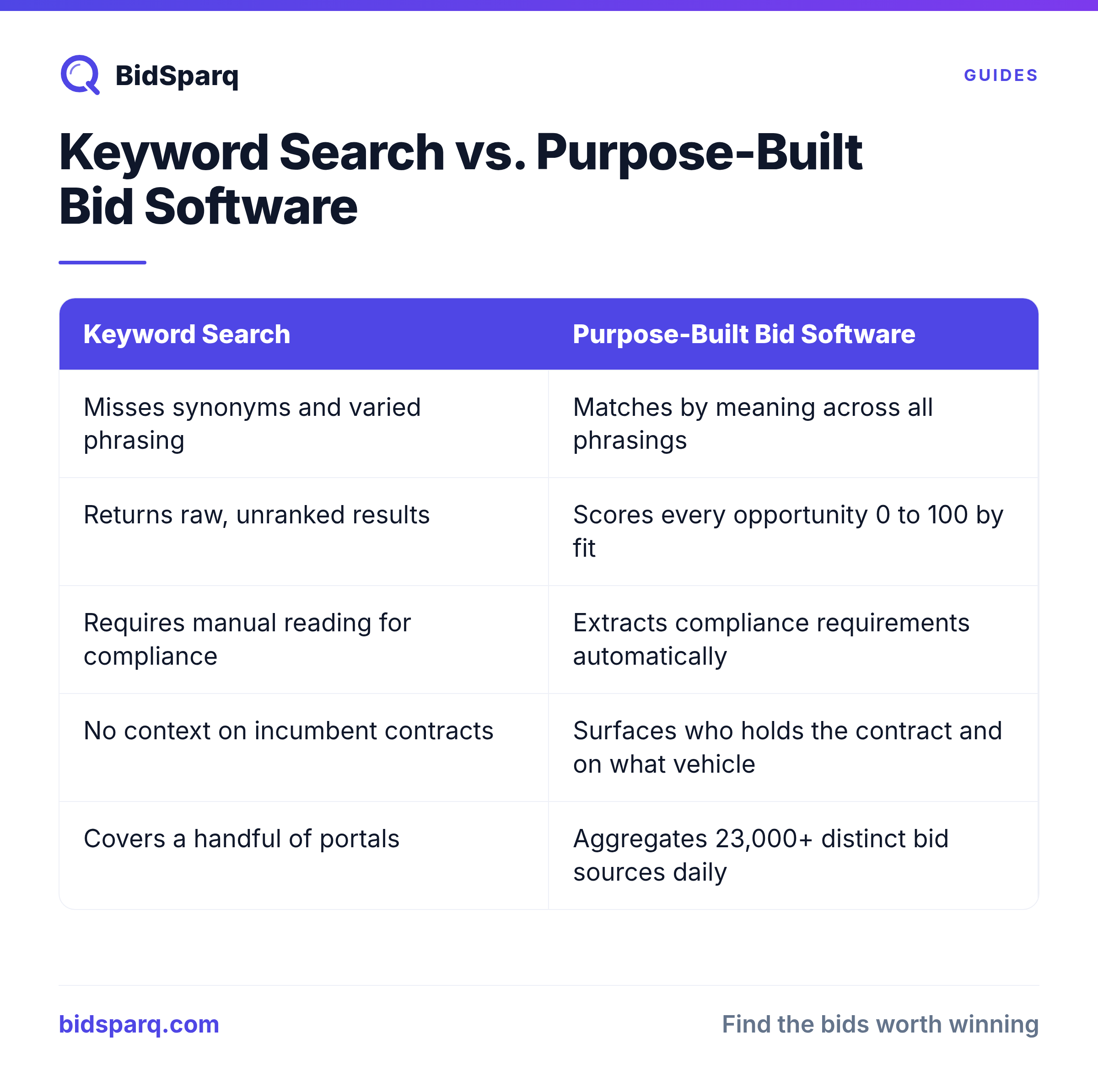
Keyword search is not the same as bid discovery. A hospital network posting an EHR implementation RFP may use the phrase electronic health records in one solicitation and clinical information system in another. A keyword search for one term misses the other. For a lean team without a dedicated business-development researcher, those missed opportunities are invisible losses. Multiply that pattern across construction, facilities management, professional services, and K-12 technology, and the gap between what keyword tools surface and what actually exists becomes significant. Semantic search, which matches by meaning rather than exact phrasing, is the mechanism that closes that gap without requiring a team of researchers.
The scale problem no small team can solve manually
The sheer volume of active solicitations makes manual monitoring a losing strategy for lean teams. As of August 2026, 62,374 solicitations are open across the 23,000+ sources BidSparq aggregates daily. No small team can review that volume each week and still do the actual work of winning contracts. Consider a narrower picture of urgency: 147 new solicitations mentioning "affordable" as a program or service requirement were posted in the last 30 days, and 54 of those close within the next 14 days. A team relying on manual search and ad hoc reminders will miss deadline after deadline, not from lack of effort but from lack of systematic coverage.
Start discovering matched bids with BidSparq's free tier, no credit card needed. See how many relevant opportunities are open right now across your markets.
What affordable bid software should actually do
Price alone does not define value in bid software. A free or low-cost tool that only returns keyword matches still costs your team hours of manual qualification work. What separates useful platforms from basic aggregators is a set of automated functions: semantic matching that surfaces relevant bids regardless of exact phrasing, a 0-to-100 fit score that ranks opportunities by how well they match your actual capabilities, automated extraction of compliance requirements and bonding thresholds so your team does not have to read every document to find the go/no-go criteria, and incumbent intelligence that tells you who currently holds a contract before you invest in a proposal. Together, these features replace research tasks that would otherwise consume a full workday, turning a small team into a capable bid operation without adding headcount.
How to evaluate a platform before you commit
Start with the free tier and treat it as a working audit of your market. Log in, set your capability profile, and see how many open bids match your work before spending anything. Look specifically at the fit scores: a platform that assigns a numeric score forces you to confront which opportunities are genuinely strong versus which you are pursuing out of habit or familiarity. Check whether the platform flags compliance requirements automatically, and whether it shows contract history for recurring buyers. If you find yourself manually adjusting searches to surface relevant results, the tool is not doing its job. A platform worth paying for should return fewer, better matches, not more noise.
FAQ
Is there free bid software for small businesses?
Yes. Several purpose-built bid discovery platforms, including BidSparq, offer a free tier that provides access to matched solicitations across education, healthcare, construction, and commercial markets with no credit card required. Free plans are a practical way to audit the opportunity volume in your sector before committing to a paid subscription.
How much does bid software cost for a small team?
Paid plans designed for lean teams typically run under $250 per month. BidSparq's Pro Max plan is $249 per month, or $199 per month when billed annually. That price range covers automated discovery, AI fit scoring, compliance extraction, and incumbent intelligence across all major procurement markets, replacing research hours that would otherwise cost far more in staff time.
Can bid software cover markets beyond government contracts?
Yes, and most small teams underestimate how much opportunity exists outside federal and state procurement. Purpose-built platforms aggregate solicitations from education institutions, hospital systems, construction authorities, IT buyers, and commercial organizations alongside government agencies. Limiting your search to government portals alone means leaving a significant portion of the market unmonitored.
Explore BidSparq's free bid discovery plan and filter your first matched opportunities in minutes. No contract, no commitment.
Find RFPs that match your business
BidSparq monitors 23,000+ procurement sources and uses AI to score every opportunity against your capabilities. Try it free for 14 days.
Start Free Trial →