AI Prompts for Government Contractors That Save Hours
A practical guide to AI prompts for government contractors and every bid team: the prompts that genuinely save hours, and the live-data work no prompt can do on its own.
Most bid teams are pasting solicitation text into a chatbot and hoping the answer holds up. It usually does not, because a generic prompt only knows what you feed it, and it has no idea which opportunities are even open this week.
That gap shows up in every market that runs on formal bids. A regional healthcare supplier chasing a hospital system contract, a construction firm tracking prevailing-wage projects, an IT integrator qualifying for a framework: all of them can use AI prompts to read faster and write sharper, and all of them hit the same wall the moment the prompt has no live pipeline behind it. Good prompts make you quicker at the document in front of you. They do nothing about the documents you never saw.
- Prompts are a starting point, not a data source. An LLM only knows what you paste into it.
- The best bid prompts impose structure: scope, eligibility, deadlines, and evaluation criteria, pulled out cleanly.
- Compliance extraction saves the most hours, but only when the input document is complete and current.
- Generic prompts cannot see live solicitations; a matching platform can, and can rank them.
- Fit scoring beats gut feel for deciding which bids actually deserve a full response.
Treat AI prompts as a reading assistant first
Point your first prompts at understanding, not at answers. A dense solicitation is where most hours quietly disappear, so aim the model at comprehension: have it compress the scope, surface every eligibility condition, and separate hard deadlines from soft ones. A prompt like "Summarize this solicitation in 200 words covering scope, eligibility, submission format, and every hard deadline, and flag anything ambiguous" turns forty pages into something a whole team can align on in minutes. You are not asking the model to decide anything yet. You are asking it to read carefully so you do not have to read blindly.
The AI prompts government contractors actually need
Keep your prompt library boring and repeatable. The prompts that move a bid forward are unglamorous on purpose, because their value is consistency, not cleverness. Four earn their place on almost every opportunity:
- "List every mandatory requirement in this RFP as a compliance checklist, with the exact section reference for each item."
- "Draft three clarifying questions worth submitting before the Q and A deadline, based on gaps or contradictions in this document."
- "Rewrite this past-performance paragraph to map directly to the evaluation criteria in the scoring section."
- "Compare our capability statement against this scope and list what we can clearly meet, partially meet, and cannot meet."
Notice what they have in common. Each one forces the model to work from the actual text and produce something traceable, which keeps you honest and keeps the output usable.
Know exactly where these prompts stop working
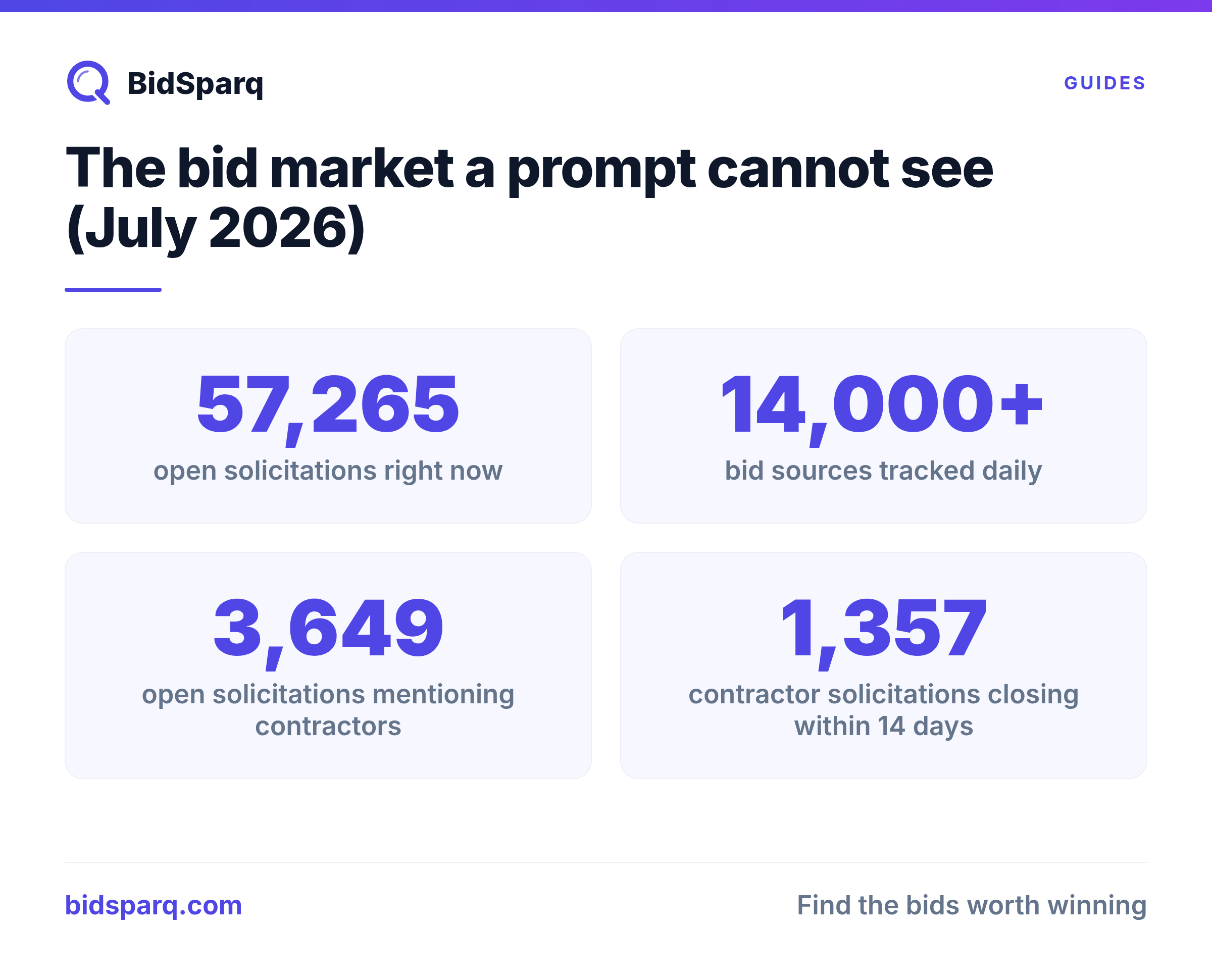
Assume the model sounds confident even when it is wrong. An LLM will happily invent a submission portal, a requirement code, or a deadline if the document is unclear, and it will do so in fluent, official-sounding prose. It also has no memory of the market: it cannot tell you what is open, what closes soon, or who holds the incumbent contract, because none of that lives in the prompt. As of July 2026 there are 57,265 open solicitations across the 23,000+ sources we track, and 3,649 of them mention contractors. A chatbot sees none of that. It sees only the one document you happened to paste, which means the hardest question, "what should we even be bidding on," is the one prompts cannot touch.
Give your prompts something real to work on
Feed your prompts from a system that already tracks live bids. This is the difference between an assistant that reads and a workflow that decides. Instead of keyword alerts that miss a relevant opportunity because it used different terminology, semantic matching finds bids by meaning, so a solicitation for "pupil transportation" still surfaces when you sell school bus services. Instead of eyeballing a list and guessing, BidSparq scores each match from 0 to 100 so your team spends its writing hours on the bids most likely to convert. And instead of hand-copying an RFP into a prompt and hoping it caught everything, automatic compliance extraction pulls the mandatory requirements for you, then your prompts refine and draft against a clean, complete checklist. The manual, keyword-driven version of this is slower and leakier at every step. Layer that live data underneath your prompt library, add incumbent and contract-vehicle intel, and the model finally has real ground to stand on.
A prompt workflow you can reuse on every bid
Run the same four passes on every solicitation you touch. First, summarize for comprehension. Second, extract the full compliance checklist with section references. Third, draft the clarifying questions before the question window closes. Fourth, map your strengths and past performance onto the evaluation criteria. The same discipline scales across education, healthcare, construction, commercial, and government work, because the structure of a competitive bid is the same everywhere. The only variable is whether the opportunity in your prompt was worth your time in the first place, and that decision belongs upstream, before a single prompt runs.
FAQ
What are the best AI prompts for government contractors?
The most useful prompts extract structure rather than opinions: summarize the scope and deadlines, list every mandatory requirement with its section reference, draft clarifying questions, and map your past performance to the evaluation criteria. Keep them consistent so you run the same reliable passes on every solicitation, in government or any other market.
Can ChatGPT find government contract opportunities?
Not on its own. A general chatbot can only analyze text you paste into it; it has no live feed of what is open, closing, or newly posted. To actually find opportunities you need a platform that aggregates bid sources and matches by meaning, then hand the specific document to your prompts for reading and drafting.
How do I use AI to write a bid proposal?
Use AI to accelerate, not to author blindly. Have it build a compliance checklist from the solicitation, then draft sections that map directly to the scoring criteria, and always verify requirements and deadlines against the source document. AI is strong at structure and first drafts and weak at facts it was never given, so keep a human on accuracy.
Stop guessing which opportunities are worth a prompt at all. See your live bid matches free, no credit card needed.
Find RFPs that match your business
BidSparq monitors 23,000+ procurement sources and uses AI to score every opportunity against your capabilities. Try it free for 14 days.
Start Free Trial →