2026 GSA Mileage Rate: What Bidders Get Wrong on Travel
The 2026 GSA mileage rate caps reimbursable travel in far more bids than federal ones. Here is where to confirm it and how to price mileage into a proposal.
Travel is one of the easiest lines in a bid to price wrong. Most teams reuse last year's mileage number, assume the buyer will reimburse it, and never read the travel clause that says otherwise. The 2026 GSA mileage rate matters well beyond federal work, because buyers across education, healthcare, construction, and commercial services borrow it as their own reimbursement cap.
The rate itself takes a minute to look up. The harder part is knowing how each solicitation uses it.
- Never price mileage from memory. The rate changes, and last year's number can be quietly wrong in this year's bid.
- A ceiling is not a guarantee: many buyers cap mileage at the GSA rate, and some pay less or nothing at all.
- Outside federal work, school districts, health systems, universities, and private owners often adopt the GSA rate by reference.
- Multi-year contracts outlive a single rate. How the contract handles future rate changes belongs in your pricing assumptions.
- Read the travel clause before the price sheet, because whether mileage is reimbursed separately or folded into your rates changes the whole number.
The short answer
The 2026 GSA mileage rate is the per-mile amount the U.S. General Services Administration sets for travel in a privately owned vehicle during calendar year 2026, and the current figure is published on GSA.gov's privately owned vehicle (POV) mileage reimbursement rates page. GSA normally makes a new rate effective on January 1 and publishes separate rates for automobiles, motorcycles, and airplanes, along with a lower automobile rate for travelers who had a government vehicle available. The automobile rate has historically matched the IRS business standard mileage rate, so IRS.gov is a useful cross-check. For bidders, the rate usually works as the maximum a buyer will reimburse per mile, which means you should confirm both the figure and the solicitation's own travel terms before you price.
Where the GSA rate shows up outside federal contracts
Assume the GSA rate may apply even when the buyer is not a federal agency. A health system's RFP for courier or home health services may state that mileage is reimbursed at the current GSA rate. A large school district's solicitation for itinerant therapists or consultants may say the same thing. Construction owners often limit reimbursable travel on inspection and commissioning work to the GSA rate, and commercial master service agreements frequently do too.
The reason is practical. The GSA rate is public, updated on a known schedule, and easy to audit. A buyer that points to it does not have to maintain a rate of its own.
Not every buyer does this. Some states and local governments publish their own travel rates, usually through a comptroller or finance office, and a solicitation can set any figure it wants. The solicitation's travel clause decides what you are paid, and it overrides any assumption you bring from another contract.
How to price mileage into a bid
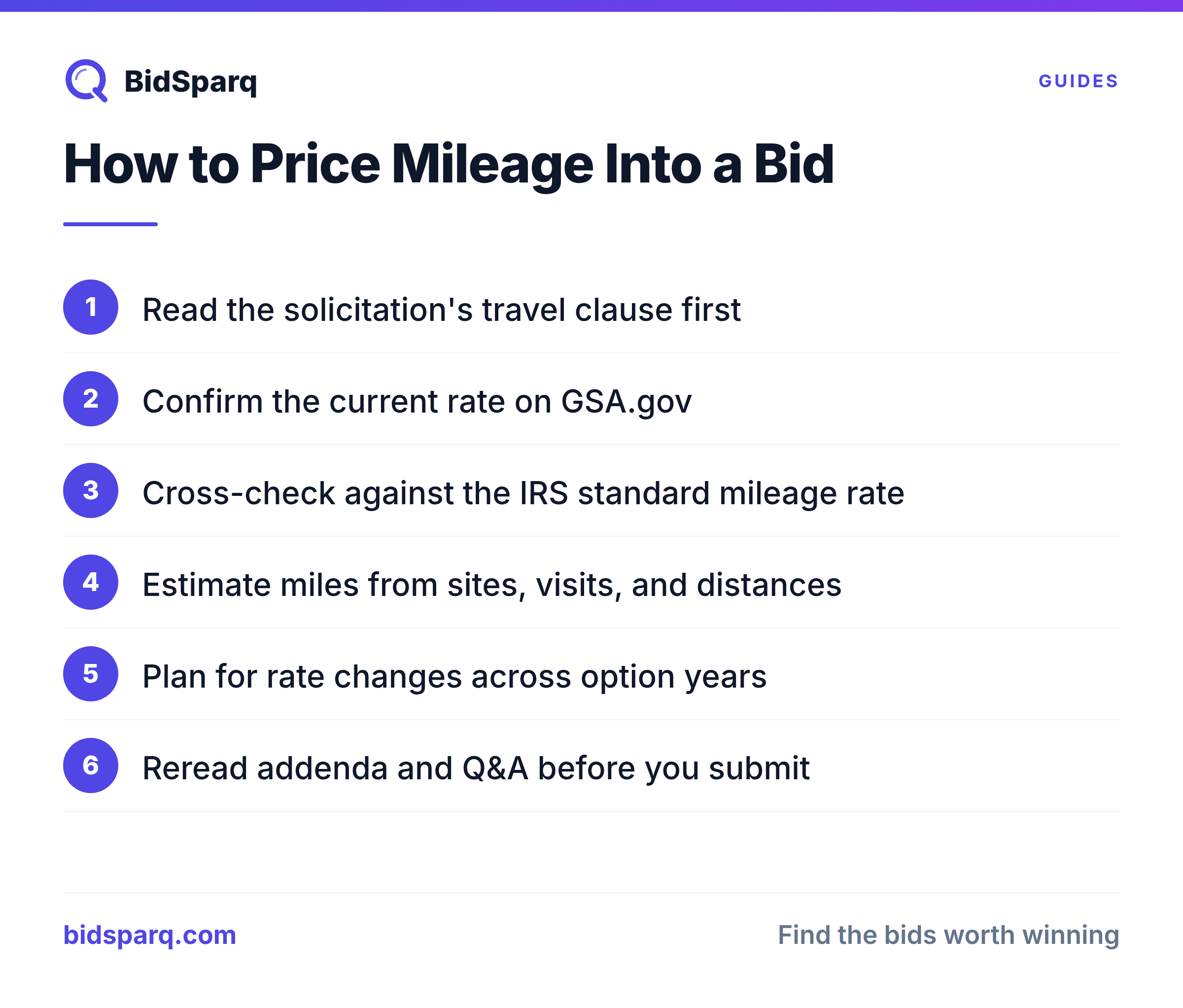
Start with the travel clause, then the rate, then the miles. The clause tells you which of three situations you are in. Mileage may be reimbursed separately at a stated rate. It may be capped at the GSA rate in effect when the travel occurs. Or it may not be reimbursed at all, in which case every mile has to live inside your unit prices or hourly rates.
Once you know which applies, work through the details that change the math:
- Confirm the current rate on GSA.gov on the day you price, and cross-check it against the IRS standard mileage rate.
- Estimate miles from the scope of work. Count sites, visit frequency, and the distance between locations instead of guessing a round figure.
- Check what counts as reimbursable. Many buyers exclude commuting miles or travel inside a defined local area.
- Plan for rate changes across option years, since a contract that runs several years will span several published rates.
- Reread addenda before submission. Travel terms are a common subject of vendor questions, and answers can change them.
If the solicitation is silent on travel, ask during the question period. An unanswered travel question becomes your cost after award.
Why checking travel terms by hand does not scale
Count how many solicitations you would have to open to find the ones where mileage actually matters. As of November 2026, 53,648 solicitations are open across the 33,000+ sources we track, and 45 of them mention "mileage" directly. Of those, 16 close within the next 14 days, and 56 new mileage solicitations were posted in the last 30 days. The set turns over fast.
A keyword alert will not solve this. Searching "mileage" misses the solicitation that says "travel reimbursed per federal travel rates" or "vehicle expenses at the POV rate," and it returns documents where the word appears once in an unrelated form. Even a good hit still leaves you scrolling through a long PDF to find one paragraph of travel terms. Repeat that across school districts, hospitals, construction owners, and agencies, and a pricing detail turns into hours of reading every week.
See which open solicitations fit your business free for 14 days, no credit card needed.
Let the solicitation tell you its travel terms
Automate the reading so your team's time goes to pricing. Travel clauses are a requirement extraction problem, and software handles that better than a manual skim. BidSparq uses semantic matching, so a search for travel-heavy work finds solicitations by meaning even when the document never uses the word "mileage." Automatic compliance and requirement extraction then pulls terms such as reimbursement caps, travel limits, and reporting rules out of the document, so they are in front of you before you build a price.
Two more signals help you decide whether the pursuit is worth it. AI fit scoring rates each opportunity from 0 to 100 against your business, which keeps a field-service bid with unreimbursed travel across a wide territory from looking as attractive as one near your base. Incumbent and contract vehicle intelligence shows who holds the work today, and that context tells you how aggressively the travel line is likely to be priced.
Manual and keyword tools give you a list of documents to read. An automated workflow gives you the terms already extracted and a score to rank them by.
Mileage is a small line item, and that is why it gets less attention than it should. Confirm the rate at the source, read the clause, and make the travel line a decision you chose.
Start a 14-day free trial of RFP discovery and requirement extraction and review your first matches with the travel terms already pulled out.
FAQ
What is the 2026 GSA mileage rate?
It is the per-mile reimbursement amount GSA sets for privately owned vehicle travel in calendar year 2026. The current figure is posted on GSA.gov's POV mileage reimbursement rates page, with separate rates for automobiles, motorcycles, and airplanes. Check the page directly before pricing, because GSA can revise rates.
Is the GSA mileage rate the same as the IRS mileage rate?
For automobiles, the GSA rate has historically matched the IRS business standard mileage rate, and both are typically announced around the start of the calendar year. They serve different purposes. The IRS rate governs tax deductions, and the GSA rate governs federal travel reimbursement. Confirm each one at its own source, GSA.gov and IRS.gov.
Do contractors have to use the GSA mileage rate in a bid?
Only when the solicitation or contract says so. Many federal, state, education, healthcare, and commercial buyers cap reimbursable mileage at the GSA rate. Others set their own rate or do not reimburse mileage at all. The travel clause in the solicitation controls, so read it first and ask a question during the Q&A period if it is unclear.
Find RFPs that match your business
BidSparq monitors 33,000+ procurement sources and uses AI to score every opportunity against your capabilities. Try it free for 14 days.
Start Free Trial →