Is Per Diem Taxable? The Rules Contractors Get Wrong
Is per diem taxable? Learn when per diem stays tax-free, when it becomes wages, how it differs for contractors, and how to price it into a bid correctly.
Most bidders price per diem as if it were a pass-through expense, then find out at year end that part of it was wages all along. The confusion is understandable. The same two words describe a nurse's shift arrangement, a construction crew's travel allowance, a consultant's hotel reimbursement, and a line in a proposal's cost volume. The tax treatment is different in each case, and the solicitation that asked for the number rarely explains which one it means. This post is general information, not tax advice; the rules below are the standard federal rules, and your own tax professional should confirm how they apply to your business.
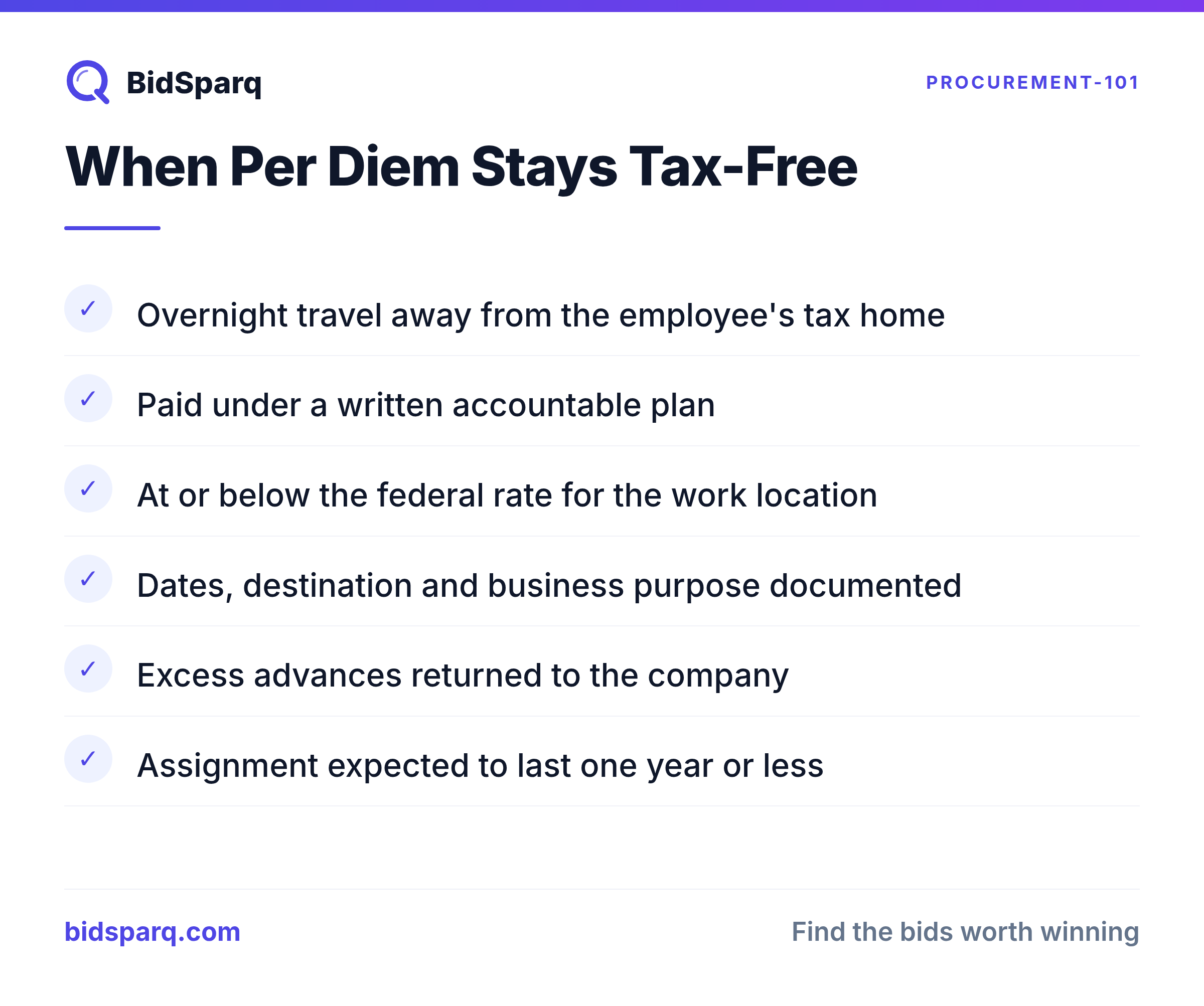
- Per diem is tax-free only under an accountable plan: overnight business travel away from the tax home, documented, paid at or below the federal rate, with any excess advance returned.
- Anything above the federal rate is ordinary wages, subject to withholding, and reported on the employee's W-2.
- Independent contractors cannot receive tax-free per diem. A client's per diem payment is gross income, and only the meals portion can be deducted at a flat rate.
- An assignment expected to last more than a year turns the work site into the tax home, and per diem paid from that point is taxable.
- Solicitations describe per diem in a dozen different phrases, so travel terms get missed during pricing far more often than they get misread.
The short answer
Per diem is not taxable when it is paid to an employee under an accountable plan for overnight business travel away from their tax home, at or below the federal per diem rate for the location, with the dates, place and business purpose documented. Payments that fail any one of those tests become ordinary wages: the portion above the federal rate, per diem paid for a day trip with no overnight stay, or an allowance paid with no documentation requirement at all. Self-employed people and independent contractors are in a different position entirely, because money a client labels "per diem" is simply part of their gross receipts, and they recover it by deducting actual lodging plus a standard meal allowance on their own return. The label on the invoice never decides the tax treatment; the plan rules and the paperwork do.
Accountable plan or taxable wages: the test that decides it
Check your reimbursement policy against the accountable-plan requirements before you quote a single per diem line. An accountable plan needs a business connection, substantiation within a reasonable time, and the return of any amount paid above what was substantiated. The per diem method exists to make the substantiation easier: the published rate stands in for receipts on the amount, so the traveler only has to prove when they traveled, where they went, and why. Skip that documentation and the plan becomes nonaccountable, which makes every dollar taxable wages even if the rate itself was modest.
The federal rate is the ceiling. The U.S. General Services Administration (GSA) publishes lodging and meals-and-incidentals rates for every locality in the continental United States, the Department of Defense publishes rates for Alaska, Hawaii and U.S. territories, and the Department of State publishes foreign rates. The IRS also permits a simplified high-low method that uses one rate for designated high-cost areas and another for everywhere else. A company can pay more than the published rate, but the excess is wages, and payroll has to split the payment into a tax-free portion and a taxable portion.
Two more traps catch small firms. Owners with more than a small stake in the business that pays them cannot use the per diem method for lodging; they may use the meals-and-incidentals rate and must document actual hotel costs. And per diem only applies to travel that requires sleep or rest away from the tax home, so a long day of driving to a job site and back is not per diem travel no matter how far it is.
Contractors, consultants and per diem income
Treat every per diem payment a client sends you as revenue first, then take the deduction on your own return. When a hospital system, a general contractor or a software integrator pays an independent contractor a daily allowance, there is no employer-employee relationship and therefore no accountable plan. The payment is income, it typically appears on the contractor's 1099, and the contractor deducts travel costs against it: actual lodging with receipts, plus the federal meals-and-incidentals rate, with meals subject to the standard partial deduction limit.
The tax home rule matters most for people who travel for a living. A per diem nurse who picks up shifts at one local facility is simply an hourly employee, and "per diem" describes the scheduling, not a tax-free stipend. A travel clinician on a thirteen-week contract far from home can receive tax-free lodging and meal stipends only if they maintain a real tax home elsewhere and are duplicating living expenses. Once an assignment is expected to run more than a year, or once there is no home base to return to, the work location becomes the tax home and the stipends become wages. Staffing bidders who promise "tax-free per diem" in a proposal without those conditions are promising something the tax code does not deliver.
Where per diem hides inside bids and RFPs
Read the travel and reimbursement clause of every solicitation before you build your rate sheet, because it decides whether per diem is billable, capped or absorbed. A regional hospital's nurse staffing bid will ask for a per diem shift rate and may separately cap travel stipends at the federal rate. A commercial construction owner building across several states will specify travel and subsistence for out-of-town crews, sometimes alongside prevailing-wage rules that treat the allowance as part of the wage package. An enterprise software implementation will reimburse on-site consultant travel "at actual cost not to exceed GSA rates," which quietly makes the federal table your pricing ceiling. A school district buying teacher training will often state that trainer travel is included in the fixed fee, which means per diem is your cost to absorb, not a line to bill. Government agencies are one more buyer in that mix, usually pointing to the federal travel cost principles rather than inventing their own.
The volume is larger than most pricing teams assume. As of October 2026, 67 of the 54,813 open solicitations across the 23,000+ sources BidSparq tracks mention "diem" directly, 62 new ones were posted in the last 30 days, and 21 close within the next 14 days. Those are only the documents that use the word. Many more bury the same obligation under "travel and subsistence," "lodging allowance," "reimbursable expenses" or "M&IE," which a keyword alert never catches. Semantic matching finds the clause by its meaning regardless of the phrasing, and automated compliance extraction pulls the travel terms, rate caps and documentation requirements into one view, so the pricing team sees them before the deadline instead of after award. A 0 to 100 fit score built on those extracted requirements also tells a lean firm whether a travel-heavy pursuit is worth the trip at all.
See which open bids carry travel and per diem terms free, no credit card needed.
How to price per diem into a bid without a tax surprise
Build the per diem line from the published federal rate for the work location, then decide in writing whether your company pays it under an accountable plan. Start at the GSA per diem lookup on gsa.gov for the city or county where the work will happen, and use the Department of State foreign rates if the contract sends staff abroad. Read IRS Publication 463 for the travel rules and the current IRS notice on special per diem rates for the high-low figures. Then compare what the solicitation allows: some buyers reimburse actual cost up to the federal rate, some pay a flat allowance, and some include travel in the fixed price.
From there the work is internal. Write the accountable plan down, require an expense report with dates and locations even when no receipts are needed, and decide in advance how to handle an assignment that stretches past a year. If the solicitation is a re-compete, the incumbent's prior contract and modifications are often public, and incumbent and contract-vehicle intelligence shows how travel was priced and reimbursed last time, which is a far better anchor than guessing from the statement of work. Firms that do this once and template it stop losing margin to per diem. Firms that treat it as a payroll afterthought keep paying the correction.
FAQ
Is per diem taxable if it exceeds the GSA rate?
Yes, the portion above the federal rate is taxable. An employer can pay a higher daily allowance, but only the amount up to the published GSA, Department of Defense or Department of State rate for that location stays tax-free under an accountable plan. The excess is treated as wages, run through payroll withholding, and reported on the employee's W-2.
Is per diem taxable for 1099 contractors?
Yes. An independent contractor has no accountable plan with the client, so any per diem the client pays is part of the contractor's gross income and typically appears on the 1099. The contractor then deducts travel costs on their own return: actual lodging with receipts plus the federal meals-and-incidentals rate, with the standard partial limit on meals.
Do I have to keep receipts for per diem?
Not for the per diem amount itself, which is the point of the method. You still have to document the dates of travel, the destination and the business purpose, and the trip must involve an overnight stay away from your tax home. Owners with more than a small stake in the business and all self-employed people must keep actual lodging receipts, because the per diem method only covers their meals and incidentals.
Start finding bids with travel clauses already extracted on the free tier.
Find RFPs that match your business
BidSparq monitors 23,000+ procurement sources and uses AI to score every opportunity against your capabilities. Try it free for 14 days.
Start Free Trial →