What Are Popular Tools for Government Bid Writing?
A practical guide to the most-used discovery, writing, and compliance tools for government bids, covering GovWin IQ, BidNet, DemandStar, BidSync, Responsive, and how to layer them into a winning stack.
A contract your team never bids is a contract your competitor wins by default. The more dangerous version is a proposal that was written, submitted, and disqualified before scoring began because a single mandatory 'shall' statement in Section L was never addressed. The tools your pursuit team uses for opportunity discovery, proposal writing, and compliance verification determine which version of that outcome you face before a word of narrative is drafted.
- Bid discovery comes before bid writing: the best writing tools are worthless on the wrong opportunity.
- No single platform does it all: winning teams layer discovery, writing, and compliance tools.
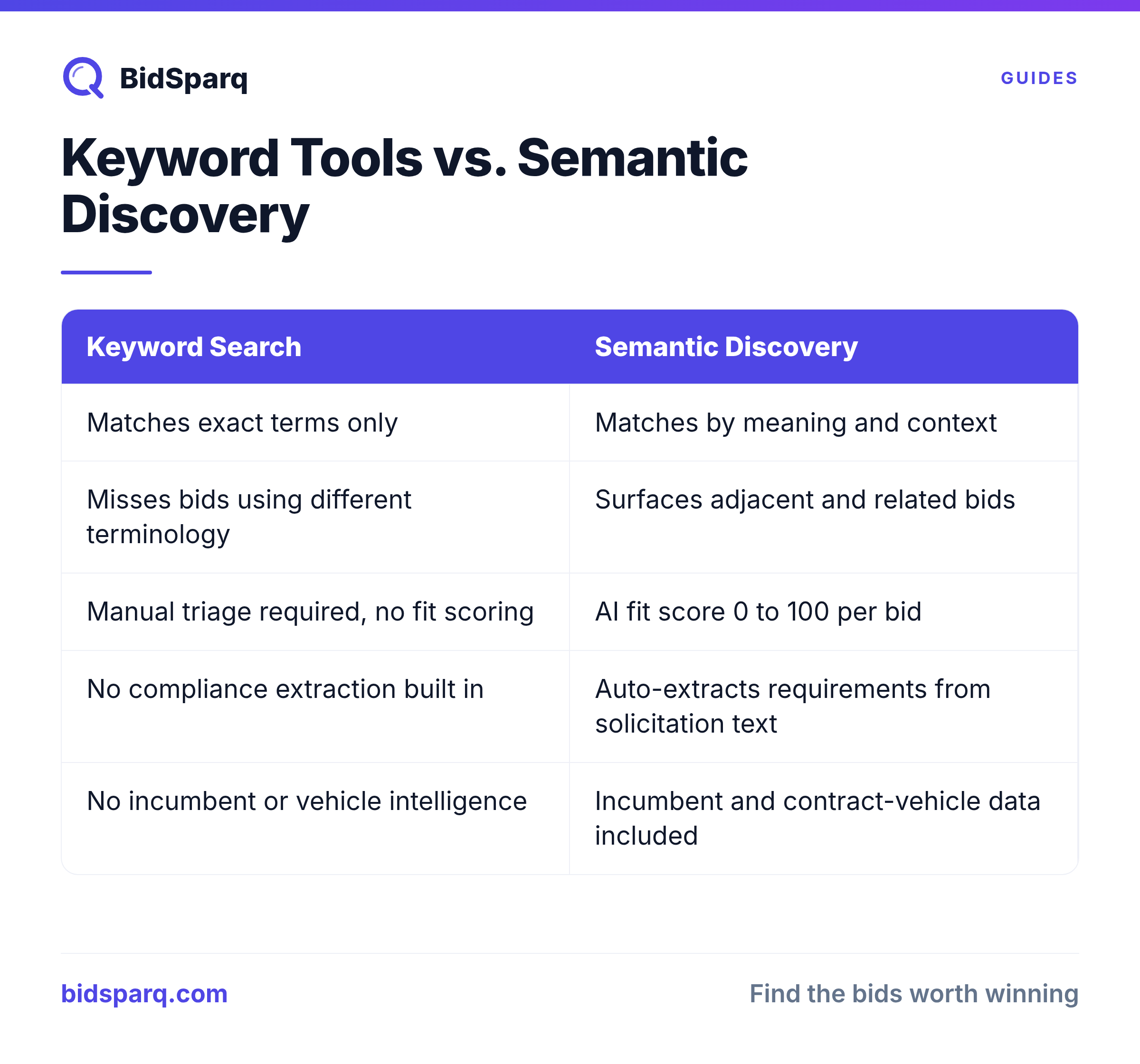
- Semantic matching surfaces relevant solicitations that keyword searches miss, including bids in adjacent categories.
- Thrown out on a technicality: a missed compliance requirement kills a well-written proposal before scoring begins.
- Incumbent intelligence shapes pricing decisions before a word of the narrative is drafted.
- Volume alone does not win contracts: as of September 2026, 670 writing-related solicitations close within 14 days, making triage the real competitive edge.
The short answer
Government bid writing tools fall into three layers: discovery, writing, and compliance. The discovery layer finds and scores relevant solicitations across federal, state, and local portals. The writing layer structures, drafts, and assembles the proposal narrative. The compliance layer verifies that every stated requirement is addressed before submission. Most experienced contractors use tools from all three layers, and the teams that win most consistently are the ones that automate the first and third layers so that skilled writers can focus on differentiation.
Discovery Platforms: Finding the Right Bids
You cannot write a winning bid for an opportunity you never found, and the platforms available for discovery vary widely in coverage, depth, and cost. Understanding what each one covers is the first decision a pursuit team makes.
SAM.gov is the mandatory starting point for federal bids above the simplified acquisition threshold. Every federal agency is required to post solicitations there, making it a non-negotiable free resource for any contractor pursuing federal prime contracts. For the bids that live below or beyond that threshold, the market fragments quickly.
The major named platforms each serve a distinct segment:
- GovWin IQ (Deltek) is the incumbent standard for federal business development. It tracks pre-solicitation intelligence, agency spend patterns, and contractor pipeline data, and is widely used by mid-to-large federal contractors who need early awareness of opportunities before they post on SAM.gov.
- BidNet Direct aggregates state and local government solicitations and has established direct relationships with hundreds of municipalities, making it a practical option for contractors focused on the SLED (state, local, and education) market.
- DemandStar operates as an eProcurement network where many local governments post bids directly, giving it strong coverage in certain regional markets and smaller agency tiers.
- BidSync aggregates government bids across federal, state, and local levels and is commonly used by contractors who want consolidated multi-level coverage without building a separate multi-source monitoring workflow.
The practical challenge across all of these platforms is volume and fragmentation. As of September 2026, BidSparq tracks 57,517 open solicitations across more than 23,000 distinct sources. Of those, 1,849 new writing-related solicitations were posted in the last 30 days alone. Keyword-based alerts, which most of the platforms above rely on, miss solicitations that use different terminology for the same scope of work and return false positives that consume review time with no return.
Semantic matching changes this calculus. Instead of matching a search term, a semantic discovery platform reads the meaning of a solicitation and compares it to your capability profile, surfacing relevant bids that a keyword search would never flag. Paired with an AI fit score from 0 to 100, your team can triage a day's worth of new solicitations in minutes rather than hours. The same approach applies if your practice spans healthcare, education, construction, or commercial sectors: semantic matching surfaces relevant bids across all buyer types from a single interface, so your pursuit decision stays consistent regardless of who the buyer is.
Explore the full open-bid landscape and see your scored matches free, no credit card needed: BidSparq RFP Software.
Writing and Proposal Management Tools
The writing layer is where most teams already have tooling, and the right choice depends on how many proposals you submit each month. For smaller contractors or occasional bidders, Microsoft Word or Google Docs with shared folder access is a complete writing stack. Both are universally accepted for final submission formats and require no learning curve.
Contractors that respond to multiple RFPs per month typically use dedicated proposal management platforms. Responsive (formerly RFPIO) and Loopio are two of the most widely adopted: both provide a content library where approved answers to recurring questions are stored and retrieved, reducing the time spent rewriting standard past-performance narratives or corporate capability statements from scratch. Both support multi-author workflows with version tracking, which matters when a proposal requires simultaneous contributions from technical, pricing, and management writers.
For format and assembly, government agencies often require proposals in specific PDF formats with precise section ordering and bookmarking. Adobe Acrobat Pro is the standard tool for final document assembly and compliance with file-size submission limits. Plain-language and grammar tools are used as a final polish pass before submission, though none are specific to government procurement.
The Shipley Associates methodology is not a software platform but a widely recognized framework for structuring the narrative and discriminating content of a proposal. Many large government contractors require Shipley certification for their proposal managers, and the framework is applied at all government levels.
Compliance Extraction and Incumbent Intelligence
Every government solicitation contains mandatory compliance requirements, and missing even one can disqualify a proposal regardless of its technical quality. Section L (instructions to offerors) and Section M (evaluation criteria) in a federal RFP define the compliance envelope, and their requirements must be mapped to every proposal section before writing begins. State and local solicitations use different formatting conventions but impose the same obligation.
Manual compliance checklists are the traditional approach: a proposal coordinator reads the entire solicitation and builds a matrix of every "shall," "must," and "will" statement, then tracks coverage through each draft. This process is time-consuming and error-prone on solicitations that run to hundreds of pages.
Automated compliance extraction closes that gap. Responsive (formerly RFPIO) includes a requirements extraction feature that reads solicitation text and generates a structured checklist of mandatory and conditional items, flagging each for coverage as the draft is built. Extractions that previously required hours of careful manual reading now take minutes, and the checklist travels with the document through review cycles so nothing gets buried in a comment thread.
Incumbent intelligence adds another dimension before writing begins. Knowing which contractor holds the existing contract, which vehicle was used, and what the period of performance covered informs every positioning and pricing decision. BidSparq surfaces award history and contract vehicle data automatically, drawing from public records including USASpending.gov, so your team sees existing federal awards, GWAC and BPA incumbents, and NAICS-level spend patterns without building manual lookup workflows. Contract vehicle data is particularly important for federal work, where access to the right vehicle is a threshold requirement before any writing is relevant.
Building a Practical Stack
The most effective government bid writing stacks combine a discovery platform, a proposal management tool, and a compliance tracker, with each layer feeding the next. Discovery surfaces the right opportunities with fit scores so the team commits writing time to realistic pursuits. The proposal management platform manages the writing workflow and reuses approved content. The compliance tracker ensures the final document addresses every stated requirement before the proposal manager does a last read.
Teams that skip the discovery layer or treat it as a manual task spend significant time writing proposals for bids they were unlikely to win. As of September 2026, 670 writing-related solicitations close within the next 14 days across more than 23,000 monitored sources. The contractors most likely to win are the ones who identified the right subset for their capabilities early enough to allocate serious writing time, not just any writing time.
FAQ
What is the best tool for finding government bids to write proposals for?
SAM.gov is the required source for federal bids above the simplified acquisition threshold and is the mandatory starting point for any federal contractor. For state and local bids, platforms like BidNet Direct and DemandStar aggregate from hundreds of local portals. For contractors pursuing bids across multiple jurisdictions and sectors, aggregation platforms that apply semantic matching with AI fit scoring reduce the manual monitoring burden significantly, surfacing relevant opportunities that keyword-based alerts miss.
Do government bid writing tools work for both federal and local bids?
Most proposal management and compliance tools work at any government level because the underlying structure of a well-written proposal is consistent: technical approach, past performance, management approach, and price. Discovery tools vary more, since federal bids are centralized on SAM.gov while state and local bids are distributed across hundreds of separate portals. Platforms that aggregate across all government levels, including GovWin IQ for federal intelligence and BidNet Direct or DemandStar for SLED coverage, give the broadest reach from a single or combined interface.
Can AI tools help write government proposals?
AI tools can accelerate several proposal tasks: drafting boilerplate sections, retrieving and adapting past-performance narratives from a content library, and extracting compliance requirements from long solicitations. The sections that still require experienced human judgment are the technical approach and the discriminators that explain why your team is the best choice for this specific scope. AI drafts for those sections tend to be generic and require substantial editing to be competitive.
Start building your pursuit list from live, scored opportunities: search open government bids free on BidSparq, no commitment required.
Find RFPs that match your business
BidSparq monitors 23,000+ procurement sources and uses AI to score every opportunity against your capabilities. Try it free for 14 days.
Start Free Trial →