Pre-RFP Intelligence for Government Contractors: Win Early
Pre-RFP intelligence for government contractors means tracking expiring contracts, incumbents, and early procurement signals before a formal solicitation is released. Learn how to build a systematic pursuit process that puts your team ahead of the competition.
Most government contractors lose bids before the RFP is ever published. The formal solicitation is not the starting line for competition. It is closer to the finish line for the team that has been watching, positioning, and shaping requirements for months.
Pre-RFP intelligence is what separates contractors who react from contractors who compete. This guide explains what it is, how to act on it systematically, and why manual keyword searches across agency forecast pages cannot scale to a real pipeline.
- Waiting for the solicitation is a reactive posture that surrenders the field to incumbents who have been building relationships with the program office for months.
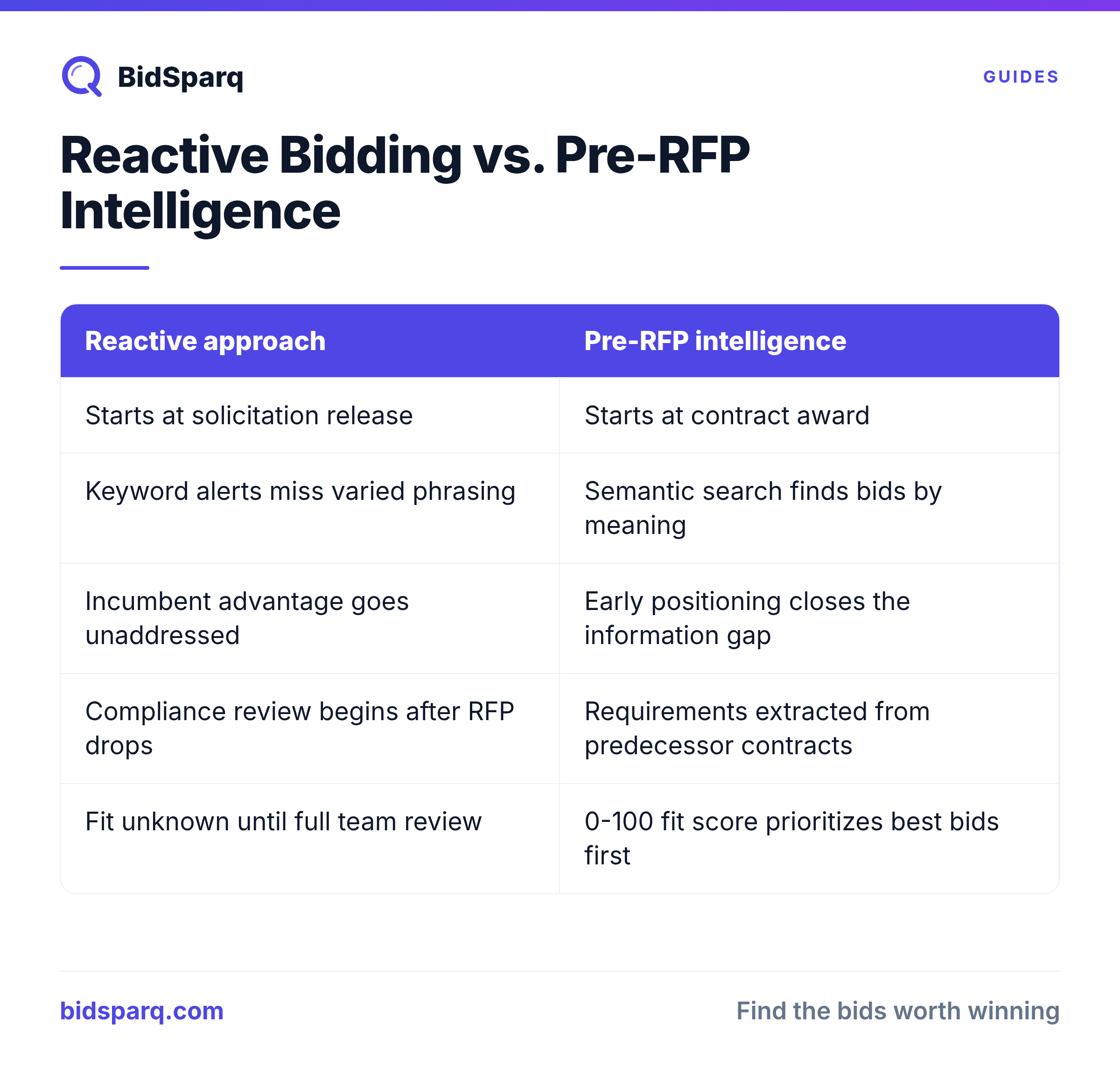
- Pre-RFP intelligence means monitoring expiring contracts, agency forecasts, and incumbent patterns before any formal solicitation is released.
- Semantic matching finds opportunities keyword tools miss because agencies describe the same requirement in dozens of different ways across thousands of sources.
- Compliance requirements emerge in predecessor contracts and draft RFPs before the final solicitation, giving prepared contractors a meaningful head start.
- A 0-to-100 fit score makes pursuit decisions faster by surfacing the bids most aligned to your capabilities before your team commits to a full review.
- Acting early is not just about winning one contract but about building a pipeline that is predictable rather than reactive.
The short answer
Pre-RFP intelligence for government contractors is the practice of identifying and tracking potential opportunities before an official solicitation is released, using contract expiration data, agency forecasts, incumbent information, and procurement history to inform pursuit decisions early. Teams that adopt this approach enter the formal competition window with a clearer sense of requirements, a mapped incumbent, and an already-drafted teaming strategy. The window between contract award and recompete can span years. Contractors who treat that entire window as competition time win at higher rates than those who begin at solicitation release.
What pre-RFP intelligence actually looks like in practice
Start with expiring contracts, not open solicitations. A contract awarded today in construction management, IT services, or healthcare staffing will recompete. The question is whether your team is watching that award from day one, or scrambling to respond when the solicitation hits. As of August 2026, there are 66,442 open solicitations across the 23,000+ sources we track, but the more actionable layer is the awards and contract vehicles that represent tomorrow's recompetes. Monitoring those awards as they happen is the foundation of a pre-RFP posture.
In markets like professional services, IT modernization, and facilities management, the same opportunity can appear under multiple labels: a statement of work, an industry day notice, a sources sought, or a request for information. Each of those is a signal, not just a formality. A sources sought notice is an agency actively scoping requirements and looking for market feedback. Responding to it puts your organization in front of the contracting officer before the competition officially begins.
Why incumbents hold a durable advantage, and how to close the gap
Incumbents win recompetes at disproportionate rates because they start preparing long before the RFP drops, not weeks before it. They know the program office, they have shaped the performance metrics written into the original contract, and they carry institutional knowledge that no amount of proposal writing can replicate. The only way to compete with that is to begin your own intelligence effort at the same time the incumbent does: at contract award.
The competitive gap is not effort. It is information lag. Contractors who rely on a single agency portal or a generic keyword alert across a few sources will always be behind. The intelligence that matters, including contract vehicle usage, task order history, subcontracting relationships, and program office priorities, is spread across hundreds of distinct sources. Aggregating and interpreting that data manually is not a workflow. It is a full-time job for a team.
For contractors operating in or adjacent to the intelligence community, the volume of active opportunities in that sector illustrates the stakes. As of August 2026, there are 362 open solicitations mentioning "intelligence" across the sources we track, with 448 new ones posted in the last 30 days. Virginia leads with 35 active postings and Maryland follows with 31, reflecting the geographic concentration of that market. In a landscape that active, a contractor relying on manual monitoring will miss opportunities that a systematic process would catch in real time.
How automated tools change the pursuit calculus
Automated pre-RFP intelligence replaces fragmented manual searches with a single, continuously updated signal layer. Instead of a coordinator checking multiple agency portals and forecast spreadsheets, the platform watches 23,000+ sources simultaneously, identifies relevant opportunities by meaning rather than keyword, and surfaces the ones most aligned to a contractor's capabilities with a 0-to-100 fit score. That score is not a filter for convenience. It is a resource allocation tool. Teams that can rank opportunities by genuine fit make faster go or no-go decisions and spend their business development hours on pursuits they can actually win.
Compliance extraction works the same way. Contract requirements, certifications, clearance levels, and set-aside designations are pulled automatically from solicitations and similar predecessor contracts, giving pursuit teams an early view of what the final RFP is likely to require. That signal, available before the solicitation drops, is exactly what the difference between winning and reacting comes down to.
Building a pre-RFP workflow your team will actually use
The most effective pre-RFP workflows treat intelligence as a continuous input, not a periodic project. That means setting up persistent monitors on contract vehicles relevant to your NAICS codes, tracking expiration dates on awards in your target agencies, and reviewing sources sought and RFI responses on a regular cadence. It also means having a clear pursuit threshold: when a fit score crosses a defined level, a pursuit decision is triggered and a team is assigned. Without that threshold, intelligence becomes noise.
Across market segments including healthcare procurement, construction, IT modernization, and defense services, the contractors who use pre-RFP intelligence most effectively are not necessarily the largest firms. They are the ones with the most disciplined process for deciding what to pursue and why, before the competition officially begins. Intelligence does not guarantee a win. It guarantees that your team is never surprised by an RFP that has been visible in some form for months.
FAQ
What is pre-RFP intelligence for government contractors?
Pre-RFP intelligence is the practice of identifying, tracking, and analyzing procurement signals before an official solicitation is published. It includes monitoring expiring contracts, agency forecasts, sources sought notices, requests for information, and incumbent contract history, all with the goal of informing earlier and better-informed pursuit decisions.
How do I find pre-RFP opportunities before they are officially posted?
The most reliable approach is to monitor contract awards in your target agencies and NAICS codes as they happen, track expiration timelines, and watch for early procurement signals like industry days, sources sought notices, and draft RFPs. Tools that aggregate and semantically search across thousands of procurement sources automate much of this work and surface signals that manual searches routinely miss.
Does pre-RFP intelligence only apply to federal contracting?
No. State, local, education, and healthcare procurement all follow similar patterns: contracts expire, agencies forecast, and incumbents benefit from early positioning. The same pre-RFP discipline that works in federal contracting applies across every sector where contracts are competed and recompeted on a defined cycle.
See your matches free on BidSparq's bid discovery platform, no credit card needed.
Find RFPs that match your business
BidSparq monitors 23,000+ procurement sources and uses AI to score every opportunity against your capabilities. Try it free for 14 days.
Start Free Trial →