How to Write a Sole Supplier Letter That Gets Approved
A sole supplier letter is the written justification that clears a non-competitive purchase for audit. This guide covers what the letter must include, a complete annotated template with sample language for each required section, and how to track sole source opportunities across healthcare, education, construction, and public-sector markets.
When buyers want to skip competitive bidding, they need written proof that the decision can survive an audit. When vendors want to be the only supplier considered, they need to make a case the buyer can actually approve. The sole supplier letter is that proof, and it fails procurement review for the same reasons across healthcare, construction, education, and public-sector markets alike.
- Sole sourcing is defensible only when the justification clears one of the qualifying categories procurement policy recognizes: proprietary technical compatibility, a unique capability no alternative shares, emergency continuity need where a competitive timeline would cause material harm, or a verifiable absence of qualified competitors; preference and price alone never qualify under any standard procurement code.
- The letter stands or falls on its technical justification block: reviewers need not just a claim of uniqueness but named alternatives with documented proof that each one fails the stated requirement, which means assembling that evidence before drafting rather than scrambling after the letter comes back for revision.
- Policy authority, price reasonableness, and due diligence each require their own dedicated section; a cited regulatory authority, a price statement backed by market data or a prior benchmark, and written confirmation that the buyer searched for alternatives answer the audit questions before they are asked.
- Published sole source notices are competitive intelligence: a pre-award justification shows the incumbent vendor, the requirement scope, and the contract vehicle in use, giving competitors a fixed window to identify where incumbency is locked and position for the next renewal cycle before the award is made.
The short answer
A sole supplier letter is written documentation that justifies purchasing from one vendor without a competitive bidding process, and what it must contain depends on the jurisdiction reviewing it. Federal buyers cite the applicable FAR authority (FAR 6.302-1 for a unique source, FAR 6.302-2 for unusual and compelling urgency); state and local buyers reference their state procurement code or board-approved purchasing policy, and healthcare and education buyers often answer to accreditation standards that procurement reviewers check alongside the justification. For emergency continuity cases, the letter must document not just the nature of the emergency but the specific timeline constraint that makes competitive bidding impractical, because an undocumented emergency claim carries the same audit risk as no justification at all. In every jurisdiction, approval depends on what the buyer's review chain can defend on the record, which is why every section of the letter is written for a future auditor, not for the vendor relationship.
When sole sourcing is a legitimate procurement path
Not every single-vendor purchase qualifies as a sole source, and procurement policies are specific about what does. School district purchasing policies, hospital system contracting guidelines, and state procurement codes each define a narrow set of qualifying circumstances. The most defensible categories include genuine proprietary compatibility, where a vendor's product is the only one that integrates with an existing licensed system; unique expertise or certification that no competing firm holds; emergency situations where competitive timelines would cause material harm; and cases where only one qualified supplier exists in the market. Convenience and price preference do not qualify. A buyer who approves a sole source on the basis of preference rather than documented necessity creates audit exposure for the organization. That is the framing a vendor needs before drafting the letter: the buyer's approval depends entirely on what the buyer can defend, not what the buyer prefers.
What a complete sole supplier letter must include
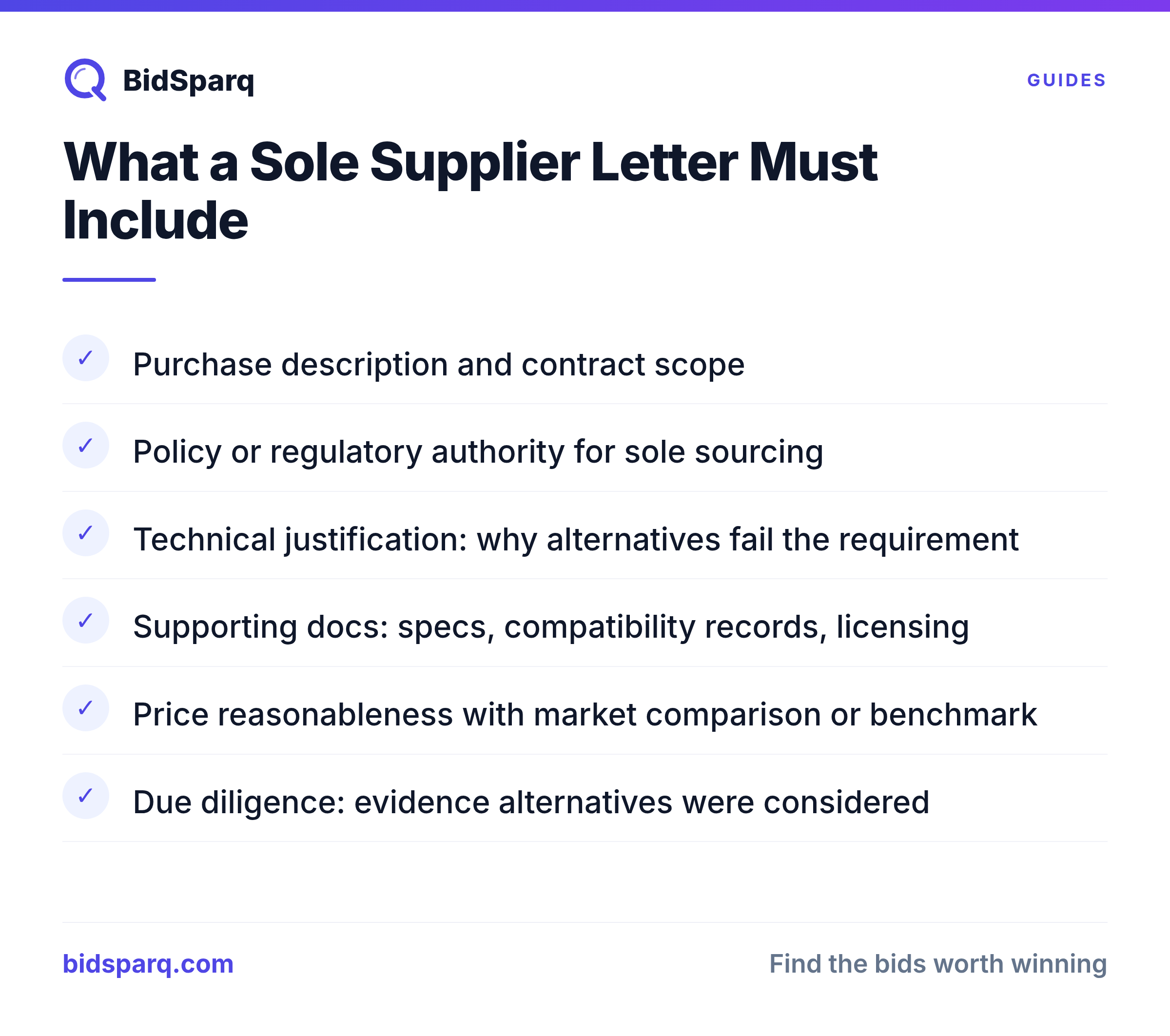
Structure the letter around the buyer's burden of proof, not the vendor's sales argument. Begin with a clear statement of what is being purchased and the contract scope. Then cite the specific policy or regulatory authority that permits a sole source in this jurisdiction; most procurement codes enumerate the exact qualifying categories, so name the one that applies. The core of the letter is the technical justification: state precisely why the requirement cannot be met by a competing product or provider, and attach supporting documentation. Product specifications, compatibility matrices, licensing records, or engineering assessments all serve this function. Close with a price reasonableness statement supported by a published price list, a market comparison, or a prior contract benchmark. Many procurement officers also require a due diligence statement, written confirmation that the buyer checked for alternatives before concluding none exist. A letter missing any of these elements is the most common reason approvals stall or come back for revision.
Sole supplier letter template with annotated sample language
Use this template as a starting point: each section includes the sample phrasing reviewers expect and an annotation explaining what the section must accomplish to clear audit.
Header and identification
[Date]
[Contracting Officer or Procurement Director name and title]
[Buyer organization name and department]Re: Sole Source Justification for [Description of Goods or Services], Estimated Value [Dollar Amount]
The Re line must name the goods or services specifically enough that the approval becomes a standalone audit record. Procurement officers file these by description; an ambiguous header creates matching problems if the file is audited or challenged later.
Section 1: Policy authority
This sole source request is submitted pursuant to [cite specific authority: federal buyers cite FAR 6.302-1, "Only One Responsible Source," for unique sources, or FAR 6.302-2 for unusual and compelling urgency; state buyers cite the applicable section of their state procurement code; school districts and hospital systems cite their board-approved purchasing policy section]. This provision permits a non-competitive acquisition when the supplies or services required are available from only one responsible source and no other type will satisfy the stated requirement.
Reviewers verify this citation before reading anything else. A missing or incorrect citation is the single most common reason a submission is returned for revision. Federal buyers should confirm which FAR 6.302 subcategory fits the documented facts; citing the wrong subcategory (for example, using 6.302-1 when the correct ground is 6.302-2 urgency) triggers the same result as omitting it.
Section 2: Description of requirement
[Buyer organization] requires [specific product or service name and version, including proprietary identifiers, license numbers, or system designations] for [specific operational purpose]. The requirement originates in [contract number, project phase, system name, or operational need]. Estimated contract value is [dollar amount]. The anticipated performance period is [start date] through [end date].
State what is needed and the operational context that drives the need. The description should establish that the requirement exists independently of any vendor relationship, which is the distinction reviewers are specifically looking for in this section.
Section 3: Technical justification and comparison to alternatives
[Buyer organization] has reviewed the following alternatives and determined that none satisfies the stated requirement:
Alternative 1: [Competing product or provider name]
Why it does not meet the requirement: [Specific gap, for example: "This product does not support real-time bidirectional data exchange with [existing licensed system name and version], as confirmed by [vendor documentation reference or compatibility matrix, attached as Exhibit A]. Substituting this product would require [describe consequence: system downtime, data migration cost, loss of certified functionality]."]Alternative 2: [Competing product or provider name]
Why it does not meet the requirement: [Same format; if the gap is a certification or patent, cite the specific credential or patent number.]No other qualified suppliers have been identified in the market for this requirement. [If a market survey was conducted: "A survey was conducted between [date range] using [method: SAM.gov search, industry association directory, direct outreach to [N] firms]. Results are attached as Exhibit B."]
This section determines approval or rejection. The format must name each alternative considered, state the specific gap that disqualifies it, and reference the documentation that supports the gap claim. A blanket statement that "no alternatives exist" without named comparisons fails most procurement review standards. Two or three named alternatives with documented gaps is typically sufficient for non-emergency submissions; emergency continuity cases should additionally document why the normal search process was not feasible within the available timeline.
Section 4: Price reasonableness statement
The proposed price of [dollar amount] is determined to be fair and reasonable based on [select one: (a) the vendor's published commercial price list dated [date], attached as Exhibit C; (b) comparison to the most recent contract for substantially similar supplies or services, [prior contract number], awarded at [price] on [date]; or (c) an independent cost estimate of [dollar amount], documented in [reference]]. [If applicable: "The price represents an increase of [X]% from the prior contract period, consistent with [documented market rate or published index]."]
Price reasonableness is a separate compliance gate from technical justification. An approved technical case with a missing price statement will still stall at the contracting officer level. The published price list option is the fastest to document and the simplest for reviewers to verify; use it when it exists.
Section 5: Due diligence attestation and signature
I, [name and title of signing official], attest that the information in this sole source justification is accurate and complete to the best of my knowledge. Prior to preparing this justification, [buyer organization] [conducted a market survey / reviewed available sources on SAM.gov / contacted industry associations / issued a sources sought notice] between [dates] to determine whether qualified alternatives exist. No qualified alternative was identified. This justification has been prepared in accordance with [applicable policy or regulation] and is submitted for review and approval by the appropriate authority.
Signature: __________________________ Date: __________
Name: __________________________________
Title: ___________________________________
Organization: ___________________________
The attestation converts the letter from a vendor argument into a buyer's official procurement record. In public agencies and healthcare systems, a signed attestation is required before the approval enters the file. Specific methods listed (SAM.gov search date, sources sought notice number) create a verifiable trail; a general statement that "a search was conducted" is weaker and will often prompt follow-up from reviewers.
Finding and tracking sole source procurement notices
Published sole source notices are among the most actionable signals in competitive procurement intelligence, and most vendors overlook them entirely. Under FAR 6.302-1, federal contracting officers are required to post pre-award justifications for sole source awards above the simplified acquisition threshold, placing the incumbent vendor, the requirement scope, and the contract vehicle on the public record before the purchase order is signed. State and local procurement codes impose parallel disclosure requirements, making these notices a consistent cross-market data stream when you know where to search. As of September 2026, 3,608 of the open solicitations across the 23,000+ sources BidSparq tracks include sole source references, and 1,705 of those close within the next 14 days. In the last 30 days, 7,124 new sole-related solicitations were posted across healthcare, education, construction, IT, and public-sector markets combined.
Competitive vendors use this data in two ways. The first is direct: find open sole source solicitations in your category, confirm that you meet the published requirement, and submit a capability statement before the award window closes. The second is strategic: BidSparq's fit scoring and incumbent vehicle tracking identify where existing sole source relationships are locked against specific contract vehicles and flag the agencies where an incumbent's contract is approaching its renewal window, before competitors identify the same gap. Pennsylvania and New York currently lead on posted sole-related solicitations, with 371 and 275 open notices respectively as of September 2026, making both states high-priority targets for vendors building pipeline in public-sector markets.
Manual search covers a fraction of this market. Federal pre-award justifications appear on SAM.gov under FAR 6.302-1 filings. State-level awards are published on each state's eProcurement portal. Local and education markets distribute notices across individual agency procurement pages and BoardDocs board agendas, where K-12 districts approve sole source purchases on consent calendars that most keyword search tools never surface.
Search sole source and competitive solicitations free across all these markets at once, with semantic matching that finds relevant opportunities even when the exact phrase varies, no credit card required.
How procurement teams review sole source submissions
Procurement officers are not trying to approve or reject the letter; they are building a file that can survive an audit. That means the letter does not need to be long. It needs to be complete. A focused two-page submission with clear section headers, a policy citation, a technical comparison, and a price reasonableness statement will clear review faster than five pages of general narrative. When submitting to a public agency, assume the letter becomes a public record. Write it factually, avoid claims that cannot be supported by attached documentation, and address the audit question directly. In education and healthcare procurement especially, sole source approvals move through internal compliance review, legal counsel, and sometimes a board vote before a purchase order is issued. A letter that anticipates those review layers moves through the cycle without unnecessary back-and-forth.
FAQ
What is a sole supplier letter used for in procurement?
A sole supplier letter documents the justification for purchasing from one vendor without competitive bidding. Buyers use it to satisfy audit and compliance requirements before issuing a non-competitive purchase order. Vendors submit one to request sole source consideration when they can show their product or service has no qualified alternative in the market.
What reasons are valid for a sole source justification?
Widely accepted grounds include proprietary compatibility with an existing licensed system, a unique patent or technical capability no competing product shares, emergency continuity needs where a competitive timeline would cause material harm, and verifiable market conditions where only one qualified supplier exists. Price preference, prior relationship, or administrative convenience are not valid grounds under most procurement policies.
How do I find sole source procurement opportunities?
Federal sole source notices appear on SAM.gov under FAR 6.302-1 filings. State-level awards are posted on each state's official eProcurement portal. For local and education markets, check agency procurement pages, school district websites, and BoardDocs board agendas, where sole source approvals sometimes appear on board consent calendars. A bid aggregation platform that monitors solicitations across all these sources simultaneously can surface relevant notices far faster than manual portal searches.
Find open sole source and competitive solicitations free, no credit card needed, and see where current demand aligns with what you offer across every market we track.
Find RFPs that match your business
BidSparq monitors 23,000+ procurement sources and uses AI to score every opportunity against your capabilities. Try it free for 14 days.
Start Free Trial →