Government Buying Signals Explained: Know Before You Bid
Government buying signals reveal what public-sector and institutional buyers plan to purchase before the formal RFP appears. Learn to read pre-solicitation notices on SAM.gov, expiring contracts on USASpending.gov, and sources-sought postings, and act before competitors even know the opportunity exists.
If your pipeline depends on published RFPs, you are already behind. The vendors who consistently win are tracking the market weeks or months before a solicitation appears, using buying signals to position early while requirements can still be shaped in their favor.
A buying signal is any pre-solicitation document or data point showing that a buyer is moving toward a purchase: a sources-sought notice, a request for information, a pre-solicitation announcement, or an expiring contract record. These signals are not unique to government; healthcare networks, school districts, construction project owners, and large commercial enterprises all publish pre-solicitation signals before issuing formal bids.
- Buying signals include pre-solicitation notices, requests for information, sources-sought postings, and expiring-contract records that appear before the formal bid window opens, across government, healthcare, education, and commercial markets.
- Acting before the RFP drops gives vendors time to align with the buyer's language and requirements while they can still be shaped.
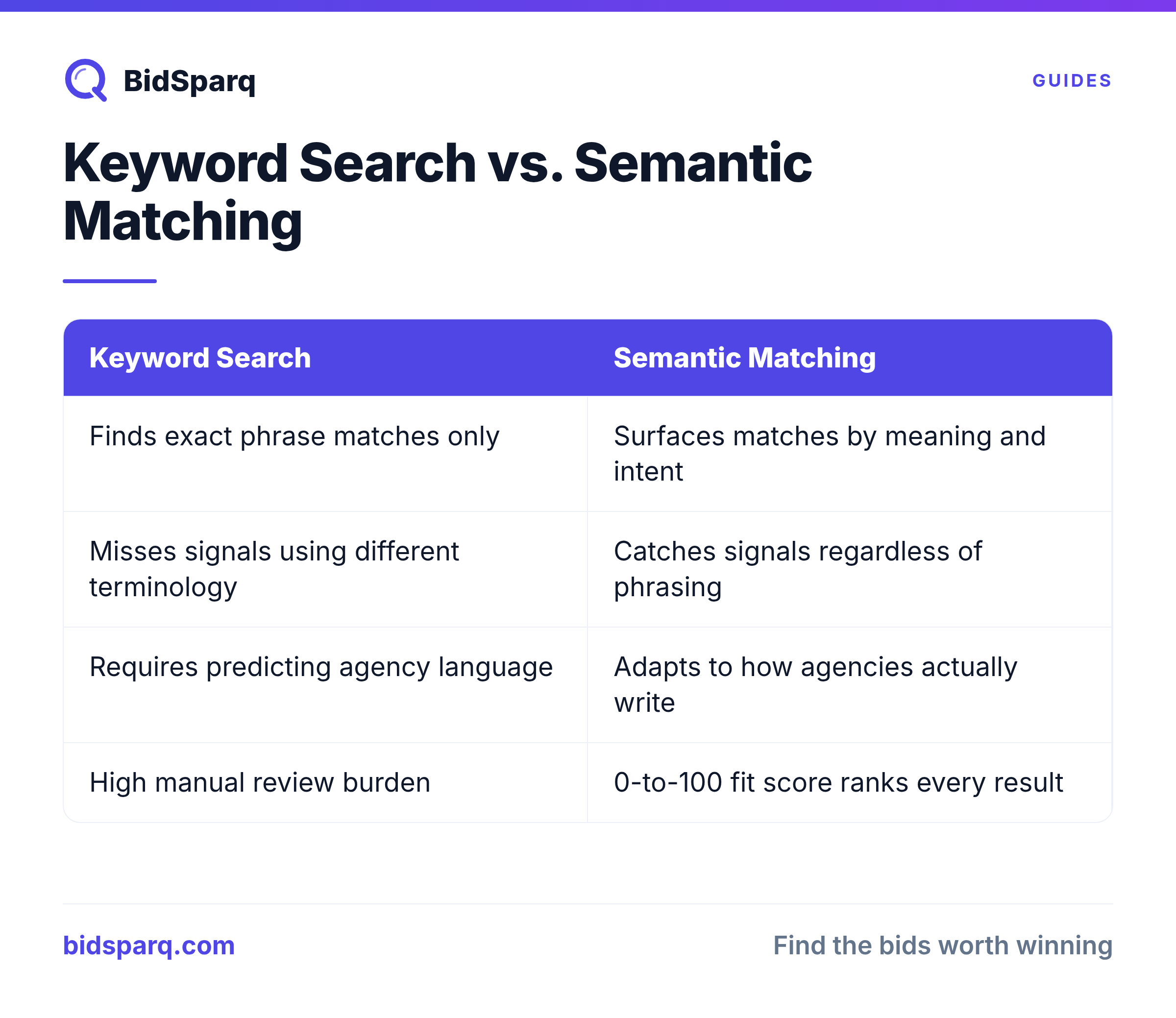
- Keyword search tools miss most signals because agencies describe the same need in dozens of ways; semantic matching captures the full picture by reading meaning, not exact words.
- A 0-to-100 fit score makes it possible to prioritize the highest-probability opportunities without manually reviewing every signal.
- Incumbent and contract-vehicle intel, read alongside the signal, reveals the competitive landscape before a single proposal page is written.
- As of August 2026, 163 new buying signals appeared in the last 30 days across 23,000+ tracked sources, and 35 close within the next 14 days.
What buying signals actually look like
A buying signal is any published document or data point showing that a buyer is moving toward a purchase, and most do not look like a traditional solicitation. At the federal level, FAR Part 10 requires agencies to conduct market research before issuing formal solicitations, which is the legal foundation for the pre-solicitation notices and sources-sought postings that appear on SAM.gov weeks or months before an RFP. Expiring federal contracts surface on USASpending.gov, often signaling a recompete six to twelve months before the follow-on solicitation launches. State agencies, school districts, and municipalities post equivalent signals through state e-procurement portals, following similar pre-solicitation practices at the local level.
The lead time is the opportunity. Significant procurement opportunities commonly generate signals 60 to 180 days before the formal solicitation. Large infrastructure projects and multi-year IT contracts often have longer pre-solicitation windows; smaller purchases may have only a few weeks. A healthcare network preparing to replace its facilities management system typically starts with an industry-day notice or a sources-sought posting, asking vendors to describe capabilities before requirements are finalized. A school district planning a technology refresh follows the same pattern: a sources-sought or a request for information appears weeks before the formal RFP, giving the buyer market knowledge and vendors an early look at what is coming.
Why keyword searches leave most signals on the table
Keyword searches fail at the pre-solicitation stage because agencies rarely use the same terminology vendors use to describe their own capabilities. A construction firm specializing in structural retrofits might search for “seismic upgrade” while a public agency posts a notice describing “building resilience improvements” or “structural life-safety modifications.” Both describe the same opportunity. A keyword search finds neither. Semantic matching reads the underlying meaning of each notice and surfaces opportunities that match what your firm does, regardless of how the agency phrased the requirement. That gap, between what you search for and what agencies write, is where most winning signals disappear for teams relying on keyword-based tools.
How to act on a buying signal before the RFP drops
The window between a buying signal and a published solicitation is where prepared vendors build advantages that reactive teams can never close.
Qualify the signal before anything else. Not every early-stage notice matures into a contract worth pursuing. Check the scope, the buyer's budget history, and whether the timeline fits your team's capacity before committing resources.
Sources-sought responses are more valuable than most vendors realize. Buyers use them as a qualification filter, not just a market survey. A well-crafted response puts your firm in the competitive record before the formal window opens, can influence final requirements in your favor, and signals to the agency that you are a capable, engaged vendor worth including in future outreach. Vendors who skip this step do not simply miss an opportunity; they cede it to whoever showed up.
Automated compliance extraction changes how you build the proposal baseline. Rather than reading a signal document page by page to locate certification thresholds, past-performance volume requirements, and technical specifications, a system that parses the document surfaces those requirements directly. Starting that documentation the moment a signal appears means the core proposal framework is largely in place before the solicitation drops, not the week after it appears.
Map the competitive landscape from the signal itself. If the notice references an incumbent contractor or a specific contract vehicle, that information defines the environment you are entering. Confirming vehicle eligibility in advance and understanding the incumbent's positioning before the RFP window opens is the difference between a reactive proposal and a prepared one.
Turning signal intelligence into a repeatable pipeline
One-off signal monitoring is better than nothing, but it does not scale to the volume of the modern procurement market. As of August 2026, 66,563 solicitations are open across 23,000+ monitored sources. Among them, 163 new signals with buying intent appeared in the last 30 days, and 35 close within the next 14 days. No team reviews that volume manually without missing the opportunities that matter most.
A repeatable signal pipeline requires four things: continuous monitoring across all relevant sources, semantic matching that surfaces signals regardless of terminology, a fit score that ranks every opportunity so the team focuses on high-probability matches first, and automated compliance extraction that pulls requirements from every document without manual review. Automated procurement tools handle this at scale; manual keyword search cannot. When those four elements work together, the team spends time on qualified opportunities rather than search results.
Buying signals beyond government: healthcare, education, construction, and commercial
The pre-solicitation pattern is not unique to government procurement; it is standard operating practice for any large organized buyer. Healthcare networks planning capital equipment purchases routinely circulate requests for information months before issuing a formal bid. School districts preparing technology refreshes publish sources-sought equivalents through their e-procurement portals. Construction project owners issue pre-qualification notices and letters of intent that function identically to government pre-solicitation documents. Commercial enterprises running supplier qualification panels follow the same logic: signal first, formal process second.
What differs across markets is visibility. Government buying signals follow the most structured public-posting requirements, which makes them systematically findable through a single monitoring layer. Healthcare, education, and construction signals are posted across a wider and less standardized set of portals, which makes broad-source monitoring the only reliable way to capture them. Terminology also diverges sharply across sectors. What a federal agency calls a “performance work statement” a hospital system may call a “scope of services” and a school district may call a “project brief.” The underlying intent is identical; the language is not. Semantic matching is especially valuable in this environment because it reads meaning rather than words.
Vendors who limit signal monitoring to a single sector leave a significant share of opportunities uncovered. A managed services provider, a structural engineering firm, or a corporate training company may have capabilities that fit dozens of active opportunities across government, healthcare, and education simultaneously, but only if they are tracking all three.
If your team is still waiting for the published RFP, the incumbent is already weeks ahead. Closing that gap means monitoring signals before the solicitation drops, responding to sources-sought before requirements are locked, and building your proposal baseline the moment a signal appears. As of August 2026, BidSparq tracks 66,563 open solicitations across 23,000+ sources, covering the federal, state, and commercial markets where your next contract is forming right now. Start finding buying signals free, no credit card required.
FAQ
What is the difference between a government buying signal and an RFP?
An RFP is the formal, published solicitation that invites vendors to submit binding proposals. A buying signal is any pre-solicitation action, such as a sources-sought notice, a request for information, a pre-solicitation announcement, or an expiring-contract record, that indicates the agency is preparing to buy. Under FAR Part 10, federal agencies are required to conduct market research before soliciting; those sources-sought notices and pre-solicitation announcements on SAM.gov are the public output of that requirement. Buying signals carry no binding obligation on either side; they exist so agencies can gather market intelligence and vendors can position early.
How far in advance do government buying signals typically appear?
It varies by agency, contract value, and procurement type, but significant opportunities commonly generate signals 60 to 180 days before the formal solicitation. Large infrastructure projects and multi-year IT contracts often have longer pre-solicitation windows; smaller, routine purchases may have only a few weeks between signal and RFP. Federal pre-solicitation notices appear on SAM.gov; expiring contracts surface on USASpending.gov months before the recompete launches. Monitoring continuously across all sources ensures you catch signals at whatever lead time the agency provides.
Do buying signals appear only in government procurement?
No. Healthcare, education, construction, and commercial buyers all use pre-solicitation processes before issuing formal bids. Government buying signals follow the most consistent public-posting requirements, which makes them easier to monitor systematically. The differences across sectors are in where signals are posted and how terminology varies, not in whether the signals exist. Broad-source monitoring with semantic matching is the only reliable way to capture signals across all of these markets at once.
Find the buying signals that match your capabilities free on BidSparq, no credit card required.
Find RFPs that match your business
BidSparq monitors 23,000+ procurement sources and uses AI to score every opportunity against your capabilities. Try it free for 14 days.
Start Free Trial →