Recompete AI: Win the Rebid Before It Goes Live
Recompete AI surfaces expiring contract opportunities before competitors even know they exist. Here is how to build a recompete pipeline that consistently wins.
Most contractors lose recompetes not because they were outpriced, but because they were out-positioned. The team that wins has been building its narrative, pricing strategy, and delivery approach for months before the formal solicitation ever posts. Recompete AI is the practice that makes that head start systematic, not a function of who happened to stumble onto the right portal first.
The underlying economics are straightforward: contracts have end dates, and those end dates are public record. Award databases and contract registries log the start date, duration, and expected expiration of virtually every publicly funded contract. That information exists months before any buying organization drafts a new solicitation, which means the competitive window opens far earlier than most business development teams recognize. Teams tracking expiration signals at the 12-to-18-month horizon can build relationships, refine their service narrative, and anticipate requirements while competitors are still waiting on a portal alert.
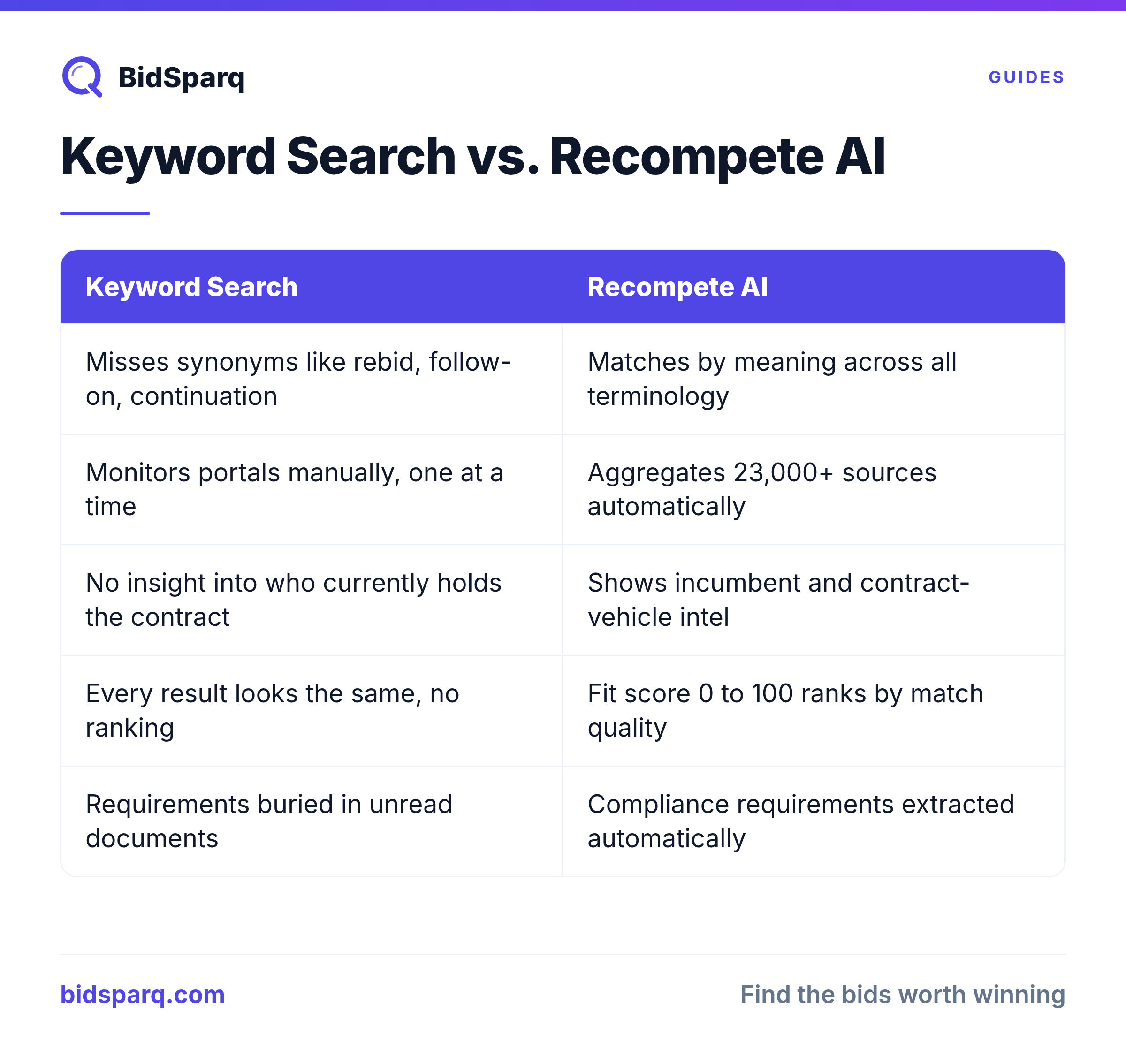
The language problem compounds this. Procurement offices have no standardized vocabulary for contract renewals. The same type of rebid appears as a "follow-on solicitation," a "contract continuation," a "second-generation program," or simply a new solicitation referencing the predecessor contract number in the scope of work. Monitoring platforms built on keyword alerts capture the cases where buyers happen to use your exact search term and miss everything else. For any organization tracking recompetes across healthcare, IT, construction, education, and public services simultaneously, keyword reliance does not just create coverage gaps; it systematically surfaces the opportunities that are easiest to find, which are generally the most competed.
At scale, fit-scoring and incumbent intelligence determine whether a recompete pipeline drives wins or just drives activity. Fit-scoring compresses thousands of open opportunities into the subset genuinely worth pursuing by assigning each solicitation a numeric match against your firm's capability and past performance profile. Incumbent intelligence reveals who holds the work today, at what estimated value, and under which contract vehicle, shaping whether you challenge, partner, or pass before committing bid-and-proposal resources. Together these capabilities convert procurement from a reactive monitoring exercise into a structured business development cycle that compounds over time.
- Expiration signals are public months in advance: award databases log contract end dates long before solicitations post, giving AI-equipped teams a structural head start over those waiting on portal alerts.
- Semantic matching closes the language gap: procurement offices use inconsistent terminology for renewals, and only intent-based AI reliably captures the full recompete market across every sector.
- Fit-scoring turns volume into focus: a score from 0 to 100 compresses thousands of open solicitations into a prioritized shortlist your team can act on without expanding headcount.
- Incumbent intelligence shapes your strategy: knowing who holds a contract, at what value, and under which vehicle is what separates a strategic challenger from a reactive bidder.
- The market is larger and faster-moving than most teams recognize: as of September 2026, 2,518 recompete solicitations are open across tracked sources, 257 close in the next 14 days, and 248 new ones posted in the last 30 days.
The short answer
Recompete AI is the practice of using artificial intelligence to identify, score, and track contract renewal opportunities before and after they are formally advertised as solicitations. Unlike keyword search tools that catch bids only after they post, AI platforms monitor expiration signals, award-database patterns, and procurement language to surface recompetes early across every sector. For contractors in healthcare, IT services, facilities management, education, and construction, this early visibility is the difference between a reactive last-minute bid and a strategic campaign built over months. The organizations winning the most recompetes today are not simply working harder; they are working with better timing and better information.
The recompete market is larger than most teams realize
Start your recompete strategy by understanding the full scope of what is actively on the market across every sector. Contracts expire on a rolling schedule in healthcare, IT, facilities, education, construction, and public services alike. A health system renews its clinical staffing contract; a school district rebids its network infrastructure; a municipality recompetes its facilities maintenance work. As of September 2026, 53,818 solicitations are open across BidSparq's 23,000+ tracked sources, of which 2,518 explicitly mention "recompete" and 248 new ones posted in the last 30 days alone. That figure captures only the solicitations that use the word directly; thousands more represent the same renewal dynamic under different terminology. At the state level, Massachusetts, Maryland, and Washington are among the most active right now, with 662, 597, and 543 open recompete solicitations respectively, but the volume is distributed broadly across every region and sector.
Why Keyword Searches Miss Recompete Opportunities, and What Recompete AI Catches Instead
Recognize that the language of recompetes is inconsistent enough to defeat any fixed-keyword strategy at scale. A procurement office might label the same type of renewal as a "re-compete," a "follow-on solicitation," a "contract continuation," a "rebid," or it might use none of those terms and simply reference the expiring contract number in the scope of work. Manual monitoring at the required scale is not sustainable: checking dozens of portals daily across healthcare, education, construction, IT, and public sector channels is a full-time job before you have reviewed a single document. Teams that rely on keyword alerts also miss the pre-solicitation signal entirely. Award databases and contract registries show an incumbent's contract end date months before any solicitation posts. Resources like USASpending.gov and SAM.gov surface federal contract expirations publicly, and most states publish comparable data through their comptroller offices or official eProcurement portals. Board agenda platforms like BoardDocs publish school board meeting minutes that often contain advance notice of upcoming bids. Cross-referencing all of these manually against your active pipeline does not scale.
See which recompetes in your sector close in the next 14 days, no credit card needed.
How Recompete AI Surfaces Opportunities Across Every Sector
Use semantic matching to catch recompetes the moment they post, regardless of what the issuing organization calls them. The distinction between semantic AI and keyword search is architectural, not a matter of degree. Keyword indexing scans for exact or near-exact phrase matches against a defined list, so a solicitation written in different terminology simply does not appear in results. Semantic AI converts the full text of each solicitation into a high-dimensional numerical representation, then measures how closely that representation matches your capability and past performance profile. Two solicitations describing the same underlying need in entirely different language score at similar relevance because the model has learned that "wide-area network refresh" and "district connectivity services" occupy the same region of meaning. Award-database pattern matching adds a second layer: by cross-referencing contract award records against solicitation activity, the system identifies contracts approaching expiration that have not yet generated a renewal solicitation, placing your team in the pre-solicitation window where early positioning makes the largest competitive difference.
Fit-scoring then assigns each match a number from 0 to 100 based on how well the solicitation aligns with your capabilities, certifications, and past performance profile. A healthcare IT firm tracking clinical-system integrations can use fit-scoring to filter thousands of open opportunities down to the 40 or 50 that genuinely warrant a proposal review, in the time it would take a manual researcher to scan a single portal. Automated compliance extraction pulls key requirements, deadlines, and evaluation criteria from each document before your team spends a minute reading it; this matters most in sectors like construction or public safety where bid packages routinely run hundreds of pages and a missed requirement can disqualify an otherwise strong proposal. Incumbent and contract-vehicle intelligence shows who currently holds the contract and, where available, which vehicle was used, giving your business development team the context to decide whether to challenge, partner, or pass before committing bid-and-proposal resources. When a municipality recompetes its facilities maintenance work, knowing the incumbent's contract value and vehicle lets a challenger price strategically and frame its differentiation around documented gaps rather than guesswork.
Building a recompete pipeline that compounds
Treat recompete pursuit as a four-stage pipeline, not a reactive alert queue, and assign a timing cadence to each stage so no opportunity reaches close without preparation behind it.
Stage 1: Expiration-signal monitoring (12 to 18 months out). Set automated watches on award databases, contract registries, and state eProcurement portals for contracts in your target sectors and geographies. At this horizon no solicitation exists yet; your only task is to log the incumbent, the estimated contract value, and the expected end date. Most competitors are not looking this far out, which means entering Stage 2 with a substantial head start before the buyer has even begun drafting requirements.
Stage 2: Early-BD qualification by fit score (6 to 12 months out). When a monitored contract enters this window, run it against your capability and past performance profile. A fit score at or above 70 moves it to active pursuit; below 50, document the pass decision and reallocate those resources. This threshold keeps your bid-and-proposal budget focused on winnable work. At this stage, begin relationship-building with the issuing organization through industry days, capability statements, or pre-solicitation outreach where the procurement rules allow.
Stage 3: Capture planning (3 to 6 months out). For opportunities above threshold, build a capture plan: define your win themes, identify gaps in your past performance, assess whether a partnership adds a capability or certification the buyer values, and develop a preliminary price narrative informed by the incumbent's known contract value. The teams that win recompetes most consistently have a proposal outline in place before the solicitation drops.
Stage 4: Solicitation-ready prep (0 to 90 days out). When the solicitation posts, your team is not starting from zero. Automated compliance extraction flags every requirement against your existing draft. The technical approach, past performance citations, and pricing model are already shaped. The only work remaining is tailoring to the final requirements, not building the response from scratch. A pipeline with 10 to 15 opportunities distributed across all four stages means no single deadline becomes a crisis, and each cycle through the stages sharpens your execution for the next one.
FAQ
What does "recompete" mean in procurement?
A recompete is a competitive solicitation issued when an existing contract expires and the buying organization opens the work to bids again rather than extending or sole-sourcing the renewal. Recompetes occur across every sector: federal agencies, state and local governments, school districts, health systems, universities, and private companies all recompete contracts when terms roll over. The incumbent vendor may rebid alongside any qualified challenger.
How early can AI identify a recompete opportunity?
The earliest signal comes from award databases rather than solicitation portals. When a contract is awarded, the record typically shows the start date, duration, and expected end date. AI platforms that cross-reference these records against solicitation activity can alert contractors to a potential recompete months before the buying organization formally posts anything. Once a solicitation does post, AI platforms can surface it within hours rather than the days a manual check might take.
Does recompete AI work outside of federal contracting?
Yes. Recompete dynamics exist wherever contracts have fixed terms, which means every sector. Healthcare organizations, school districts, municipalities, construction authorities, and commercial enterprises all recompete contracts on a schedule. The challenge is that non-federal procurement is fragmented across thousands of portals and publication venues. An AI platform aggregating from 23,000+ distinct sources handles that fragmentation automatically, surfacing recompetes from every sector in a single feed.
See every recompete that matches your capabilities, free. Start your no-cost search on BidSparq's bid intelligence platform.
Find RFPs that match your business
BidSparq monitors 23,000+ procurement sources and uses AI to score every opportunity against your capabilities. Try it free for 14 days.
Start Free Trial →