Sole Source Provider Letter: How to Respond Fast
What a sole source provider letter means, why nearly 1,000 are open right now across procurement markets, and how vendors can find and act on them before the protest window closes.
A sole source provider letter is one of procurement's most misunderstood documents. When a buying organization issues one, competitive bidding stops. One vendor is designated as the only qualified supplier and the contract moves forward. For vendors positioned correctly, this is the highest-value outcome in bid pursuit. For everyone else, it is an invisible loss.
- A sole source designation removes competition entirely, making early detection the single most important factor in whether these notices benefit you or go to a competitor.
- No single procurement portal captures all of them: education, healthcare, construction, and government agencies each post these notices in different systems under different labels.
- The window is genuinely short: as of October 2026, 427 sole source solicitations close within the next 14 days, and most carry minimal lead time from posting to award.
- Keyword searches miss the majority because agencies use dozens of phrasings for the same event: proprietary, emergency purchase, non-competitive procurement, and limited competition all describe the same thing.
- Incumbent contract data identifies which vendor held the prior sole source relationship, pointing you toward the right positioning before the next cycle opens.
- Automated compliance extraction from the justification letter surfaces qualifying criteria immediately, reducing assessment time from hours to minutes.
The short answer
A sole source provider letter is a formal document a buying organization issues when only one vendor can satisfy a specific requirement, authorizing purchase without competitive bidding. These notices are not rare: as of October 2026, 997 open solicitations across the 23,000+ sources BidSparq tracks mention sole source, and 1,850 new ones were posted in the last 30 days alone. The letter names the justification category, the qualifying vendor, and typically opens a protest window during which other qualified vendors can challenge the designation. For firms not yet named, finding these notices the day they publish is the only path to acting before that window closes.
What a sole source provider letter actually contains
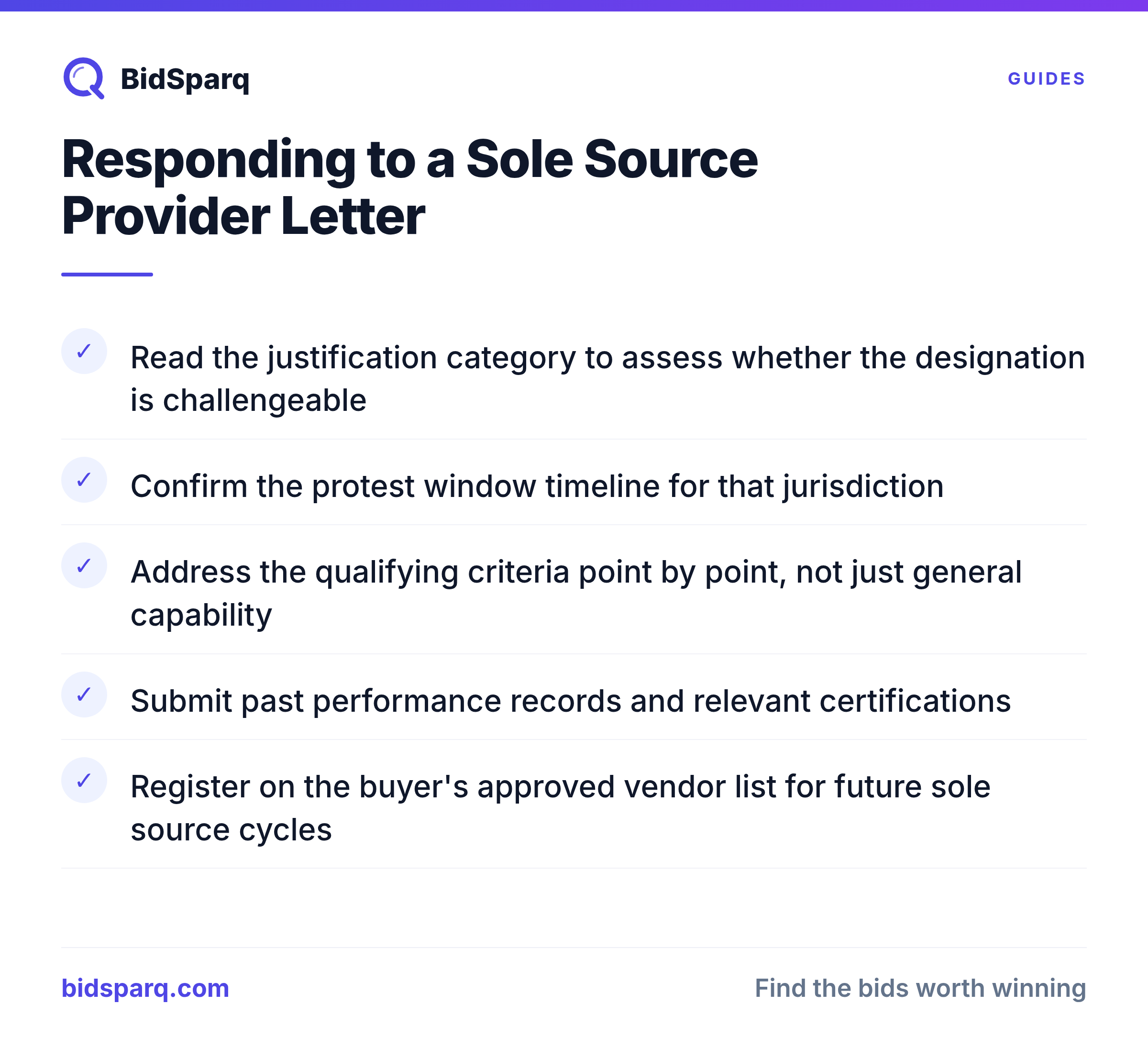
Read the justification category first: it tells you whether the designation is open to challenge. Most sole source letters cite one of a small set of grounds: proprietary compatibility, where only this vendor's system integrates with the buyer's existing infrastructure; emergency need, where time does not permit competition; unique expertise, where only one qualified source exists in the market; or statutory authority specific to the issuing entity. School districts, hospital systems, construction authorities, and IT departments each operate under their own rules governing when sole source is permitted, but the letter structure is consistent across markets. The qualifying criteria section is the most actionable part: it describes exactly what a vendor must demonstrate to be considered the sole qualified source, and reading it carefully tells you whether a protest has merit or whether your energy is better spent positioning for the renewal cycle.
Why sole source opportunities are easy to miss
Sole source notices do not live in one place, and they rarely carry a consistent label. A healthcare system may post an emergency sole source notice on its vendor portal. A school district may bury a non-competitive purchase authorization in board meeting documents. A construction authority may file a limited competition notice with the state comptroller. These are the same procurement event published under different names in completely different systems. Manual monitoring of a handful of portals will miss the bulk of them. Semantic search, which reads by meaning rather than exact phrase, is the only method that reliably captures the full range of phrasings agencies use for these notices.
Tracking sole source notices manually across dozens of portals is exactly the kind of time drain that compounds as your pursuit list grows. See your sole source matches free, no credit card needed.
How to respond to a sole source provider letter
If you are not the named vendor, your first move is to confirm whether the designation is still within its protest window. Most procurement regulations require a public notice period, typically between 7 and 30 days depending on jurisdiction, during which qualified vendors can formally demonstrate they can meet the stated requirement. This is not an adversarial process: it is a regulatory mechanism to ensure the buyer has considered all available sources. A protest submission must address the specific justification criteria in the letter point by point. General capability statements rarely succeed. If you are the named sole source vendor, the letter typically initiates a negotiation period rather than a proposal process: price reasonableness documentation, past performance records, and technical scope confirmation are the standard requests at that stage.
Building a sole source strategy before letters are issued
The most durable sole source strategy begins long before any letter is published, with systematic tracking of incumbent contracts and expiring contract vehicles in your target markets. Organizations that hold sole source relationships earn them by becoming the default: they are on the approved vendor list, hold the relevant certification, and have the compatible system already in use. Identifying which organizations in your target markets currently hold sole source contracts with competitors shows you where to invest in positioning now. Real sources to monitor include SAM.gov for federal notices, your state's official eProcurement portal for state-level awards, BoardDocs and similar board agenda platforms for school district actions, and individual hospital or health system vendor portals for healthcare markets. As of October 2026, South Carolina and Pennsylvania are posting the highest volumes of sole source solicitations among states, with 125 and 87 open notices respectively. If either market is a target for your firm, the activity is measurable and trackable right now.
What separates firms that win sole source contracts consistently
Consistent sole source wins come from combining early detection, fast internal routing, and a prior relationship with the buying organization. Automated discovery handles the first layer: across 23,000+ tracked sources, waiting for weekly digests or manual portal checks means arriving after the protest window has already closed. The internal routing piece requires a clear decision rule: who reviews a sole source notice, how quickly, and what criteria trigger a go or no-go decision. The relationship layer is built before the letter arrives, through prior contract performance, pre-solicitation engagement, and registration on the buyer's approved source lists. Firms that combine all three convert these opportunities at significantly higher rates than those relying on discovery alone. Start tracking sole source notices across your markets at no cost, with no commitment required.
FAQ
What is a sole source provider letter in procurement?
A sole source provider letter is a formal document a buying organization issues to justify purchasing from one vendor without competitive bidding. It identifies the vendor, states the justification category, such as proprietary need, emergency, or unique expertise, and typically includes a public protest period during which other qualified vendors can challenge the designation by demonstrating they can meet the requirement.
How do I find sole source opportunities in my market?
Sole source notices appear across many systems: SAM.gov for federal opportunities, state eProcurement portals for state-level awards, BoardDocs and similar board agenda platforms for school districts, and individual agency or hospital vendor portals for other markets. Because the terminology varies widely across sectors, semantic search tools that match by meaning rather than exact keyword capture significantly more of these notices than manual monitoring of individual portals.
Can I protest a sole source designation?
Yes, in most public procurement jurisdictions. Regulations typically require a notice period, ranging from 7 to 30 days depending on the level of government or institution type, during which qualified vendors can formally submit evidence they can satisfy the stated requirement. A successful protest does not guarantee a contract award: it initiates a competitive procurement. The protest must address the specific justification criteria in the sole source letter directly, not just assert general capability.
Find RFPs that match your business
BidSparq monitors 23,000+ procurement sources and uses AI to score every opportunity against your capabilities. Try it free for 14 days.
Start Free Trial →