Meeting Intelligence Platforms for Pre-RFP Deals: Win Earlier
Meeting intelligence platforms for pre-RFP deals surface buying intent from board agendas, budget hearings, and public meeting records before a solicitation ever posts. Learn what separates a true platform from a keyword alert tool, and how semantic matching, AI scoring, compliance extraction, and incumbent intel combine to put teams on shortlists before requirements are locked in.
- 9,993 new solicitations mentioning “meeting” were posted in the last 30 days across 23,000+ tracked sources, showing how much buying intent forms before any formal RFP appears.
- Requirements are written before the RFP posts. By the time a solicitation is published, specifications already reflect the vendors who arrived early and shaped them.
- Why do late entrants compete on price? Because buying requirements were built around a competitor’s capabilities, often months before the solicitation appeared.
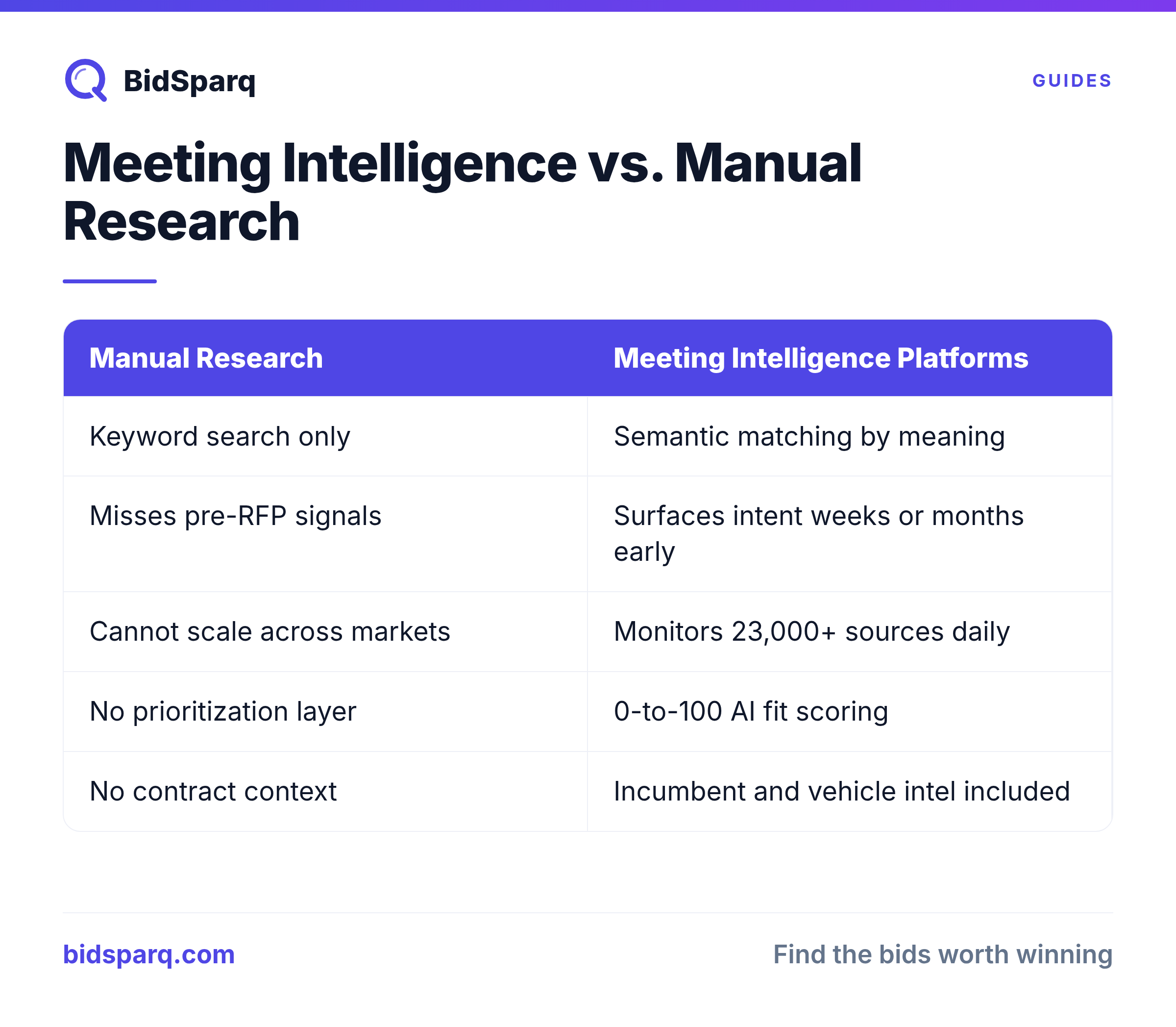
- Semantic matching finds intent that keyword search misses by reading for meaning in the buyer’s vocabulary, not the vendor’s, closing the gap at the pre-RFP stage.
- Know within seconds whether a signal is worth pursuing. A 0-to-100 AI fit score applied at the moment of discovery tells teams which conversations to open and which to skip.
- Compliance requirements lock in before an RFP is drafted. Automatic extraction of certifications and set-aside designations from meeting records gives teams months of lead time to qualify.
The short answer
Meeting intelligence platforms for pre-RFP deals surface buying intent from public records, board agendas, and budget hearings before any formal solicitation is issued, giving teams a window to influence requirements rather than respond to them. When a team enters a buying cycle while specifications are still being written, the competitive dynamic changes entirely: relationships form, requirements reflect what leading vendors can deliver, and latecomers compete on price alone. Platforms that combine this meeting-signal layer with AI fit-scoring, compliance extraction, and incumbent contract intelligence let teams prioritize the signals worth pursuing, not merely find them. This logic extends across the full procurement market: healthcare organizations, school districts, construction project owners, and corporate sourcing teams all run predictable buying cycles that surface in public records months before an RFP appears.
Why pre-RFP timing determines who wins
The vendor who influences requirements is not competing on the same terms as the vendor who finds the solicitation after it posts. Procurement decisions take shape during the months of internal reviews, vendor briefings, and budget planning that precede a formal RFP. A healthcare organization evaluating clinical workflow tools, a school district planning a facilities renovation, or a construction firm identifying specialty subcontractors all go through a discovery phase where preferences form and requirements get written around what the leading vendors can deliver. By the time a solicitation is published, incumbents and well-positioned challengers have already had multiple substantive conversations. Arriving at the RFP stage without that groundwork means competing on price in a field already narrowed by specification language written with someone else in mind.
What meeting intelligence platforms actually track
The signals that predict a procurement event are visible in public records before any solicitation is drafted. Board meeting minutes, capital budget hearings, curriculum or technology committee packets, facilities master plan updates, and contract renewal discussions all contain language that marks the beginning of a buying cycle. Real public resources carry this data: BoardDocs publishes school board agenda packets with searchable text, SAM.gov contract award notices identify expiring federal contract vehicles, and state comptroller budget pages list approved capital spending line items. Meeting intelligence platforms continuously parse these sources and extract signals that indicate a purchase is forming: budget line approvals, renewal flags, technology roadmap references, and RFP preparation language. As of October 2026, 9,993 new solicitations mentioning “meeting” were posted in the last 30 days across the 23,000+ sources tracked, a pace that illustrates both the volume of active procurement and the scale of coverage required to stay ahead of it.
Why manual research cannot keep up with pre-RFP volume
The volume of pre-RFP signals across the full procurement market is too large for any pursuit team to monitor by hand. As of October 2026, 56,897 solicitations are open right now across the 23,000+ sources tracked, and 7,254 of them mention the word “meeting.” Behind each of those is a public meeting record, a committee agenda, or a budget hearing where the buying intent was first visible. A single state may have hundreds of active school districts, hospital systems, municipal authorities, and construction project owners, each running independent budget and planning cycles. Even teams with dedicated researchers cannot cover that ground consistently, which means opportunities are routinely missed, not because the signal was hidden, but because no one had the capacity to find it. The teams winning pre-RFP positioning at scale are the ones using platforms that automate signal extraction so human effort can focus on the conversations that matter, not the search for them.
What separates a true meeting intelligence platform from a keyword alert tool
A keyword alert tool tells you when a word appears; a meeting intelligence platform tells you what it means, whether it fits, and what action to take next. Keyword monitoring catches only the signals that use your exact terminology. A hospital procurement committee discussing a patient engagement initiative is not writing solicitation language yet, and a school district evaluating life-safety compliance upgrades describes a purchase in facilities and regulatory terms, not vendor terms. Semantic matching resolves this by reading for conceptual meaning rather than literal strings, surfacing buying intent that keyword search cannot reach at the pre-RFP stage.
Three additional capabilities mark the distance between a platform and an alert tool. First, a 0-to-100 AI fit score applied at the moment of discovery lets teams rank signals in seconds rather than reading through raw results manually. Second, incumbent and contract-vehicle intelligence surfaces alongside each opportunity so teams know who holds the current contract, when it expires, and which procurement vehicle the buyer has used before, context that turns a vague meeting signal into a timed pursuit decision. Third, automatic compliance extraction reads meeting records for mandatory certification requirements, set-aside designations, and local preference provisions before they ever appear in a solicitation. Teams that catch these requirements at the meeting-record stage can begin qualification conversations months ahead, rather than discovering a disqualifying requirement on the day a bid is due.
Building a pre-RFP pipeline that converts
A pre-RFP pipeline converts when it pairs early signal detection with a disciplined outreach cadence. The first step is identifying which buying cycles are forming: using meeting intelligence to flag budget approvals, technology reviews, and contract renewal windows in your target markets. The second step is qualifying quickly: a fit score and a review of incumbent intel tells you within minutes whether a signal is worth a pursuit conversation. The third step is outreach timed to the buyer’s planning cycle, before requirements are drafted: a technical brief, a relevant framing of your capabilities, or a request for an informational meeting. Teams that execute this consistently find themselves on shortlists before solicitations are written, and frequently find that RFP language reflects the conversations they initiated. As of October 2026, 3,660 solicitations mentioning “meeting” close within the next 14 days, a reminder that the window between pre-RFP engagement and solicitation close is shorter than most teams assume.
FAQ
What is a meeting intelligence platform for pre-RFP procurement deals?
A meeting intelligence platform for pre-RFP deals is a tool that monitors public meeting records, board agendas, budget hearings, and planning documents to identify procurement intent before a formal solicitation is issued. It extracts language signaling a buying cycle is forming and surfaces those signals to sales or capture teams so they can engage buyers while requirements are still being shaped, not after they are published.
How far in advance can meeting intelligence platforms identify pre-RFP opportunities?
Depending on the market and the buyer’s planning cycle, pre-RFP signals can appear anywhere from a few weeks to twelve or more months before a solicitation posts. Capital budget approvals and facilities master plan updates often appear a full fiscal year before an RFP. Technology committee discussions and contract renewal notices typically appear three to six months out. Monitoring consistently across all of these source types gives teams the earliest possible window into forming buying cycles.
Do meeting intelligence platforms for pre-RFP deals work beyond government procurement?
Yes. While government entities produce the most publicly accessible meeting records, meeting intelligence for pre-RFP deals applies across healthcare, education, construction, and commercial markets. Hospital system board meetings, university facilities committees, and corporate sourcing reviews all produce trackable signals in public or semi-public records. The key is using a platform that covers the full procurement landscape rather than one scoped to a single vertical.
Find RFPs that match your business
BidSparq monitors 23,000+ procurement sources and uses AI to score every opportunity against your capabilities. Try it free for 14 days.
Start Free Trial →