How to Use USASpending.gov for Competitive Intelligence
USASpending.gov is a free goldmine of contract data most contractors ignore. Learn how to research incumbents, estimate pricing, identify recompetes, and find teaming partners.
Every federal contract award: who won, how much, when it ends, which agency bought it, is public data. It's all on USASpending.gov, and it's completely free. Yet most contractors never use it.
This is a strategic mistake. USASpending is the single best tool for competitive intelligence in federal contracting. It tells you who your competitors are, what they charge, when contracts come up for recompete, and which agencies buy what you sell.
"After burning weeks writing proposals for contracts that were clearly going back to the incumbent, I started tracking the patterns." (r/GovernmentContracting)
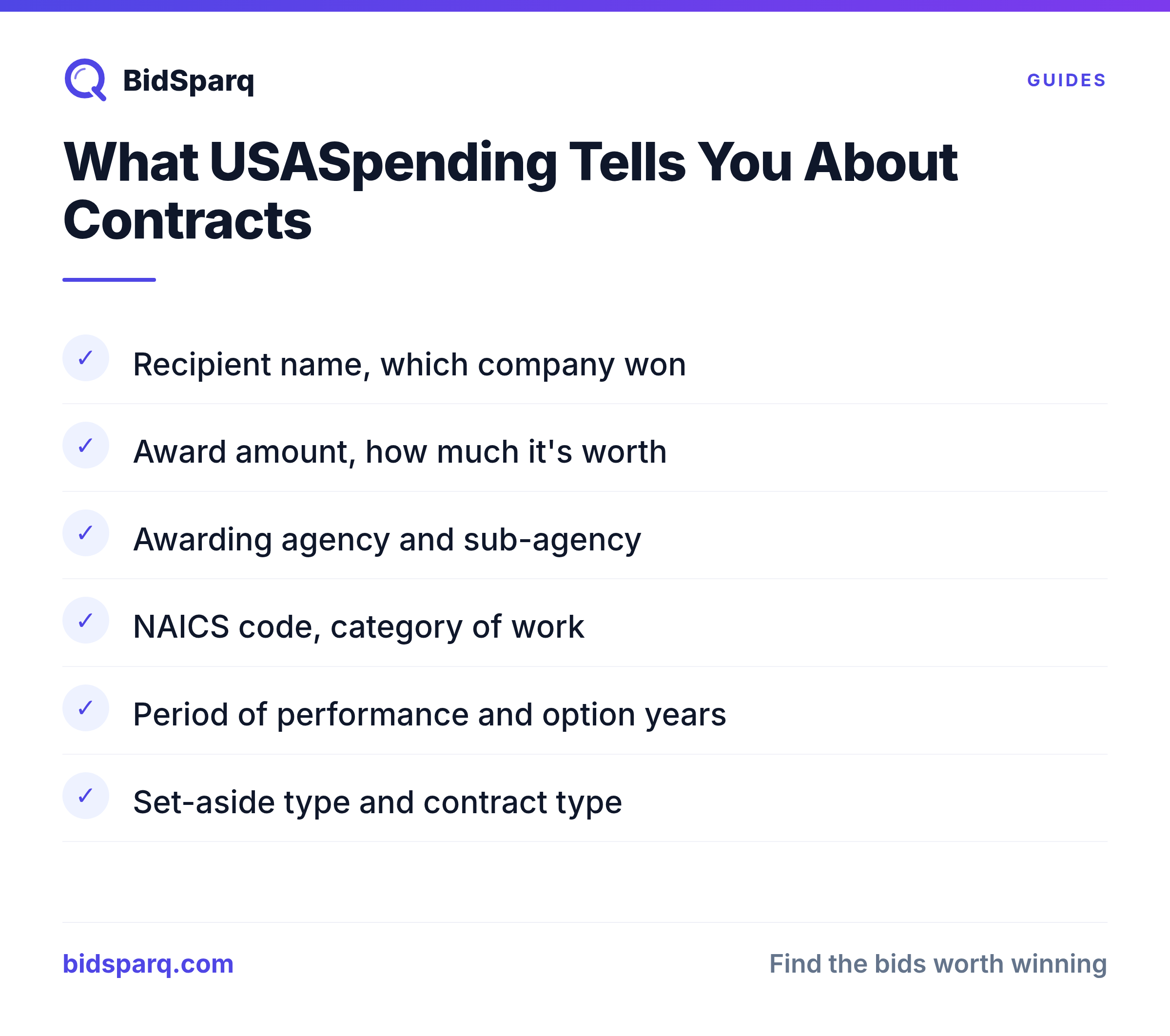
What USASpending Contains
USASpending tracks every federal dollar spent: contracts, grants, loans, and other financial assistance. For contractors, the valuable data is in contract awards:
- Recipient name: which company won
- Award amount: how much the contract is worth
- Awarding agency and sub-agency: who bought it
- NAICS code: what category of work
- Period of performance: start date, end date, option years
- Place of performance: where the work is done
- Contract type: FFP, T&M, IDIQ, etc.
- Set-aside type: small business, 8(a), HUBZone, etc.
- Description: brief scope of work
Five Intelligence Plays You Should Be Running
Play 1: Identify the Incumbent Before You Bid
Before spending $6,000 and 20 hours on a proposal, find out who currently holds the contract. Here's how:
- Go to USASpending.gov/search
- Search by awarding agency and NAICS code
- Filter by date range (last 5 years)
- Look for contracts with similar scope descriptions
If the same vendor has won the last 2-3 recompetes, that's critical intelligence. It doesn't necessarily mean the contract is wired, but it means the incumbent has a deep relationship, institutional knowledge, and probably shaped the requirements through years of performance.
What to do with this information:
- If the incumbent is strong and this is their 3rd recompete: consider no-bidding or teaming with them
- If the incumbent is a large business and this is set aside for small business: you have a real shot
- If there's no incumbent (new requirement): the playing field is more level
Play 2: Price Your Proposals Using Award Data
One of the hardest parts of government pricing is knowing the right range. USASpending solves this.
Search for similar contracts by NAICS code and agency, and look at:
- Total award amounts for comparable scope
- Average annual run rate (total value ÷ years of performance)
- Modifications: if a contract started at $500K but ended at $2M, the original price was too low
"Research prior award amounts on USASpending. Price 10-15% below the last award, not 50%. Never price to 'buy' the business: it's a death spiral." (r/GovernmentContracting)
For T&M contracts, you can estimate the blended hourly rate by dividing the total value by the estimated hours (derived from the period of performance and team size mentioned in the description).
Play 3: Find Recompetes Before They Hit SAM.gov
Every contract has an end date. When you know a contract expires in 6-12 months, you know a recompete is coming: often before the RFP is even drafted.
To build a recompete pipeline:
- Search USASpending for contracts in your NAICS codes
- Filter for contracts ending in the next 6-18 months
- Note the agency, scope, value, and current holder
- Monitor SAM.gov for Sources Sought notices from those agencies
- Reach out proactively with your capability statement
This is how experienced contractors position themselves months before an RFP drops, and why they seem to always know about opportunities before you do.
Play 4: Find Teaming Partners
If you're a small business trying to break in, subcontracting with an established prime is one of the best strategies. USASpending helps you find potential partners.
Search for companies winning contracts in your NAICS code with your target agencies. These are potential primes to approach about teaming. Large businesses in particular need small business subcontractors to meet their subcontracting plan requirements.
"They used sub work to learn the agency, build past performance, and get their name into CPARS before ever competing on their own." (r/GovernmentContracting)
Play 5: Map Agency Buying Patterns
Different agencies buy differently. USASpending reveals these patterns:
- Which agencies spend the most in your NAICS code: focus your business development where the money is
- Contract type preferences: some agencies favor FFP, others prefer T&M or IDIQs
- Set-aside usage: some agencies aggressively use small business set-asides; others rarely do
- Seasonal patterns: the federal fiscal year ends September 30, and agencies rush to spend remaining budget in Q4 (July-September)
- Average contract size: helps you target agencies whose contracts match your capacity
FPDS for Deeper Research
FPDS (Federal Procurement Data System) is the underlying data source that feeds USASpending. It offers more granular search capabilities:
- Contract modifications history: see every modification, extension, and funding action
- Contracting officer name: know who manages the procurement
- Referenced IDV (contract vehicle): identify which IDIQ or BPA the work was issued under
- Competition type: whether it was competed, sole-source, or follow-on
FPDS has a steeper learning curve but provides the detailed data that serious capture managers use to build their pipeline.
Common Research Mistakes
- Only searching by company name. Search by NAICS code and agency to find ALL competitors in your space, not just the ones you know about.
- Ignoring modifications. The original award amount often doesn't reflect the true contract value. Modifications add scope, extend performance, and increase funding.
- Not checking option years. A contract with 4 option years might not recompete for 5+ years, even if the base period is ending.
- Assuming past patterns continue. An agency might restructure a contract, change the NAICS code, or combine multiple contracts into one large vehicle. Use the data as intelligence, not prophecy.
How BidSparq Automates This Research
BidSparq's AI does the USASpending and FPDS research automatically for every RFP:
- Competitive Intelligence card: Shows incumbent contractors, award history, and contract values for each opportunity
- Recompete tracking: Flags RFPs that are recompetes of expiring contracts
- AI Chat: Ask "who holds this contract?" or "show me recent awards from this agency" and get instant answers pulled from award data
- Seasonal Analysis: AI identifies end-of-fiscal-year spending patterns by agency
Next Steps
- Start your free trial: see competitive intelligence automatically on every matched RFP
- Use the bid/no-bid framework to evaluate opportunities with incumbent intelligence
- Learn how to write a capability statement to approach agencies and teaming partners
- Read about contract types to understand what you're seeing in award data
Find RFPs that match your business
BidSparq monitors 23,000+ procurement sources and uses AI to score every opportunity against your capabilities. Try it free for 14 days.
Start Free Trial →