How AI Is Changing Government Procurement (And Beyond)
A clear look at how AI is changing government procurement, from semantic bid matching to automatic compliance extraction, and why the same shift is already transforming education, healthcare, and construction.
Most teams chasing public contracts lose the deal before they write a single proposal. The bid was posted on a portal nobody was watching, the real requirements were buried in an addendum, and the fit was never obvious until a competitor had already helped shape the scope. Artificial intelligence is closing that gap fast, and government procurement is where the shift is loudest because the paperwork is heaviest and the deadlines are unforgiving.
The interesting part is that none of this stays confined to public agencies. The same tools reshaping how a city awards a contract are already changing how a hospital system, a school district, and a general contractor find and win work.
- AI reads for meaning, so relevant opportunities stop slipping past a rigid keyword filter.
- Fit scoring from 0 to 100 turns a flooded inbox into a ranked shortlist you can act on.
- Automatic requirement extraction pulls the compliance checklist out of a 90-page solicitation in seconds.
- Incumbent and contract-vehicle intel tells you who holds the work and how it is bought before you commit.
- The shift is market-wide: education, healthcare, and construction feel it as sharply as any agency.
From Keyword Alerts to Reading for Meaning
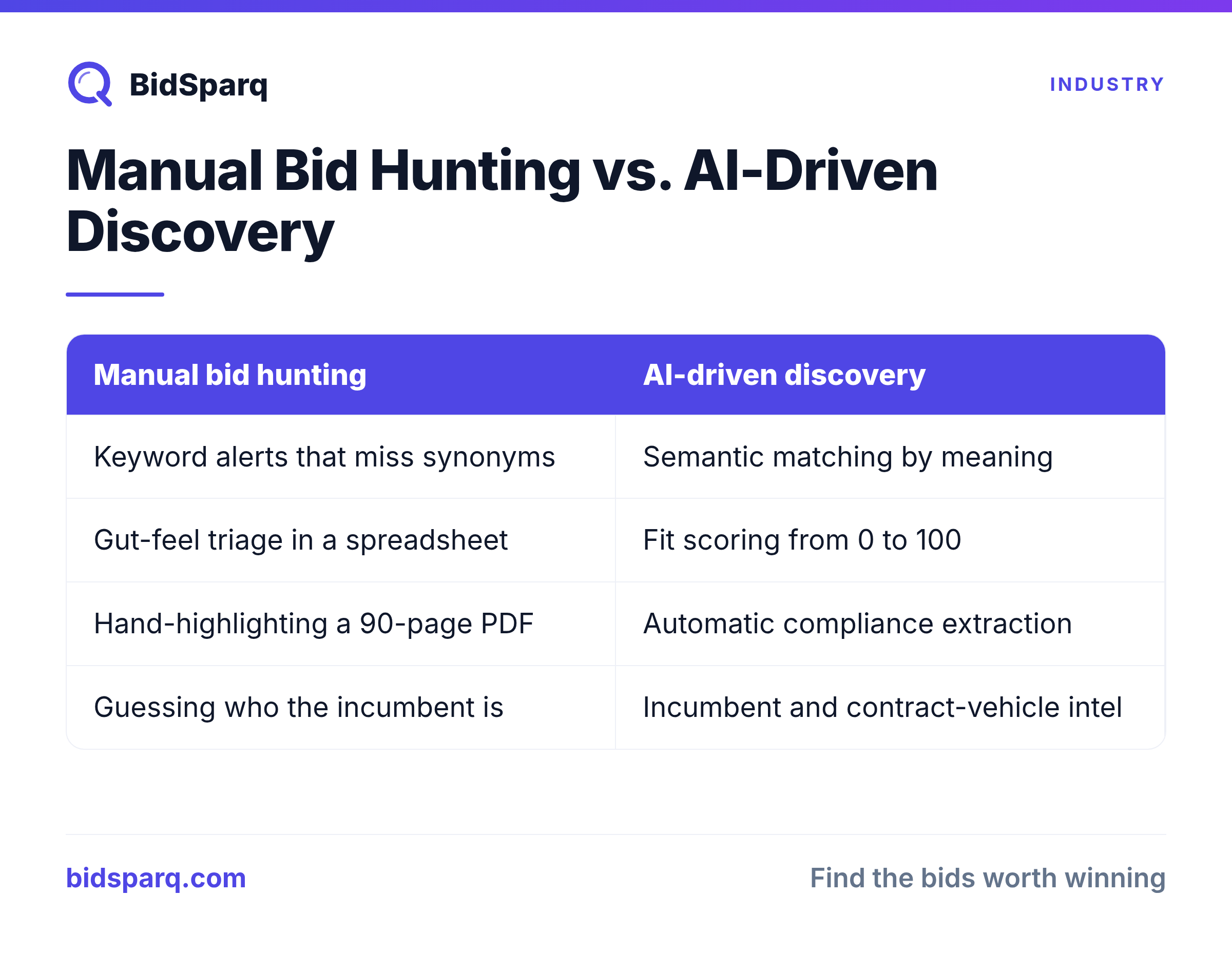
Stop trusting keyword alerts to surface your next contract. A hospital procurement lead searching for "sterile processing" will never see the bid filed under "instrument reprocessing services," and a keyword rule has no way to know they are the same job. That is the core weakness of the tools most teams still rely on: they match strings, not intent. Semantic matching works the way a person would, reading a solicitation for what it actually asks for and connecting it to what you actually do. The result is fewer missed opportunities and far less time spent tuning search terms that were always going to leak.
Scoring Fit Before You Spend a Week on It
Rank every opportunity before you invest a single hour of proposal time. Volume is not the problem anymore; relevance is. When thousands of bids surface across every vertical daily, the question is not what is out there but which few are worth your team this week. AI fit-scoring answers that by grading each opportunity from 0 to 100 against your capabilities, geography, size, and past wins. Manual triage does the same job with a spreadsheet and a gut feeling, and it buries strong matches under weak ones. A ranked score puts the winnable work at the top and lets you say no to the rest without second-guessing.
Turning a 90-Page Solicitation Into a Checklist
Let the machine read the fine print so your people do not have to. Public solicitations are dense by design, and the disqualifying detail is usually a single line about a certification, a bonding threshold, or a submission format. AI compliance extraction reads the full document and pulls those requirements into a structured checklist automatically, flagging what you must prove and where. Compare that to the manual version, where a coordinator highlights a PDF and hopes nothing was missed. One approach scales across every bid you consider; the other breaks the moment volume climbs or the deadline tightens.
Seeing the Field Before You Bid
Know who holds the contract and how it is bought before you decide to chase it. The hardest questions in procurement are rarely in the RFP itself. Who is the incumbent? Which contract vehicle or cooperative agreement is this actually flowing through? Is this a real opening or a formality for a renewal already decided? AI-driven intelligence surfaces incumbent history and contract-vehicle context so you enter with a clear read instead of a hunch. This is where BidSparq puts much of its effort, because a smart no-bid decision protects your team's time just as much as a well-targeted yes.
Why Government Is the Loudest Test Case, Not the Whole Story
Treat public procurement as the proving ground, not the boundary. Government buying is the loudest example because it is the most rule-bound, with strict formats, published requirements, and clear award trails that give AI a rich, structured problem to solve. But the same mechanics travel. A K-12 district evaluating curriculum vendors, a health network sourcing equipment, and a builder tracking subcontract packages all face the same core challenge of finding and qualifying opportunities faster than a human can read them. Aggregating 23,000+ distinct bid sources daily only matters because the intelligence layer on top makes that firehose usable across all of it.
FAQ
How is AI changing government procurement in practice?
In practice, AI shifts the work from hunting to deciding. Instead of manually scanning portals and keyword alerts, teams get opportunities matched by meaning, scored for fit, and pre-read for compliance requirements. That means less time gathering and more time on the bids you can actually win.
Can AI help find bids outside of government?
Yes, and increasingly that is the point. The same semantic matching and fit-scoring that work for federal, state, and local bids apply just as well to education, healthcare, construction, IT, and commercial opportunities. Government is one vertical among many, not a separate system.
Does AI replace the proposal team?
No. AI removes the low-value work of finding, sorting, and reading, so proposal teams spend their hours on strategy, pricing, and the writing itself. The judgment stays human; the search and triage do not have to be.
The fastest way to see the difference is on your own pipeline. See how AI-driven bid matching works for your market and check your matches free, no credit card needed.
Find RFPs that match your business
BidSparq monitors 23,000+ procurement sources and uses AI to score every opportunity against your capabilities. Try it free for 14 days.
Start Free Trial →