How to Decide Which RFPs to Bid On (and Win More)
The most expensive move a lean team can make is spending three weeks on a proposal it was never going to win. Here is a five-filter system for deciding which RFPs to bid on, so you find, score, and qualify opportunities before you commit.
It is day nineteen of a three-week proposal sprint. Your team has finished the technical volume, locked the pricing, and chased three subcontractors for commitment letters. Then someone reads page 38 closely and finds a mandatory certification your company does not hold. The bid was dead before the kickoff meeting, and you just spent three weeks proving it.
The problem is almost never effort. It is selectivity. The teams that grow are not the ones that submit the most proposals; they are the ones that pick the right ones. A small shop that turns down the wrong opportunities can write four proposals a year and win two. The shop that bids everything writes twenty, wins one, and burns out its best people getting there.
This holds whether you sell to school districts, hospital systems, city governments, transit agencies, or commercial buyers. Government is one vertical inside a far broader procurement market, and the fragmentation is the same everywhere. So is the fix: a repeatable way to decide which RFPs to bid on before you write a word. Here are the five filters to run every opportunity through, in order.
- Win rate comes from selectivity, not volume: bid on fewer opportunities and qualify each one before you draft.
- Aggregate every source into one feed instead of checking portals by hand; the procurement market spans more than 23,000+ sources.
- Match opportunities by meaning, not keywords, so you catch the right bids and skip the noise.
- Score each opportunity 0 to 100 before you read it, then read for disqualifiers before you draft.
- Check the incumbent and contract vehicle before you commit; incumbency is the strongest single predictor of your odds.
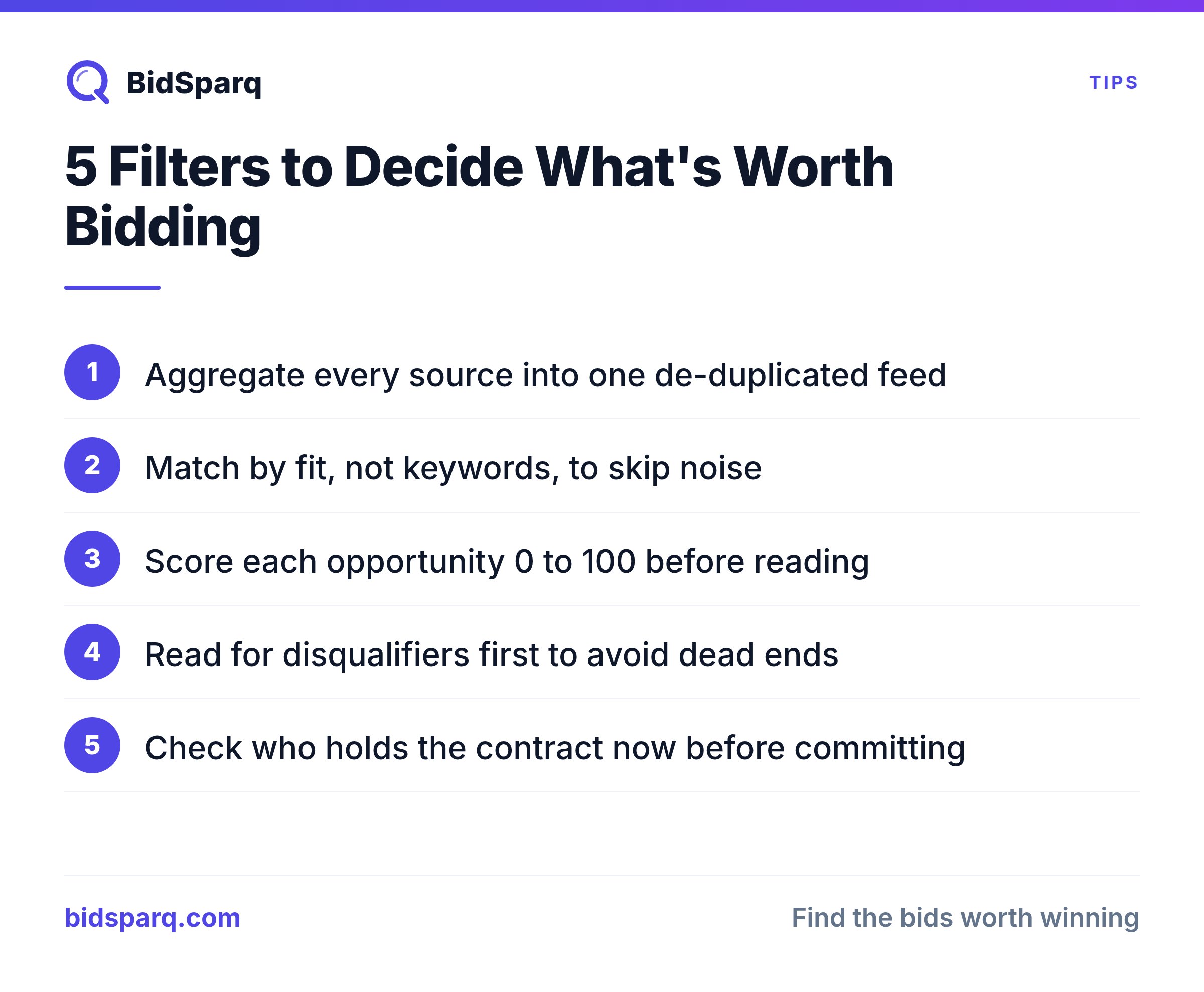
1. Pull every source into one feed
Aggregate every source automatically instead of checking portals by hand. Opportunities are scattered across an absurd number of systems: K-12 and higher-ed portals, hospital and health-system purchasing, state and local government, the federal layer such as SAM.gov and Grants.gov, transit authorities, and private-sector buyers. Many of these make you create an account before you can even read a title, and once you count them all there are more than 23,000+ distinct sources.
No person checks all of those every week, so stop trying. Automated aggregation pulls from every source into one de-duplicated feed, which means you choose from the whole market instead of the three portals you remembered to open. The benefit is coverage you cannot get manually: the right opportunity no longer depends on whether you happened to log in that day.
2. Match by fit, not keywords
Match opportunities by meaning so you stop missing the ones that use different words. Most search tools compare the literal words in a solicitation against the literal words in your saved search. You either drown in irrelevant results or miss the perfect contract because it said "instructional technology" when you searched "education software." Keyword alerts punish you for not guessing the buyer's exact vocabulary.
Semantic matching, the approach behind BidSparq, compares meaning instead. It understands that a "K-12 digital learning platform" and an "educational software" solicitation are the same opportunity even when the wording differs. The embeddings that make this reliable only matured in the last few years, and the payoff over keyword alerts is direct: you catch the right bids and skip the noise without maintaining a brittle list of search terms.
3. Score before you read
Put a number on fit before you spend a minute reading. Not every matching opportunity deserves thirty hours. Before you open a solicitation, you want a score that answers one question: does this fit your size band, certifications, geography, and track record? An automated 0 to 100 score with a plain-English reason turns "this looks interesting" into "this is worth the week" or "skip it," and it does that in seconds rather than after an afternoon of reading. If you do not have a tool that scores, write down the five factors that matter most to your shop and rate every opportunity one to five on each before you commit. The discipline matters more than the precision: a consistent number stops you from chasing whatever landed in your inbox most recently.
4. Read for disqualifiers first
Hunt for the reason you cannot win before you look for reasons you can. Before drafting a word, pull every mandatory requirement and check whether you actually meet it. A single missed "shall" statement kills a proposal faster than anything else: a mandatory certification buried on page 38, a bonding threshold you cannot reach, a past-performance minimum you do not have. Automatic compliance extraction maps every requirement to the source document, so the day-three discovery that you were never eligible becomes a five-minute check on day one. A careful manual read does the same job; the point is that you run it before you invest, not after.
5. Check who holds it now
Read the incumbent before you read the scope. Incumbency is the strongest single predictor of your odds. A thin scope on a large contract often means the incumbent helped write the requirements. A two-week window to produce a fifty-page technical volume usually means someone already had a head start. Automated incumbent and vehicle intelligence surfaces who holds the work now, which contract vehicle it sits under, and how wired the outcome looks, so you can read the pattern at a glance instead of digging through award records. You can assemble most of this from the public record by hand too; either way, a long-time incumbent plus a vague scope plus a short clock is a fight you usually decline.
Run an opportunity through those five filters and you will set aside most of what you would have bid on a year ago. That is the point. The proposals you do write target contracts you can actually win, and your team stops losing weekends to dead bids. BidSparq runs the first four filters automatically: it aggregates 23,000+ sources, matches by meaning, scores every opportunity 0 to 100, and extracts the disqualifiers, so your hours go to the bids you can win. It is free to start, with Pro Max at $249 a month, or $199 a month billed annually.
See your matches free, no credit card required.
FAQ
How do you decide which RFPs to bid on?
Run every opportunity through five filters in order: aggregate it into one feed, match by fit rather than keywords, score it 0 to 100, read for disqualifiers, and check the incumbent. Only write proposals for the opportunities that clear all five.
What is the difference between keyword matching and fit-based matching?
Keyword matching looks for the exact words in your saved search, so it misses opportunities that describe the same need in different language. Fit-based, or semantic, matching compares meaning, so a "K-12 digital learning platform" RFP surfaces even when you searched "education software."
How do you track RFPs across so many portals?
Aggregate them. Instead of logging into dozens of government, education, healthcare, and commercial portals by hand, use one automated feed that pulls from every source and removes duplicates, so you choose from the whole market at once. Across procurement, that means more than 23,000+ sources.
Find RFPs that match your business
BidSparq monitors 23,000+ procurement sources and uses AI to score every opportunity against your capabilities. Try it free for 14 days.
Start Free Trial →