How to Find RFPs for Small Businesses: Set-Asides, Free Sources & Strategy
A practical guide to finding government RFPs as a small business. Set-aside programs, free search methods, certifications, and how to compete against larger firms.
Small businesses have a massive advantage in government procurement that most people don't realize: the federal government is required by law to award at least 23% of prime contract dollars to small businesses. That's over $150 billion per year in set-aside and small-business-preferred contracts.
But finding those opportunities is harder than it should be. They're scattered across federal, state, local, and education portals: each with different search interfaces and registration requirements.
This guide covers exactly where small businesses should look for RFPs, which certifications give you the biggest advantage, and how to build a pipeline without spending 10 hours a week on manual searching.
Your Biggest Advantage: Set-Aside Programs
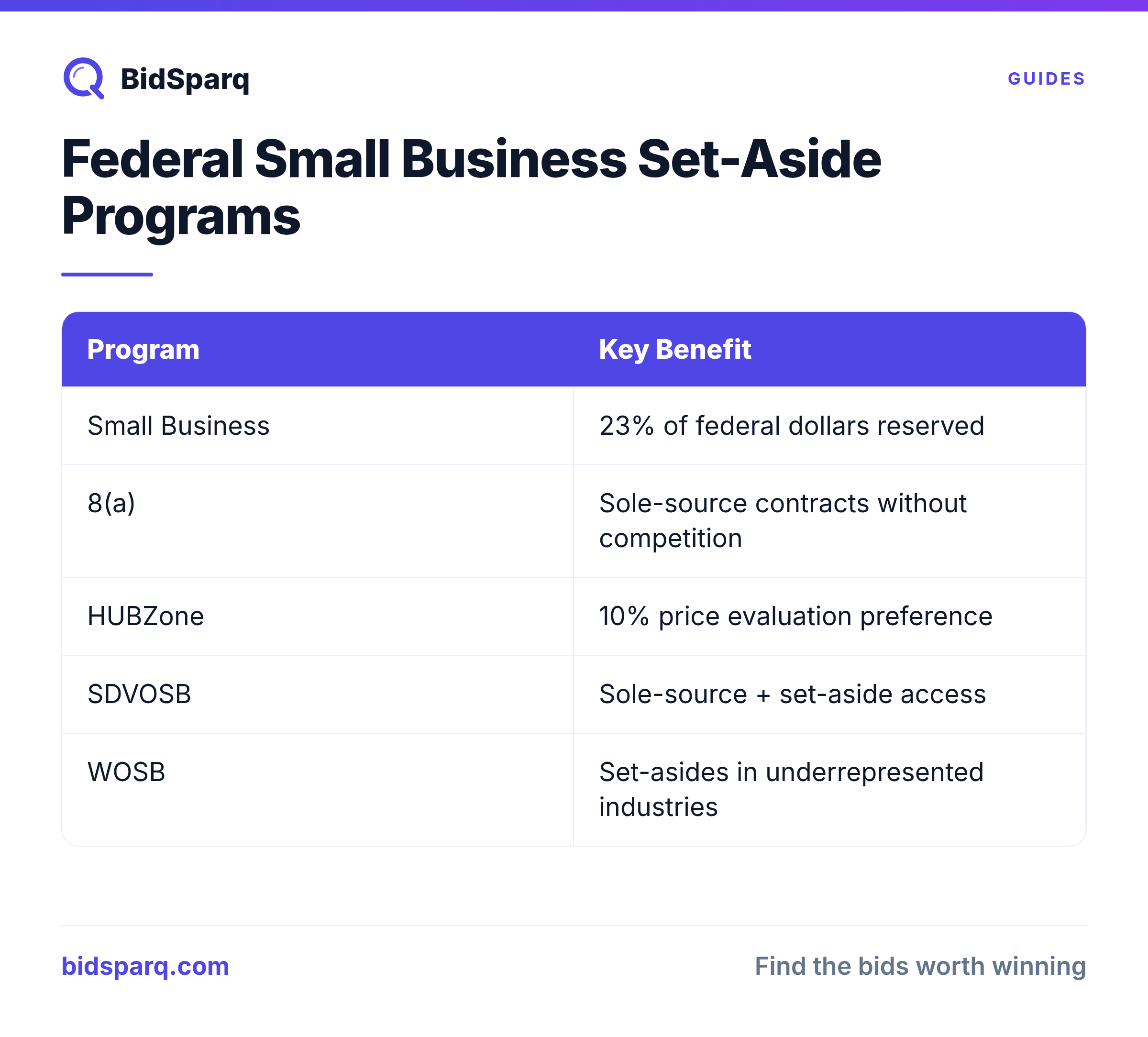
Set-aside programs restrict competition on certain contracts to small businesses only. Instead of competing against Deloitte or Booz Allen, you compete against firms your size. The major federal set-aside programs:
| Program | Who Qualifies | Sole-Source Limit | Key Benefit |
|---|---|---|---|
| Small Business | Under SBA size standard for your NAICS | N/A | 23% of federal dollars reserved |
| 8(a) | Socially & economically disadvantaged owners | $4.5M (services) / $7M (mfg) | Sole-source contracts without competition |
| HUBZone | Located in underutilized business zones | $4.5M / $7M | 10% price evaluation preference |
| SDVOSB | Service-disabled veteran-owned | $5M / $7M | Sole-source + set-aside access |
| WOSB | Women-owned (51%+) | $5M / $7M | Set-asides in underrepresented industries |
If you qualify for any of these, get certified immediately. A single 8(a) sole-source contract can be worth more than a year of commercial revenue. Read our complete set-aside programs guide for qualification details.
Where to Find Small Business RFPs
Federal Sources (Free)
- SAM.gov: Filter by set-aside type to see only small business opportunities. Use NAICS code search, not keywords.
- GSA eBuy: If you hold a GSA Schedule, task orders appear here. Many are set aside for small businesses.
- SBA Dynamic Small Business Search: Gets your firm in front of large primes looking for small business subcontractors.
- SubNet (SBA): Subcontracting opportunities posted by large primes required to use small business subs.
State & Local Sources (Free)
Don't overlook state and local government. Many states have their own small business preference programs, and local contracts are often less competitive than federal:
- State procurement portals: Every state has a free bid board. Filter for small business preferences where available.
- City and county purchasing departments: Check the procurement page of your city and county. Many have small/local business preferences.
- Transit authorities and special districts: Water districts, airports, transit agencies, all have procurement budgets and DBE/SBE goals.
Education Sources (Free)
- E-Rate (USAC): Free portal for school technology RFPs. Schools buy from small businesses regularly.
- Cooperative purchasing: BuyBoard, SourceWell, TIPS-USA, sell to thousands of schools and agencies under one contract.
- School district procurement pages: Individual districts post RFPs on their websites or on platforms like IonWave and BonFire.
Stop searching 50 portals: let AI find your matches
BidSparq monitors 23,000+ sources and scores every RFP against your profile. Filter by set-aside type across federal, state, local, and education: in one dashboard.
Start Free 14-Day Trial →Search Strategies That Work for Small Businesses
1. Filter by Set-Aside First
On SAM.gov, the first filter you apply should be set-aside type. This immediately narrows results to opportunities where you have a competitive advantage. Don't waste time reading RFPs where you'll compete against large primes.
2. Search by NAICS Code, Not Keywords
NAICS codes catch opportunities regardless of how the contracting officer titled them. "IT modernization," "digital transformation," and "cloud migration" might all use NAICS 541512.
3. Monitor Pre-Solicitation Notices
Sources Sought and RFI notices give you weeks of lead time before the RFP drops. Responding also puts your company on the agency's radar: some contracting officers specifically look for small businesses who responded to their market research.
4. Use a Bid/No-Bid Framework
"The most expensive thing a small contractor can do is spend three weeks writing a proposal for an opportunity they had no realistic chance of winning." (r/GovernmentContracting)
Small businesses can't afford to bid on everything. A disciplined bid/no-bid framework is the highest-leverage change you can make. Focus your limited BD resources on opportunities where you have a realistic win probability.
5. Start Small, Build Up
If you're new to government contracting, start with:
- Micro-purchases (under $10,000): simplified buying, often no formal proposal needed
- Simplified acquisitions (under $250,000): less competition, simpler proposals
- State and local contracts: often less competitive than federal
- Subcontracting: build past performance while learning the process
Read our guide to getting your first government contract for a complete step-by-step roadmap.
Common Mistakes Small Businesses Make
- Bidding on everything. More proposals ≠ more wins. Be selective and invest in quality proposals.
- Ignoring set-asides. If you qualify for 8(a) or SDVOSB and aren't using it, you're leaving money on the table.
- Only searching SAM.gov. Federal is just one market. State, local, and education represent billions more in spending.
- Not building relationships. Attend industry days, respond to Sources Sought, meet contracting officers. Government contracting is a relationship business.
- Underpricing to win. Agencies evaluate best value, not just lowest price. Undercutting signals you don't understand the work.
- Not tracking recompetes. The most winnable contracts are expiring ones where you can research the incumbent.
How Much Time Does RFP Searching Take?
For a small business checking portals manually:
| Approach | Weekly Time | Annual Cost (at $100/hr) | Coverage |
|---|---|---|---|
| SAM.gov only | 2-3 hours | $10,400-15,600 | Federal only |
| SAM.gov + state portal | 4-6 hours | $20,800-31,200 | Federal + 1 state |
| SAM.gov + state + local + edu | 8-12 hours | $41,600-62,400 | Broad but exhausting |
| BidSparq (AI-scored) | 30 min/week | $1,188/year | 23,000+ sources |
At $249/month, BidSparq costs less than 3 hours of BD staff time per month, and saves 5-10+ hours per week.
Frequently Asked Questions
How do I know if my business qualifies as "small"?
The SBA sets size standards by NAICS code. For most service industries, the threshold is $16.5-41.5 million in annual revenue. For manufacturing, it's typically 500-1,500 employees. Check the SBA size standards table for your specific NAICS code.
Can I bid on government contracts without certifications?
Yes. You can bid on any "full and open" competition and any "Total Small Business" set-aside without special certifications: you just need SAM.gov registration and small business status under your NAICS code. Certifications like 8(a) and SDVOSB give you access to additional sole-source and set-aside opportunities.
What's the easiest type of government contract to win?
Micro-purchases (under $10,000) require no formal proposal and can be awarded based on a phone call or email quote. Simplified acquisitions (under $250,000) have shorter proposals and less competition. State and local contracts are also generally less competitive than federal.
How long does it take to win a government contract?
Most small businesses take 6-18 months from first proposal submission to first award. The timeline depends on contract size, competition, and your past performance. Start with smaller, less competitive opportunities to build momentum.
Should I use a free RFP tool or a paid platform?
If you only bid on federal work, free methods (SAM.gov + state portal) can work, but expect to spend 5-10 hours/week searching. If you bid across multiple levels of government, a platform like BidSparq saves that time and catches opportunities you'd otherwise miss. See our platform comparison for a detailed breakdown.
Next Steps
- How to find RFPs: complete guide across all source types
- Set-aside programs guide: qualification details for every certification
- Getting your first government contract: step-by-step beginner's roadmap
- Start your free 14-day trial: see small-business RFPs matched to your profile from 23,000+ sources
Find RFPs that match your business
BidSparq monitors 23,000+ procurement sources and uses AI to score every opportunity against your capabilities. Try it free for 14 days.
Start Free Trial →