How to Bid on Government Contracts: A Step-by-Step Guide (2026)
A practical step-by-step guide to bidding on government contracts: from SAM.gov registration and UEI setup to finding opportunities, making go/no-go decisions, writing proposals, and what happens after award.
The U.S. government is the largest buyer of goods and services in the world: spending over $700 billion per year with private vendors. Yet most small and mid-size businesses never pursue a single contract, largely because the process seems opaque. It isn't. Government contracting follows a well-defined process, and once you understand the steps, the path from "never bid before" to "active vendor" is more straightforward than most people expect.
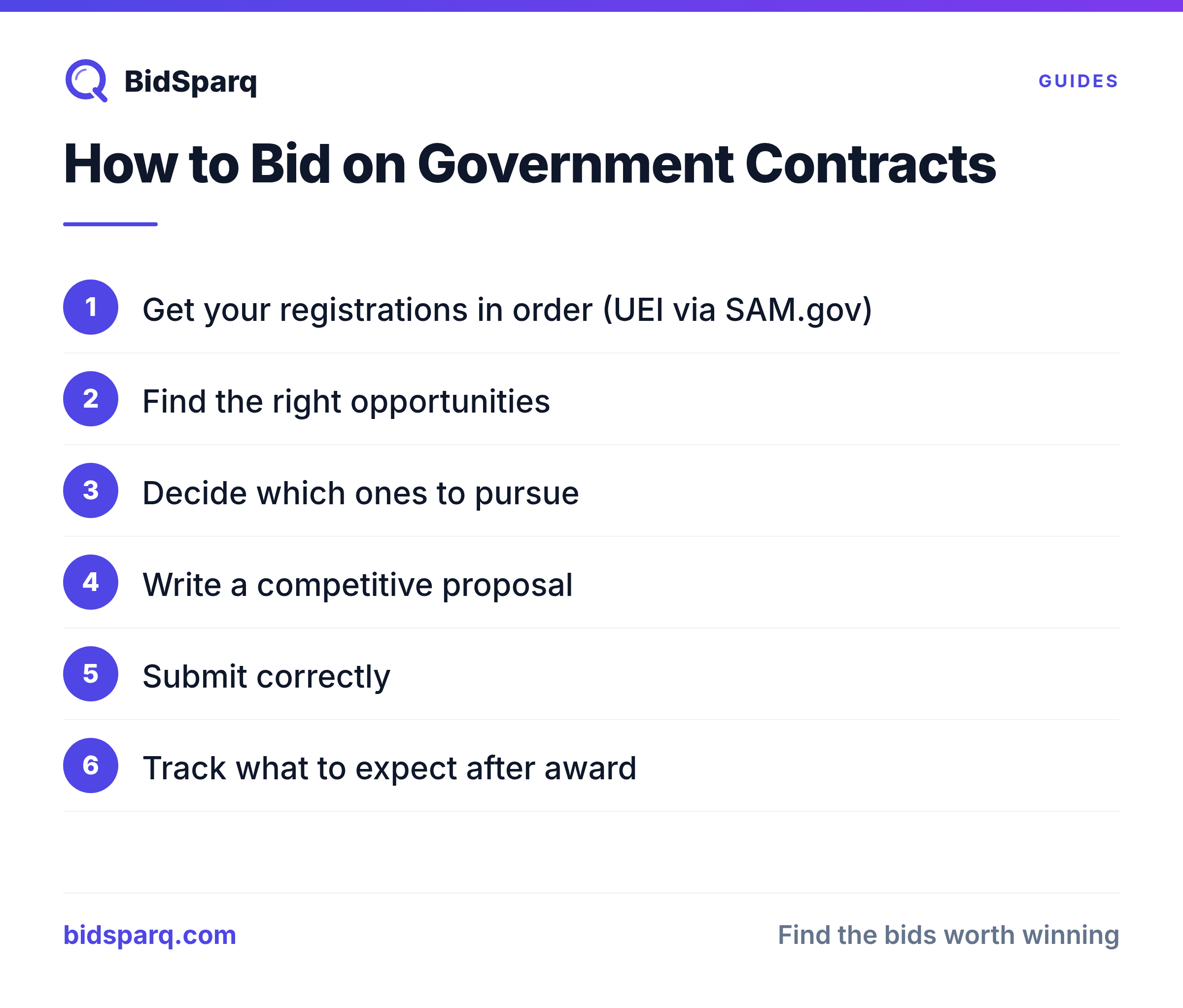
This guide walks you through every stage: getting registered, finding the right opportunities, deciding which ones to pursue, writing a competitive proposal, submitting correctly, and what to expect after award. If you're asking how do I bid on government contracts for the first time, start here.
Step 1: Get Your Registrations in Order
Before you can bid on a federal contract, and most state contracts: you need to complete a handful of mandatory registrations. This step trips up more new contractors than any other. Budget two to four weeks for the full process the first time through.
Unique Entity Identifier (UEI)
The UEI replaced the DUNS number in 2022. It's a 12-character alphanumeric identifier assigned free through SAM.gov that uniquely identifies your business in the federal procurement system. Without it, you cannot register in SAM.gov and cannot receive federal contract payments.
How to get it: Go to SAM.gov and create an account. During entity registration, your UEI is assigned automatically. The process requires your business legal name, physical address, and TIN (Tax Identification Number). It typically takes 5-10 business days to activate.
SAM.gov Registration (System for Award Management)
SAM.gov registration is mandatory for any business that wants to receive federal contract awards or grants above the micro-purchase threshold ($10,000). It's free, and you must renew annually or your registration lapses: which can delay payments on active contracts. If you're evaluating alternatives, see how SAM.gov compares to other search tools.
During registration you will provide:
- NAICS codes that describe your core capabilities
- Business size classification (small, large) under SBA standards
- Socioeconomic designations (veteran-owned, woman-owned, HUBZone, etc.)
- Banking information for Electronic Funds Transfer (EFT)
- Points of contact for contracting and accounts payable
Your NAICS code selection matters significantly. Choose the codes that best represent your core services: these are what contracting officers use to target solicitations and what set-aside eligibility is calculated against. Read our guide to NAICS codes for detailed guidance on selecting the right codes.
State and Local Registrations
If you want to bid on state and local government contracts: which represent billions in spending and are often less competitive than federal, you'll need to register separately with each state vendor portal you plan to bid in. Most states have a free vendor registration system. Some require annual renewal; others are one-time. Registration requirements vary significantly by state.
Registration Checklist
| Registration | Required For | Cost | Timeline |
|---|---|---|---|
| UEI (SAM.gov) | All federal contracts | Free | 5-10 business days |
| SAM.gov Entity Registration | Federal awards >$10K | Free | 5-10 business days |
| State vendor portal | State contracts | Free (most states) | 1-5 business days |
| SBA certifications (8a, HUBZone, WOSB, SDVOSB) | Set-aside eligibility | Free | 30-90 days |
| GSA Schedule | GSA task orders | Free (time-intensive) | 6-12 months |
Important: Beware of paid "registration assistance" services. The registrations above are all free through official government websites. Third-party services that charge $300-500 to register you in SAM.gov are legal but entirely unnecessary.
Step 2: Find the Right Opportunities
With registrations complete, the next challenge is actually finding contracts worth pursuing. The government posts solicitations across hundreds of separate portals: federal, state, county, city, education, transit, and special districts, and no single source covers them all.
Federal Sources
- SAM.gov: The mandatory source for all federal solicitations above $25,000. Use NAICS code filtering and set-aside type to narrow results. Set up saved searches with email alerts so new relevant opportunities land in your inbox. See our SAM.gov search tips guide for advanced filtering techniques.
- GSA eBuy: Task orders under GSA Schedule contracts. If you hold a GSA Schedule, this is a critical source for smaller task orders with less competition.
- Agency-specific portals: Some agencies (DoD, VA, HHS) run supplemental solicitation portals. Check the procurement pages of agencies you're targeting directly.
State and Local Sources
State, local, and education (SLED) contracts represent a substantial share of overall government spending, and competition is often lower than federal. Every state maintains a free vendor/bid portal. Counties, cities, transit authorities, school districts, and special districts each have their own procurement processes. The challenge is fragmentation: there are thousands of portals, and checking them manually is not realistic at scale.
Small businesses in particular benefit from SLED procurement, where set-aside programs and local preference rules can level the playing field further.
Using an RFP Discovery Platform
Manual searching across dozens of portals is the bottleneck that stops most small businesses from building a real bid pipeline. A purpose-built discovery platform like BidSparq monitors 23,000+ procurement sources continuously and uses AI to score every opportunity against your company profile: surfacing only the contracts where you have a realistic shot. Instead of spending 8-12 hours a week on manual searches, most contractors manage their full pipeline in under 30 minutes a week.
Stop searching 50 portals manually
BidSparq monitors 23,000+ federal, state, local, and education sources and scores every opportunity against your company profile. See your matched contracts in one dashboard.
Start Free 14-Day Trial →Step 3: Make a Disciplined Go/No-Go Decision
Finding opportunities is only the first filter. The most expensive mistake new government contractors make is responding to every RFP they can find. Proposals take significant time: federal RFPs routinely require 40-120 hours of effort, and a poorly-targeted proposal has near-zero probability of winning. A disciplined go/no-go process protects your BD investment.
Before committing to write a proposal, evaluate each opportunity against these criteria:
Go/No-Go Decision Checklist
| Criterion | Green (Go) | Red (No-Go) |
|---|---|---|
| NAICS / capability fit | Core service, strong past performance | Adjacent capability, no proven track record |
| Set-aside alignment | Set aside for your certification(s) | Full and open, competing against large primes |
| Incumbent status | No strong incumbent or recompete opportunity | Entrenched incumbent with 5+ year history |
| Contract size | Within your bonding/surety capacity | Requires resources or capacity you don't have |
| Response timeline | 30+ days to due date | Under 10 days: rushed proposals rarely win |
| Customer relationship | Prior contact with agency, attended industry day | Cold bid with no agency relationship |
| Win probability estimate | Above 25-30% (realistic) | Under 10%: opportunity cost too high |
A good rule of thumb: if you score red on three or more criteria, don't bid. Your time is better spent building relationships for the next solicitation cycle, or finding a better-fit opportunity. Read our bid/no-bid framework guide for a scoring model you can apply to every opportunity.
Step 4: Read the Solicitation Thoroughly
Before writing a single word of your proposal, read the full solicitation document: including all attachments, amendments, and referenced regulations. This step takes two to four hours for a typical federal RFP and saves far more time later by preventing costly misunderstandings.
Pay particular attention to:
- Section L (Instructions to Offerors): The rules for what your proposal must contain, page limits, formatting requirements, and submission method. Deviating from Section L requirements can result in your proposal being rejected without evaluation.
- Section M (Evaluation Criteria): How the government will score proposals and what factors matter most. Structure your proposal response directly to these criteria. If Section M says past performance is more important than price, lead with your strongest past performance narrative.
- Period of Performance and Deliverables: Make sure you can actually perform what's required within the stated timeline and budget.
- Amendments and Questions: Check SAM.gov for any amendments to the solicitation. If a Q&A period is open, submit questions about any unclear requirements. Answers are public and binding.
Step 5: Write a Competitive Proposal
Government proposal writing is a discipline of its own. The goal isn't to describe your company: it's to demonstrate, specifically and verifiably, that you are the least-risk, highest-value solution to the government's stated problem.
Core Proposal Sections
Most federal solicitations require responses across several standard volumes. Requirements vary by contract, but the most common sections are:
- Technical approach: How you will perform the work. Be specific, describe your methodology, tools, and team. Generic descriptions ("we will leverage our deep expertise...") score poorly. Evaluators reward specificity.
- Past performance: Contracts of similar size, scope, and complexity that you've successfully completed. For each reference, include contract number, agency name, dollar value, period of performance, and a point of contact. If you're a new company without direct past performance, subcontractor or team member experience can substitute.
- Management approach: Who will lead this contract, how you'll staff it, how you'll manage subcontractors, and your quality control process.
- Price / cost volume: Rates, labor categories, ODC estimates, and total price. For fixed-price contracts, price must be realistic and defensible. For cost-type contracts, you'll submit fully loaded labor rates with supporting documentation.
Proposal Writing Principles That Win
- Mirror the language in the SOW. Use the same terms and phrases the solicitation uses. Evaluators look for alignment between requirements and your response.
- Quantify everything possible. "Reduced processing time by 40%" beats "improved efficiency." Government evaluators are trained to look for verifiable claims.
- Write for the evaluator, not the agency. The person scoring your proposal may not be a technical expert in your field. Write clearly enough that a non-specialist understands why you're the right choice.
- Address the evaluation criteria explicitly. Structure your sections to map directly to Section M criteria. If it's not in your proposal, evaluators can't give you credit for it.
- Comply with formatting requirements. Font size, margin width, page limits: follow them exactly. Non-compliant proposals can be disqualified.
For firms just getting started, reviewing publicly available winning proposals on FOIA.gov and agency-specific FOIA pages is one of the fastest ways to understand what high-scoring proposals look like. Many agencies also publish debriefs: structured feedback on why you won or lost, which are invaluable for improving future proposals.
Step 6: Submit Correctly and on Time
Submission errors are a surprisingly common reason proposals get eliminated. Government contracting officers are generally not permitted to accept late submissions, and most won't grant extensions for technical difficulties on the submitting side.
Key submission rules:
- Submit before the deadline, not at it. Submit at least 24 hours early to account for portal issues, upload errors, and file size limits. Many contractors have lost bids because the portal was slow at 11:58 PM on deadline night.
- Use the required submission method. Most federal proposals go through SAM.gov or a designated portal per the solicitation instructions. Some agencies use agency-specific systems. Submitting through the wrong channel can invalidate your submission.
- Check file format requirements. Many solicitations specify PDF only, or set maximum file sizes. Make sure your submission matches.
- Keep your submission confirmation. Screenshot or save any confirmation number or acknowledgment from the submission portal. This is your proof of timely submission if a dispute arises.
Step 7: After Submission, What Happens Next
After you submit, the evaluation process begins on the government's timeline: which can range from a few weeks (simplified acquisitions) to 6-12 months (large complex programs). In the meantime, there are productive things you can do.
While Awaiting Award
- Respond to clarification requests. The contracting officer may issue Evaluation Notices (ENs) or clarification questions. Respond promptly and thoroughly: these often address specific weaknesses evaluators identified.
- Don't contact the contracting officer unnecessarily. Excessive follow-up is viewed negatively and can create the appearance of improper contact. Check SAM.gov for award notice updates instead.
- Continue building your pipeline. Never stop pursuing other opportunities while waiting on a single award. Experienced contractors run bids in parallel across multiple opportunities.
If You Win
Award is just the beginning. You'll need to:
- Review and sign the contract document carefully
- Submit any required insurance certificates, bonds, or clearance paperwork
- Set up your accounting system to track contract costs (DCAA-compliant if cost-type)
- Assign a dedicated contract manager to handle invoicing, deliverables, and reporting
If You Lose: Request a Debrief
You're legally entitled to a debrief after every federal proposal evaluation. Request it within 3 days of receiving the award notice. Debriefs reveal your numerical scores versus the awardee's, the specific weaknesses evaluators identified in your proposal, and the awardee's price (for most contract types). This feedback is the fastest way to improve your win rate on future bids.
Also consider protesting if you believe the award was improper, but only after consulting with a government contracts attorney. GAO protests have a 100-day resolution timeline and are sometimes strategically valuable even if ultimately unsuccessful.
A Note on Set-Asides: Your Biggest Competitive Advantage
If you qualify as a small business under the SBA size standards for your NAICS code, you have access to a substantial portion of the federal market that's reserved exclusively for small businesses. The government is legally required to award at least 23% of prime contract dollars to small businesses each year. Beyond the baseline small business designation, additional certifications unlock further advantages:
- 8(a) Business Development: Sole-source awards up to $4.5M (services) or $7M (manufacturing) without competition. Nine-year program with strong mentorship resources.
- HUBZone: 10% price evaluation preference and set-aside access for businesses in Historically Underutilized Business Zones.
- SDVOSB / VOSB: Service-disabled and veteran-owned set-asides, particularly strong at the VA.
- WOSB / EDWOSB: Women-owned set-asides in industries where women are underrepresented in federal contracting.
If you qualify for any of these, get certified before you submit your first proposal. The application process is free. Read our small business RFP guide for a full breakdown of set-aside programs and how to use them strategically.
Frequently Asked Questions
How do I bid on government contracts for the first time?
Start with three steps: (1) Register in SAM.gov and get your UEI, this is mandatory for any federal work and takes 5-10 business days. (2) Identify two or three NAICS codes that describe your core services and find active solicitations in those codes on SAM.gov or a discovery platform like BidSparq. (3) Start small: micro-purchases (under $10,000) and simplified acquisitions (under $250,000) have lighter proposal requirements and are ideal for building your first past performance reference. Don't start by pursuing a $10M federal contract. Build up to it with a track record.
How do I get government contracts for a small business?
The most direct paths for small businesses are: (a) apply for small business set-aside certifications that limit competition to companies your size, at minimum, ensure your SAM.gov registration correctly reflects your small business status; (b) pursue state and local contracts where competition is often lower than federal and relationship-building matters more; (c) consider subcontracting under a large prime contractor first to build past performance before pursuing prime contracts independently. Many large primes are legally required to subcontract a percentage of their work to small businesses and actively recruit qualified subs.
Do I need a lawyer to bid on government contracts?
For most straightforward commercial-item solicitations under $2-3M, you don't need legal counsel to submit a competitive proposal. However, a government contracts attorney becomes valuable when: reviewing a cost-type contract with complex accounting requirements; considering a GAO protest after an adverse award decision; negotiating large IDIQ contracts or teaming agreements; or handling any allegation of noncompliance. Many government contracts attorneys offer flat-fee proposal reviews that are worth the cost for large pursuits.
How long does it take to win a first government contract?
Most small businesses take 6-18 months from starting the registration process to receiving a first contract award. The range is wide because it depends on: how long it takes to complete SAM.gov registration and any certifications; how quickly you identify and respond to suitable opportunities; the evaluation timeline for the specific contracts you pursue (simplified acquisitions resolve faster than large federal programs); and how competitive the specific opportunities are. Contractors who focus on smaller, less-competitive opportunities and build relationships through industry days and Sources Sought responses consistently win faster than those who cold-bid large programs.
Start Building Your Bid Pipeline
Government contracting rewards consistency. The contractors who win aren't necessarily the ones with the largest proposals or the most certifications: they're the ones who have built a sustainable process for finding the right opportunities, making smart go/no-go decisions, and submitting strong proposals on a regular cadence.
- Best RFP management software for government contractors: tools to manage your full bid pipeline
- How to find RFPs as a small business: set-asides, free sources, and search strategy
- Best RFP search platforms compared: GovWin, BidNet, HigherGov, BidSparq, and more
- RFP vs. RFQ vs. IFB explained: understand the different solicitation types you'll encounter
- Government contract types explained: FFP, T&M, cost-plus, IDIQ, and when each is used
- Start your free 14-day trial of BidSparq: see matched government contracts from 23,000+ sources in minutes
Find RFPs that match your business
BidSparq monitors 23,000+ procurement sources and uses AI to score every opportunity against your capabilities. Try it free for 14 days.
Start Free Trial →