E-Rate RFPs: A Technology Vendor's Complete Guide
E-Rate funds $4 billion annually in school technology. Learn how the program works, where E-Rate RFPs are posted, the funding timeline, and how to position your business to win E-Rate contracts.
The E-Rate program (officially the Schools and Libraries Universal Service Support Program) provides $4 billion annually in federal funding to help schools and libraries purchase technology infrastructure and internet services. It's one of the largest and most consistent sources of government technology spending, and one of the most overlooked by vendors.
If you sell networking equipment, internet service, cabling, Wi-Fi infrastructure, cybersecurity solutions, or managed IT services, E-Rate is a market you should be in.
What Is E-Rate?
E-Rate is administered by USAC (Universal Service Administrative Company) under FCC oversight. It subsidizes 20-90% of eligible technology costs for schools and libraries, with the discount rate based on the percentage of students eligible for free/reduced lunch and whether the applicant is urban or rural.
The program covers two categories of service:
Category 1: Internet Access and Telecommunications
- Internet service (fiber, cable, fixed wireless)
- Wide Area Network (WAN) connections between buildings
- Cellular data plans for students
- Dark fiber and self-provisioned networks
- Telecommunications services
Category 2: Internal Connections and Managed Services
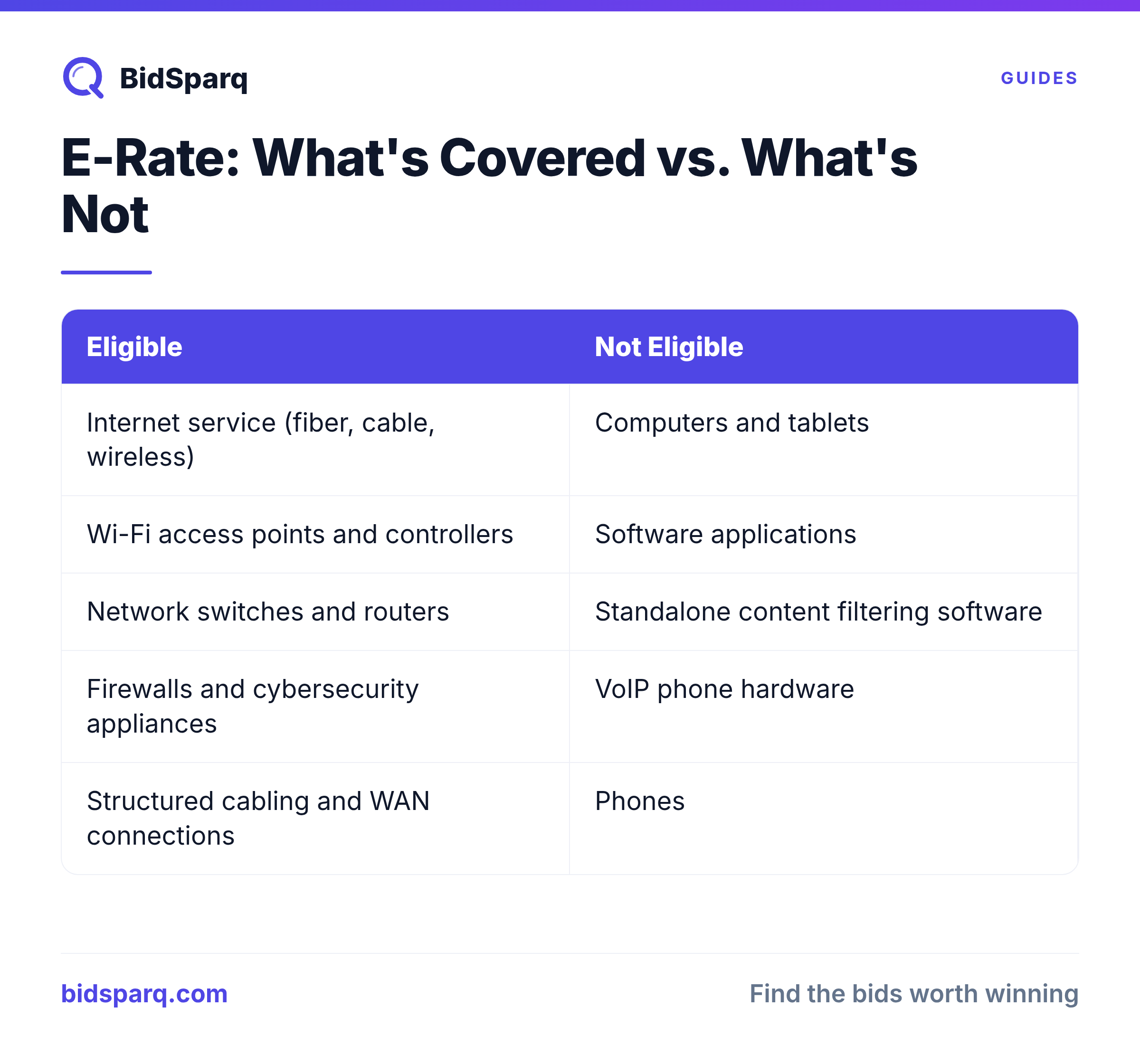
- Wi-Fi access points, controllers, and licensing
- Structured cabling
- Network switches and routers
- Firewalls and basic cybersecurity appliances
- Racks, UPS, and supporting equipment
- Managed internal broadband services
- Basic maintenance of eligible equipment
What's NOT covered: Computers, tablets, software applications, content filtering software (as a standalone purchase), phones (VoIP hardware is limited), and staff training.
The E-Rate Funding Timeline
E-Rate operates on a strict annual cycle tied to the FCC's funding year (July 1 to June 30). Understanding this timeline is critical for vendors: miss the window and you wait a full year.
| Timeframe | What Happens | Vendor Action |
|---|---|---|
| July-October | Schools assess technology needs and plan projects | Reach out to districts. Help them identify needs. |
| October-January | Schools post RFPs (Form 470) to the USAC portal | Monitor and respond to Form 470 postings |
| January-March | 28-day competitive bidding window runs. Schools evaluate bids. | Submit competitive bids. Present solutions. |
| January-March | Schools select vendors and file Form 471 (funding request) | Help applicants with Form 471 preparation |
| April-June | USAC reviews and approves (or denies) funding requests | Wait for approval. Prepare for deployment. |
| July 1+ | New funding year begins. Approved projects can start. | Begin delivery and installation. |
Key rule: The 28-day competitive bidding period is mandatory. Schools must post their Form 470 and wait at least 28 days before selecting a vendor. If a vendor is selected before the 28 days expire, the funding request can be denied.
Where E-Rate RFPs Are Posted
USAC Form 470 Search
Every E-Rate procurement must be posted on the USAC portal as a Form 470. This is the official source and where the 28-day clock starts. You can search by state, applicant name, or service type.
School District Procurement Portals
Many districts also post their E-Rate RFPs on their regular procurement platforms: IonWave, Bonfire, PlanetBids, or their own website. These often include more detailed specifications than the Form 470 summary.
State Procurement Portals
Some states aggregate education procurement. For example, PEPPM in Pennsylvania and BuyBoard in Texas include E-Rate-related solicitations.
E-Rate Consultants
Many school districts hire E-Rate consultants to manage the process. These consultants often distribute RFPs to their vendor networks before (or simultaneously with) the Form 470 posting. Building relationships with E-Rate consultants in your target regions is a valuable channel.
How to Win E-Rate Contracts
Understand the Evaluation
E-Rate evaluations are different from typical government procurements. USAC requires that price be the primary factor, but schools can also consider:
- Prior experience with the vendor
- Experience with similar projects
- References from other schools
- Quality of proposed solution
- Local presence and support capability
In practice, while price is weighted highest, schools heavily value vendors who understand the E-Rate process and can help navigate the compliance requirements.
Know the Compliance Rules
E-Rate has strict compliance requirements that trip up vendors unfamiliar with the program:
- Competitive bidding: The 28-day window is non-negotiable. Don't help a district circumvent it: denied funding hurts both of you.
- Gift rules: You cannot provide free goods or services to influence the bidding process. This includes free needs assessments, free equipment during the bidding period, or hosted dinners.
- Lowest corresponding price: Your E-Rate pricing must be at or below what you charge non-E-Rate customers for the same services. USAC audits this.
- Documentation: Keep records of everything, quotes, correspondence, contracts, installation documentation. USAC audits can occur years after the funding year.
Help With the Process
Many school districts: especially smaller ones without dedicated IT staff, struggle with E-Rate paperwork. Vendors who can guide applicants through the process (within compliance rules) build lasting relationships:
- Help identify which services and equipment are E-Rate eligible
- Assist with technology planning documents (required for Category 2)
- Provide quotes in the format USAC expects
- Support Form 471 preparation with accurate service descriptions
- Ensure invoicing matches the approved funding request
E-Rate as a Business Strategy
Why E-Rate deserves a dedicated sales strategy:
- Predictable revenue. E-Rate funding is allocated annually with a consistent $4B+ budget. It's not subject to agency budget uncertainty the way most government contracts are.
- High renewal rates. Schools that buy from you this year will likely buy from you next year. Internet service contracts often run 3-5 years.
- Lower competition. Many vendors avoid E-Rate because of the compliance complexity. If you master the process, the competitive field is smaller than you'd expect.
- Recession-resistant. E-Rate funding comes from telecom carrier surcharges, not annual appropriations. It's more insulated from budget cuts.
- Built-in funding. Your customer has 20-90% of the cost covered by federal subsidies. This makes your solution dramatically more affordable from their perspective.
Common E-Rate Mistakes
- Bidding after the window closes. If the 28-day period has passed and the district has already selected a vendor, you're too late for that funding year.
- Proposing ineligible equipment. Computers, tablets, and most software are not E-Rate eligible. Proposing them shows you don't understand the program.
- Ignoring the lowest corresponding price rule. If USAC discovers you charged a school more than your commercial rate, funding can be clawed back: from the school.
- Not tracking the timeline. E-Rate Form 470s are posted on a rolling basis from October through January. Set up alerts so you don't miss postings in your region.
- Treating it like a one-time sale. E-Rate is a relationship business. Districts that trust you will come back year after year. Invest in the relationship.
How BidSparq Covers E-Rate
BidSparq scrapes E-Rate solicitations alongside all other procurement sources:
- USAC Form 470 monitoring: E-Rate postings appear in your matched feed alongside federal and state RFPs
- School district portals: IonWave, PEPPM, BuyBoard, and other education platforms are included in our 23,000+ sources
- AI scoring: E-Rate RFPs are scored against your profile, if you sell networking equipment, you'll see relevant E-Rate opportunities ranked by fit
- Education vertical filtering: Filter your dashboard to show only education procurement, including E-Rate
Next Steps
- Start your free trial: see E-Rate and education RFPs matched to your technology business
- Browse state procurement portals that aggregate education procurement
- Learn about cooperative purchasing: another major channel for selling to schools
- Understand NAICS codes for your education technology products and services
- Browse active education RFPs on BidSparq
- Read our guide to SLED government contracting: the broader market E-Rate sits within
Find RFPs that match your business
BidSparq monitors 23,000+ procurement sources and uses AI to score every opportunity against your capabilities. Try it free for 14 days.
Start Free Trial →