How to Get Your First Government Contract: A Beginner's Roadmap
Everything you need to know to land your first government contract: from registering in SAM.gov to finding the right RFPs, writing your first proposal, and building past performance.
Getting your first government contract feels overwhelming. The registration requirements, the unfamiliar terminology, the 80-page solicitation documents: it's a lot. But thousands of small businesses break into government contracting every year, and the payoff is worth it.
Government contracts provide predictable revenue, long-term relationships, and growth opportunities that commercial work rarely matches. A single 5-year IDIQ contract can transform a small business.
Here's your step-by-step roadmap.
Step 1: Get Registered
Before you can bid on anything, you need to be registered in several systems:
SAM.gov Registration (Required)
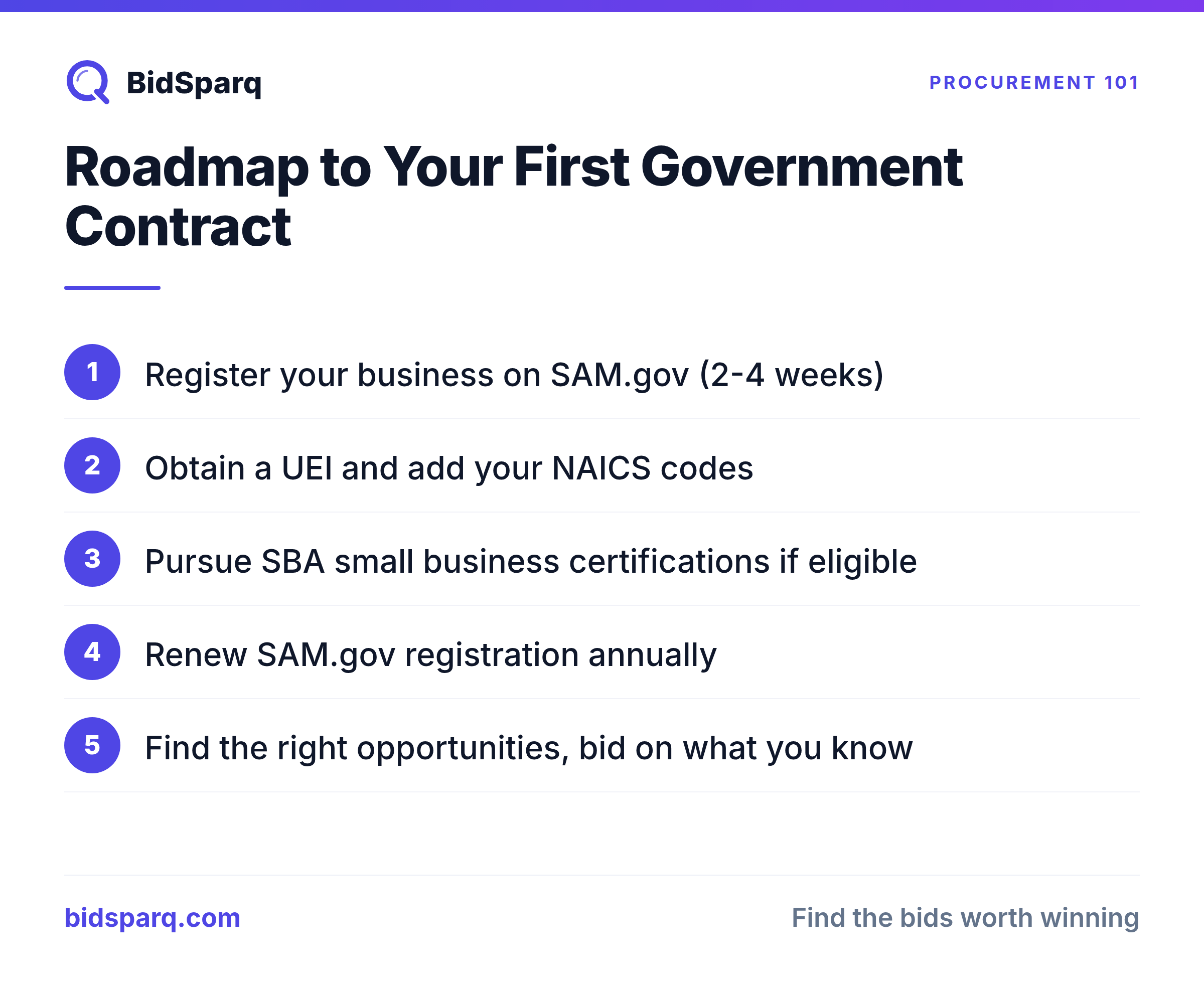
Register your business at SAM.gov. This is mandatory for all federal contractors. The process takes 2-4 weeks and requires:
- A UEI (Unique Entity Identifier): assigned automatically through SAM.gov
- Your NAICS codes (what type of work you do)
- Banking information for payment
- Business information (address, ownership, size)
Important: SAM.gov registration expires annually. Set a reminder to renew.
Small Business Certifications (Recommended)
If you qualify, get certified through the SBA certification portal:
- 8(a): Socially and economically disadvantaged
- HUBZone: Located in an underutilized business zone
- SDVOSB: Service-disabled veteran-owned
- WOSB/EDWOSB: Women-owned
These certifications dramatically reduce your competition on set-aside contracts. Read our complete guide to set-aside programs.
Step 2: Find the Right Opportunities
The biggest mistake new contractors make is bidding on everything. Instead:
- Start with what you know. Bid on work that matches your existing commercial experience exactly.
- Start small. Micro-purchases (under $10,000) and simplified acquisitions (under $250,000) have less competition and simpler proposal requirements.
- Start local. State and local contracts are often less competitive than federal ones. Your city and county governments buy the same services.
- Target set-asides. If you're certified, compete where you have an advantage.
Find your first government contract faster
BidSparq scans 23,000+ sources and AI-scores every opportunity against your profile. Filter by set-aside, contract size, and location: no more manual portal searches.
Start Free 14-Day Trial →Step 3: Respond to Sources Sought and RFIs
Before jumping into full proposals, respond to Sources Sought notices and RFIs (Requests for Information). These are low-effort responses that:
- Get your company on the agency's radar
- Help shape the eventual solicitation
- Build relationships with contracting officers
- Require only a capability statement, not a full proposal
A good capability statement is 2-3 pages covering: company overview, core competencies, past performance, certifications, and contact information.
Step 4: Write Your First Proposal
For your first proposal, pick an opportunity that:
- Matches your capabilities closely
- Is set aside for small businesses
- Has a reasonable deadline (at least 3-4 weeks out)
- Is within a contract size you can handle
Read our guide to writing winning proposals for detailed instructions. The key principle: follow the instructions exactly. Government evaluators score against specific criteria: creativity matters less than compliance.
Step 5: Build Past Performance
The catch-22 of government contracting: you need past performance to win, but you need to win to get past performance. Here's how to break through:
- Subcontracting. Partner with a prime contractor as a subcontractor. You gain past performance while learning the process.
- GSA Schedule. Getting on a GSA Schedule gives you access to task orders and builds your federal track record.
- State and local work. State and local contracts count as past performance and are often easier to win.
- Commercial relevance. Frame your commercial experience in government terms. 5 years of IT support for a hospital chain is relevant past performance for a VA IT contract.
- Mentor-Protege. The SBA's Mentor-Protege program pairs you with an experienced contractor who can share past performance and resources.
Realistic Timeline
| Milestone | Timeline |
|---|---|
| SAM.gov registration | 2-4 weeks |
| SBA certification | 2-6 months |
| First Sources Sought response | Month 1-2 |
| First proposal submitted | Month 3-6 |
| First contract award | Month 6-18 |
It takes time. Most successful government contractors spent 6-18 months before their first award. The ones who succeed are the ones who keep bidding.
Next Steps
- Start your free trial: BidSparq finds and scores opportunities from 23,000+ sources so you can focus on bidding, not searching
- How to find RFPs for small businesses: set-asides, free sources, and strategy
- Where to find government RFPs: complete source guide
- SAM.gov search tips: search like a pro
Find RFPs that match your business
BidSparq monitors 23,000+ procurement sources and uses AI to score every opportunity against your capabilities. Try it free for 14 days.
Start Free Trial →