How to Find RFPs for Free: 12 Methods That Actually Work
Every free method for finding government and commercial RFPs: from SAM.gov to Google Alerts to agency mailing lists. Plus when it makes sense to upgrade to a paid tool.
You don't need to spend $15,000 a year to find RFPs. There are legitimate, powerful free methods that can surface real opportunities: if you know where to look and how to use them.
This guide covers 12 free methods for finding RFPs across federal, state, local, and education procurement. We'll also be honest about where free methods hit their limits, so you can decide when (or if) a paid tool makes sense.
Federal RFPs (Free)
1. SAM.gov
The gold standard for federal opportunities. Every federal agency is required to post solicitations over $25,000 here. Free to search, free to set up email alerts.
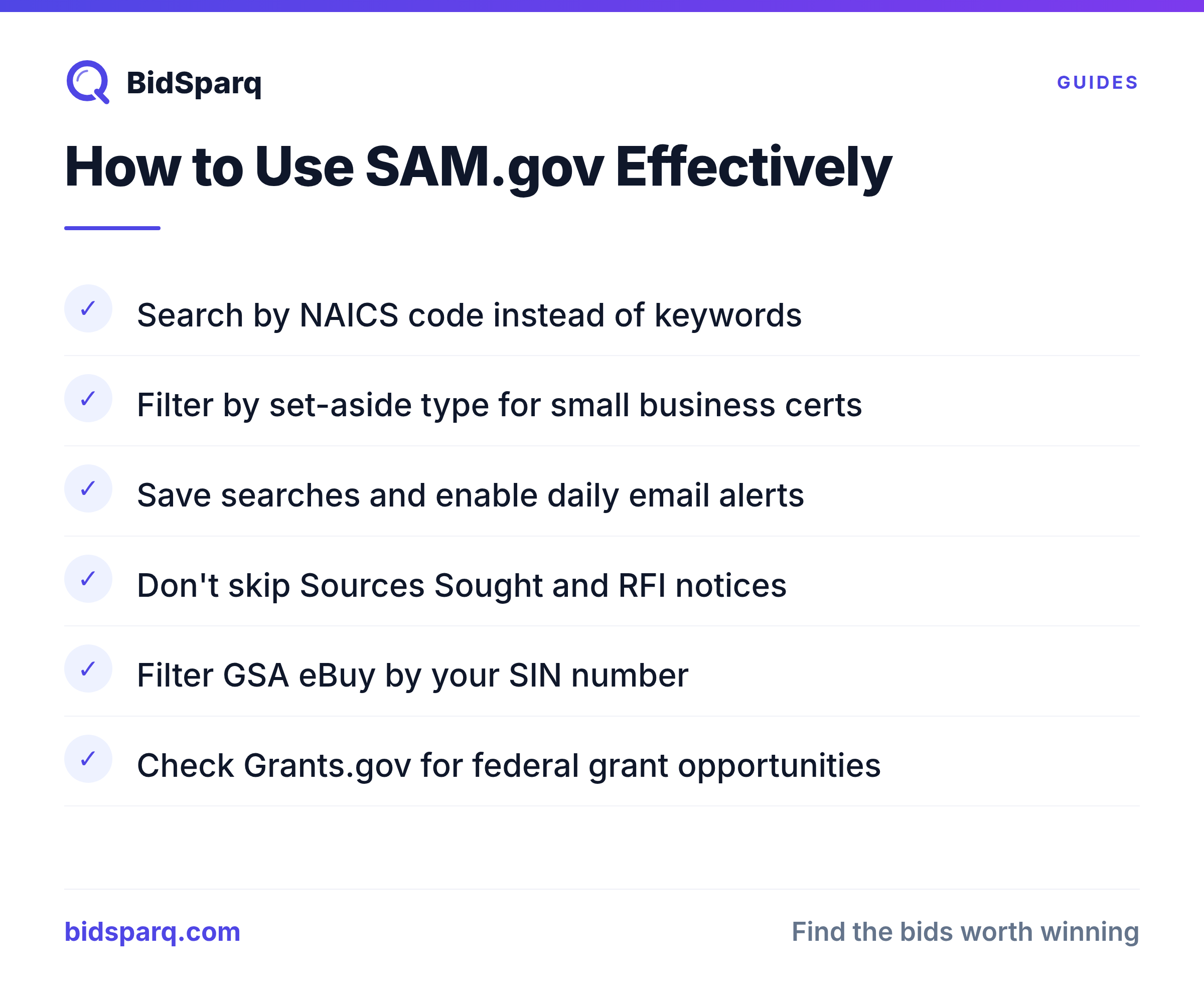
How to use it effectively:
- Search by NAICS code instead of keywords: you'll catch opportunities regardless of how the contracting officer titled them
- Filter by set-aside type if you have small business certifications
- Save your searches and enable daily email alerts
- Don't skip Sources Sought and RFI notices: they give you a head start
For more advanced techniques, see our SAM.gov search tips guide.
"I check SAM.gov 3-4 times a week but half the time I find stuff that's already closing in a day or two. Feels like I'm always behind." (r/GovernmentContracting)
2. GSA eBuy
If you hold a GSA Schedule contract, GSA eBuy is where task orders and RFQs appear. Free to use: you just need a GSA contract vehicle. Filter by your SIN (Special Item Number) to see relevant opportunities.
3. Grants.gov
For grants (not contracts), Grants.gov lists every federal grant opportunity. Essential if you're a nonprofit, university, research organization, or consulting firm that helps grantees. Free search and email alerts by CFDA number.
4. USASpending.gov and FPDS
These aren't sources of open RFPs, but they're invaluable for finding upcoming ones. By researching expiring contracts and incumbent holders, you can predict which contracts are coming up for recompete, and prepare before the solicitation drops.
State & Local RFPs (Free)
5. State Procurement Portals
Every state has a free bid board. Some of the best:
- Texas SmartBuy: Clean interface, easy to search by commodity code
- Cal eProcure: California's portal, covers state and some local
- eVA (Virginia): One of the most user-friendly state systems
- BidExpress: Used for DOT construction projects in many states
The downside: there are 50 state portals, each with different interfaces, commodity codes, and registration requirements. See our state procurement portals guide for the full list.
6. City and County Websites
Most cities and counties post bids on their own websites under "Purchasing," "Procurement," or "Bids & RFPs." This is where you find local contracts for services, construction, IT, and supplies.
The challenge: There's no central directory. You have to check individual websites. For cities you target regularly, bookmark their procurement pages and check weekly.
7. Platform-Specific Portals
Many local agencies use shared platforms that host bids from hundreds of entities:
- IonWave: Used by 50+ school districts and agencies
- BonFire: Popular with Canadian and US municipal procurement
- City & county portals: Thousands of municipalities post bids on their own procurement pages
- PlanetBids: West Coast municipalities and agencies
These are free to browse, but many require registration to see full details or download documents.
"I'm so tired of clicking links only to be met with 'You must register on our county-specific site.'" (r/GovernmentContracting)
Education RFPs (Free)
8. E-Rate / USAC Portal
The E-Rate program funds internet and technology for schools and libraries. The USAC portal lists all open Form 470 filings (which function like RFPs). Free to search: filter by state, service type, and funding year.
9. School District Procurement Pages
Individual school districts post bids on their websites, through cooperative purchasing organizations (BuyBoard, SourceWell, TIPS-USA), and on platforms like PEPPM. Most are free to access, though scattered.
Creative Free Methods
10. Google Alerts
Set up Google Alerts for terms like:
- "request for proposal" + [your industry]
- "RFP" + [your city or state]
- "solicitation" + [your NAICS description]
- site:gov "request for proposal" + [keyword]
Google Alerts are free, run daily, and catch opportunities posted directly on agency websites that don't syndicate to major portals.
11. Agency Mailing Lists and RSS Feeds
Many agencies maintain email lists for upcoming solicitations. Check the procurement page of agencies you sell to regularly: there's often a "Subscribe" or "Vendor Notification" link. Similarly, some state and federal portals offer RSS feeds.
12. LinkedIn and Industry Groups
Government contracting groups on LinkedIn share opportunities, teaming requests, and pre-solicitation intelligence. Follow agency procurement offices and join groups like "Government Contractors Network" and "Small Business Government Contracting."
LinkedIn won't replace a proper RFP search, but it surfaces opportunities and relationships you won't find on portals.
The Honest Limits of Free Methods
Free methods work. But they come with real costs that aren't in dollars:
| Challenge | Impact |
|---|---|
| Time | Checking 10-50 portals weekly takes 5-10 hours. At $75/hour BD cost, that's $375-750/week, or $19,500-39,000/year in labor. |
| Coverage gaps | No single person can monitor 23,000+ sources. You'll miss opportunities on portals you don't check. |
| No intelligence | Free portals show you the RFP exists. They don't tell you if you can win it, who the incumbent is, or what compliance requirements to watch for. |
| Late discovery | By the time you find an RFP manually, you may have days instead of weeks to respond. |
| Registration walls | Many portals require registration per agency or platform: dozens of accounts to maintain. |
If you're bidding on 1-2 opportunities a quarter from known agencies, free methods are fine. If you're actively growing your government business, the math usually favors automation.
When a Paid Tool Makes Sense
Consider upgrading from free methods when:
- You're spending more than 5 hours/week searching for RFPs
- You've missed an opportunity because you didn't check the right portal in time
- You're bidding across federal, state, and local, and can't keep up with all the portals
- You want to know your win probability before investing 20+ hours in a proposal
- You need competitive intelligence on incumbents and past awards
The paid market ranges from $2,000/year (BidNet: keyword search only) to $25,000/year (GovWin IQ, enterprise intelligence). BidSparq sits at $249/month ($199/month billed annually) with AI scoring, 23,000+ sources, competitive intelligence, and compliance checklists: designed for the contractor who's outgrown free methods but doesn't have an enterprise budget.
See our Best RFP Search Platforms Compared (2026) for a detailed side-by-side breakdown of every major platform.
Outgrown free methods?
BidSparq gives you 23,000+ sources with AI scoring for $249/month: less than a day of BD staff time. See your top-scored matches before paying anything.
Start Free 14-Day Trial →Frequently Asked Questions
Is SAM.gov really free to use?
Yes. SAM.gov is completely free to search, set up alerts, and download solicitation documents. You do need a free SAM.gov account to save searches and receive email notifications.
What's the best free way to find local RFPs?
Check your city and county procurement websites directly, plus regional platforms like IonWave and BonFire. Set up Google Alerts for "RFP" + your city name to catch opportunities posted on agency websites.
Can I find education RFPs for free?
Yes. The USAC E-Rate portal lists all open Form 470 filings for free. Individual school district procurement pages are also free to access, though they're scattered across thousands of websites.
How much time does manual RFP searching take?
Most contractors who rely on free methods estimate 5-10 hours per week checking portals, reading solicitations, and filtering irrelevant results. At typical BD hourly costs, this adds up to $19,500-39,000/year in labor.
Next Steps
- Read our complete guide on how to find RFPs across every source type
- Start your free 14-day trial: see what 23,000+ sources and AI scoring look like in practice
- Master SAM.gov search tips to get more out of the best free portal
- Learn about set-aside programs to find opportunities where you have a built-in advantage
Find RFPs that match your business
BidSparq monitors 23,000+ procurement sources and uses AI to score every opportunity against your capabilities. Try it free for 14 days.
Start Free Trial →