Subcontracting: How to Break Into Government Contracting as a Small Business
The past performance catch-22 blocks most new contractors. Learn how subcontracting builds your credentials, relationships, and CPARS history to position you for prime contracts.

Every new government contractor faces the same catch-22: you need past performance to win contracts, but you need contracts to build past performance. It's the government contracting version of "you need experience to get experience."
The most-recommended solution from experienced contractors is clear: start as a subcontractor.
"Subcontracting before trying to prime. They used sub work to learn the agency, build past performance, and get their name into CPARS before ever competing on their own." (r/GovernmentContracting)
This guide covers how to find subcontracting opportunities, what to look for in a teaming arrangement, and how to leverage sub work into prime contracts.
Why Subcontracting First Makes Sense
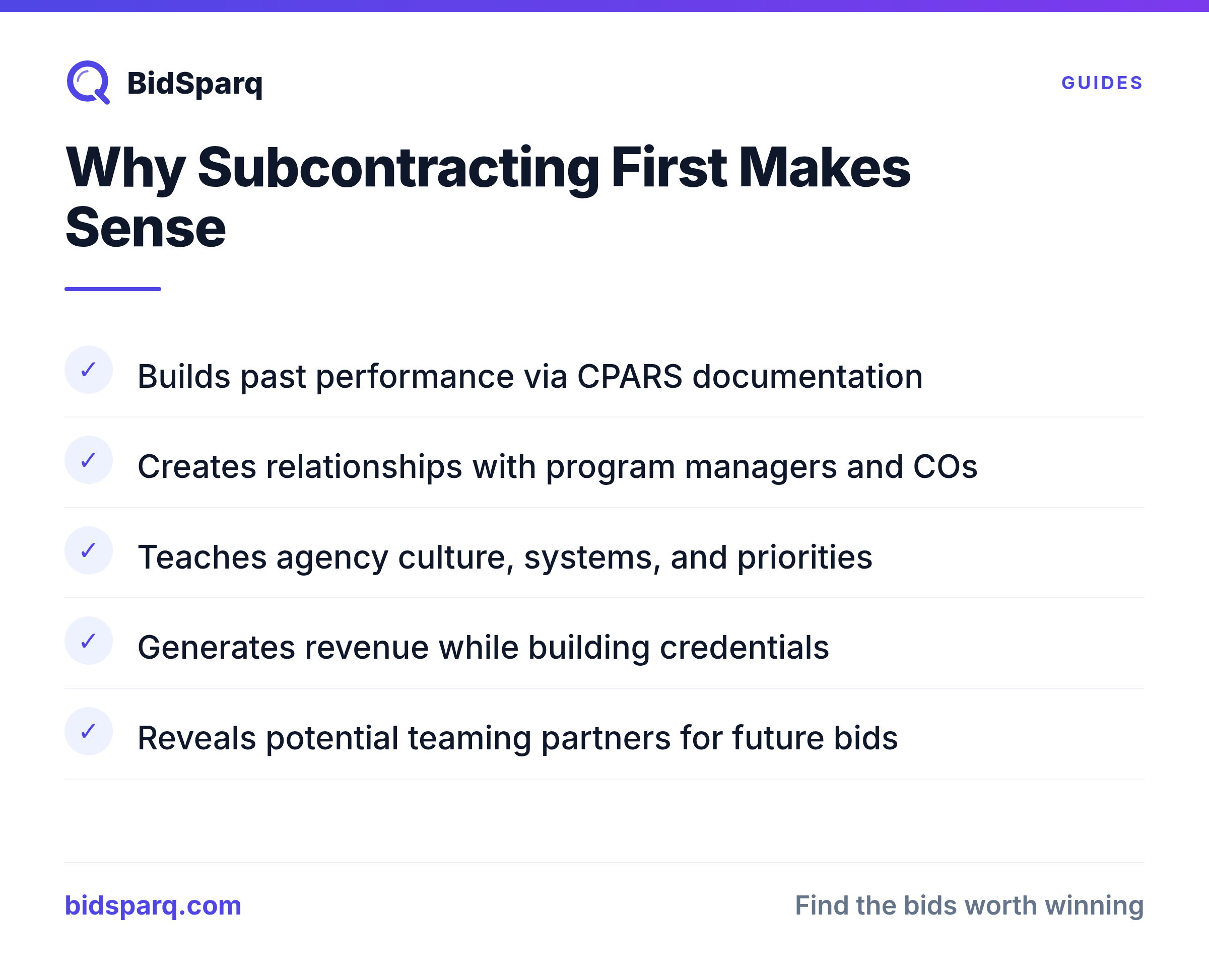
Subcontracting isn't a consolation prize: it's a strategic pathway that solves multiple problems simultaneously:
- Builds past performance. Work performed as a sub counts as past performance on future proposals: especially if you get documented in CPARS (Contractor Performance Assessment Reporting System).
- Creates agency relationships. You meet program managers, contracting officers, and end users who will remember you when the next opportunity comes around.
- Teaches agency culture. Every agency operates differently. Learning their systems, communication style, and priorities as a sub costs nothing: learning as a prime costs everything.
- Generates revenue. You get paid while building your credentials rather than spending money on proposals with low win probability.
- Reveals teaming partners. Other subs on the same contract become potential partners for future bids.
How to Find Subcontracting Opportunities
1. SBA SubNet
The SBA maintains a Subcontracting Network (SubNet) where large businesses post subcontracting opportunities. These are companies actively looking for small business partners to meet their subcontracting plan requirements.
2. Large Business Subcontracting Plans
Federal contracts over $750,000 (or $1.5M for construction) require large businesses to have subcontracting plans with goals for small business participation. This creates built-in demand for small business subcontractors.
Search USASpending for large-business prime contractors in your NAICS code. They need you to meet their subcontracting goals: approach them with your capability statement.
3. Industry Days and Matchmaking Events
Many federal agencies host matchmaking events specifically designed to connect small businesses with prime contractors. The SBA hosts annual matchmaking at events like the National Small Business Week conference. OSDBU (Office of Small and Disadvantaged Business Utilization) offices at each agency also host these events.
4. SAM.gov Sources Sought Responses
When you respond to a Sources Sought notice, you signal your capabilities to the market: not just the agency. Prime contractors monitoring the same notice may reach out for teaming discussions.
5. Direct Outreach to Primes
Identify prime contractors through USASpending research and reach out directly. Most large primes have a "small business liaison" or "supplier diversity" page on their website with instructions for how to register as a potential subcontractor.
What to Look for in a Teaming Arrangement
Not all subcontracting opportunities are equal. Evaluate each one carefully:
Good Signs
- Meaningful work share. You're performing substantive work in your area of expertise, not just providing bodies.
- CPARS visibility. The prime includes your performance in their CPARS reporting, or the agency evaluates your work separately.
- Direct agency interaction. You work directly with government personnel, not just through the prime.
- Clear scope definition. Your role, deliverables, and payment terms are documented in a formal teaming agreement or subcontract.
- Fair payment terms. Net-30 or net-45 is standard. Anything beyond net-60 is a cash flow risk.
Red Flags
- Pass-through arrangements. The prime adds a markup but contributes nothing: you do all the work, they take a cut.
- No CPARS visibility. If your work isn't documented, it's harder to use as past performance.
- Vague scope. "We'll figure out your role after award" means you'll get whatever work the prime doesn't want.
- Payment tied to prime's payment. "We pay you when the government pays us" can mean waiting 90+ days.
- Excessively low rates. Some primes squeeze sub rates to boost their own margins. If the rate doesn't cover your costs plus reasonable profit, walk away.
The Subcontractor to Prime Progression
Here's the playbook that successful small businesses follow:
Year 1-2: Build Your Foundation
- Win 2-3 subcontracts in your core NAICS codes
- Perform well: this is obvious but crucial. Your sub work IS your audition tape.
- Get documented in CPARS: confirm with your prime that your performance will be evaluated
- Build agency relationships: learn names, understand processes, demonstrate reliability
- Collect references: ask program managers if they'd serve as a reference for future proposals
Year 2-3: Expand and Position
- Respond to Sources Sought for contracts where you've built relevant sub experience
- Attend industry days at your target agencies: you now have credibility to talk about
- Team with other subs you've met along the way: combine capabilities for larger opportunities
- Monitor recompetes of contracts where you've performed well as a sub
Year 3+: Compete as Prime
- Identify a recompete where you have sub performance history and agency relationships
- Propose as prime with your sub past performance as evidence
- Bring former co-subs as YOUR subcontractors: the team is already proven
- Leverage your insider knowledge of the agency's needs, pain points, and culture
"The contractors who grow aren't the ones who bid the most. They're the ones who bid the right ones." (r/GovernmentContracting)
Teaming Agreement Basics
Always formalize your teaming arrangement in writing before investing time in a joint proposal. A basic teaming agreement should cover:
- Roles and responsibilities: who does what work
- Work share percentages: what portion of the contract value goes to each party
- Intellectual property: who owns what you create
- Exclusivity: are you locked into this team, or can you join other teams for the same opportunity?
- Payment terms: rates, payment schedule, and flow-down of government payment terms
- Termination: what happens if the team doesn't win, or if the relationship doesn't work
Get legal review. A handshake agreement is not sufficient for government contracting teaming arrangements.
How BidSparq Supports Your Subcontracting Strategy
- Competitive Intelligence: Identifies prime contractors winning work at your target agencies, your potential teaming partners
- Set-aside filtering: Find opportunities with small business set-asides where primes need qualified subs
- AI Chat: Ask "who are the top contractors at [agency]?" to identify outreach targets
- Recompete tracking: Know when contracts you've worked on as a sub are coming up for recompete
Next Steps
- Start your free trial: identify prime contractors and teaming opportunities in your NAICS codes
- Write a strong capability statement to share with potential prime contractors
- Learn to use USASpending to research primes in your target agencies
- Read about winning your first government contract for the full newcomer roadmap
Find RFPs that match your business
BidSparq monitors 23,000+ procurement sources and uses AI to score every opportunity against your capabilities. Try it free for 14 days.
Start Free Trial →