How to Find Government Contracts With ChatGPT: What Works
ChatGPT can draft proposals and research NAICS codes, but it cannot find live government contracts. Learn how to find government contracts with ChatGPT as one layer of a workflow that covers both discovery and writing.

To win government contracts, you need to find them first, and that is where most vendors run into trouble with AI tools. ChatGPT has no connection to live procurement portals: no access to SAM.gov, no feed from state eProcurement systems, no view of the education, healthcare, or commercial RFPs posted daily across hundreds of separate platforms. What it can do is accelerate the writing side of the process: drafting capability statements, researching NAICS codes, building compliance checklists, and polishing proposal narratives. This post explains what each layer handles and how to run both together.
- ChatGPT has a training cutoff and cannot show you solicitations that are open right now.
- Federal discovery starts at SAM.gov, but state, local, education, and healthcare procurement live in hundreds of separate portals.
- Keyword searches miss solicitations when buyers use different terminology than your service descriptions.
- ChatGPT can draft capability statements, research NAICS codes, and build compliance checklists directly from a scope of work.
- Pairing a live bid-intelligence platform with an AI writing tool covers both discovery and writing in one efficient workflow.
- Fit scoring tells you which opportunities deserve proposal time and which you can skip entirely.
The short answer
ChatGPT cannot find live government contracts because it has no connection to real-time procurement data. The workflow that actually works runs in three sequential steps: discover with a live bid-intelligence platform pulling from 23,000+ sources continuously, so nothing posted today on SAM.gov, a state portal, or a vertical market slips past; score with automated fit matching that filters by relevance so your team spends time only on high-probability opportunities rather than raw volume; then write with ChatGPT drafting the technical approach, compliance checklist, or executive summary once a strong match is confirmed. Running all three in order, rather than asking a language model to handle both halves of the job, is where the real efficiency gain lives.
What ChatGPT can actually do for government contracting
Think of ChatGPT as your proposal writing partner, not your bid finder. It excels at tasks that require no live data: translating a dense scope of work into plain language, drafting a past performance narrative, suggesting NAICS codes for a new service line, or building the executive summary of a proposal. These are real time savings that compound across a busy pipeline. The mistake is treating a language model as a procurement database when it is neither connected to procurement portals nor designed to query them.
The following four prompts produce reliable, reusable output:
Capability statement draft:
“Here is a description of our company: [paste company description]. Write a 250-word capability statement tailored to government buyers, emphasizing our core competencies, past performance highlights, and relevant NAICS codes.”
NAICS code research:
“We provide [describe your service]. List the three to five NAICS codes most likely to apply, explain why each fits, and flag any codes commonly paired with these in federal solicitations.”
Compliance checklist from a scope of work:
“Here is the scope of work from an RFP: [paste SOW text]. Extract every explicit and implied requirement and format them as a numbered compliance checklist I can use to verify our proposal addresses each point.”
Executive summary draft:
“Here is a draft technical approach section: [paste section]. Write a 200-word executive summary that leads with the agency's problem, states our solution clearly, and closes with one differentiator.”
Each prompt gives the model enough context to produce output worth editing. The pattern is consistent: paste the raw material, specify the format, and define the audience.
Where ChatGPT falls short for government contract discovery
The core problem is that government procurement data is fragmented, live, and constantly changing. Federal solicitations on SAM.gov update daily. State and local buyers post on dozens of different platforms, from dedicated eProcurement portals to board agenda systems like BoardDocs. Healthcare systems, school districts, and construction authorities each operate their own purchasing processes. No language model trained on a static corpus can track this in real time.
ChatGPT with the browsing plugin does not close this gap. When it retrieves a procurement page, it performs a surface-level HTTP scrape: it reads visible text but has no structured understanding of bid types, procurement stages, set-aside categories, or compliance fields. It cannot distinguish a sources-sought notice from a final solicitation, identify bonding requirements buried in an attachment, or confirm whether a posting is still open. Searchers who already know about the plugin run into this ceiling quickly: retrieval without procurement comprehension is not discovery.
Beyond access, there is a precision problem. A keyword search for "information technology services" will miss a solicitation titled "enterprise resource planning implementation" even if your firm is a perfect fit. Government procurement language is inconsistent across buyers, and a tool that matches only on exact terms leaves real opportunities on the table.
As of August 2026, 66,482 solicitations are open across the 23,000+ sources BidSparq tracks. See which of the 66,482 open solicitations match your profile, free, no credit card required.
How to find government contracts: a real workflow
Start with the official federal layer, then build outward.
Federal baseline (SAM.gov, USASpending.gov, FPDS.gov)
SAM.gov is the authoritative source for federal solicitations, covering civilian agencies, defense contracts, and vehicles like GSA schedules. USASpending.gov gives you historical award data: who won, what they were paid, and when contracts are due for recompete. FPDS.gov provides granular award history at the contract level. These three free resources form the baseline for any serious federal contracting effort.
State and local layer
Each state maintains its own eProcurement system, and sub-state buyers, including counties, municipalities, school districts, and transit authorities, often post through their own sites or third-party platforms. Monitoring this layer manually across even one state is a significant operational burden. Across the full public procurement market, the volume of new solicitations posted each day makes manual coverage impossible for any team without dedicated staff.
Vertical markets (education, healthcare, construction)
The same fragmentation applies in education, healthcare, and construction procurement. A hospital system sourcing IT infrastructure, a school district procuring curriculum software, and a transit authority bidding capital construction each post through different channels. The common thread: you need a discovery layer that aggregates sources continuously and filters by relevance, not just volume.
Pairing ChatGPT with purpose-built bid intelligence
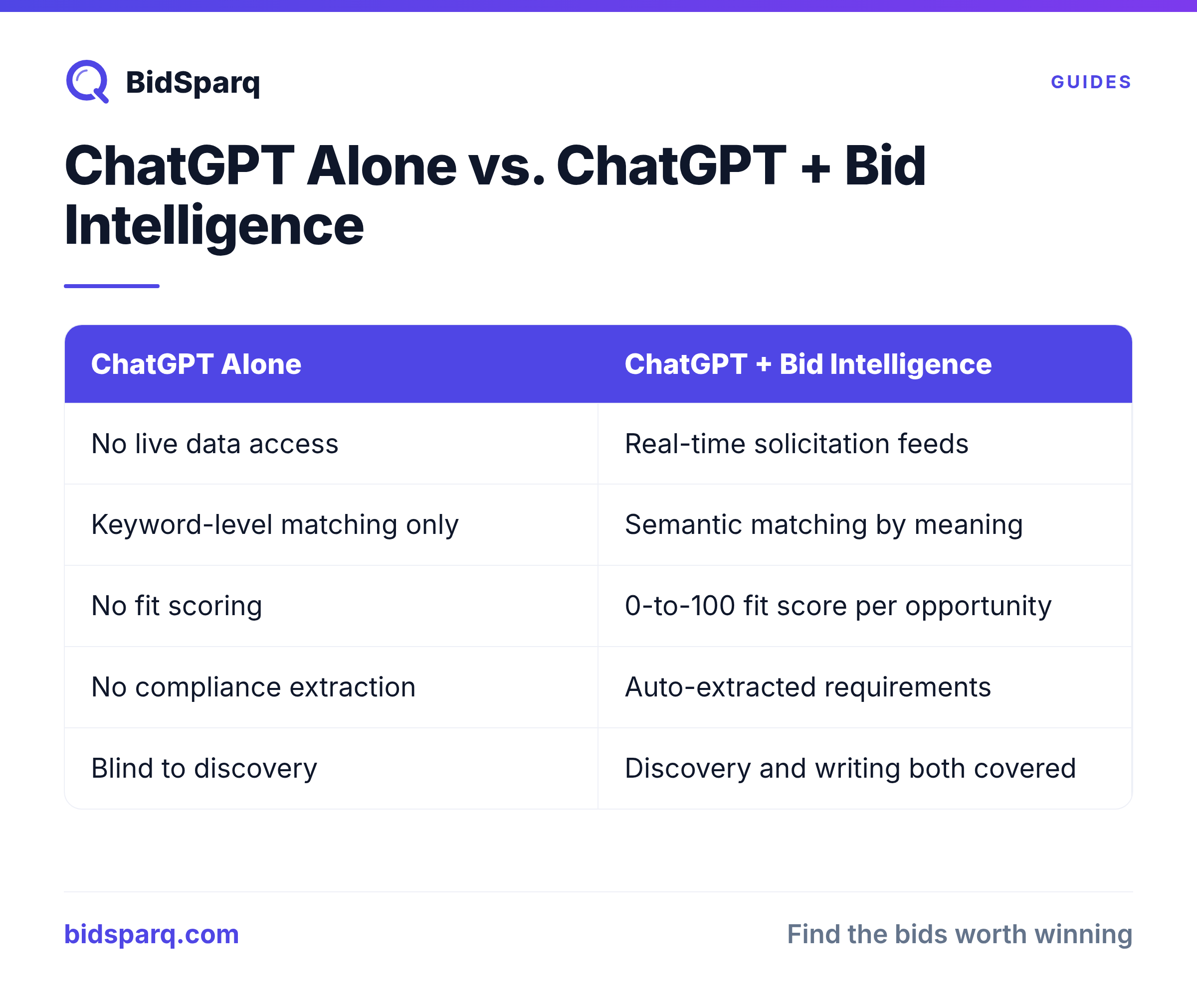
The vendors winning more work are running both layers, not choosing between them. A bid intelligence platform like BidSparq monitors 23,000+ sources daily, uses semantic matching to surface opportunities by meaning rather than keywords, applies a 0-to-100 fit score so your team prioritizes the bids most likely to convert, and flags incumbent vendors and GSA/SEWP contract vehicles due for recompete so your team can enter competitions where timing works in your favor. It also extracts compliance requirements automatically, so you know before you write whether you meet the bonding, certification, or set-aside conditions a solicitation requires. Once you have identified a high-scoring opportunity, ChatGPT becomes genuinely useful: drafting the technical approach, building the executive summary, or turning a specification into a compliance checklist.
The same model applies beyond government work. Education procurement, commercial construction bids, healthcare RFPs, and IT sourcing all follow a similar pattern: discovery first, then AI-assisted writing. The workflow does not change by market; only the portal layer does.
FAQ
Can ChatGPT search SAM.gov for open contracts?
ChatGPT does not have a native integration with SAM.gov and cannot retrieve live solicitations from it. Even browser-enabled versions perform only surface-level web searches and lack the structured understanding of procurement data needed to reliably surface, filter, and score relevant opportunities. For SAM.gov discovery, use the site's own search filters or a purpose-built aggregator that ingests and scores the full federal feed daily.
What is the best AI tool for finding government contracts?
The most effective approach combines two layers: a live bid-intelligence platform for discovery and scoring, and a general-purpose AI tool for writing and research. Platforms purpose-built for procurement aggregate thousands of sources, match by meaning rather than keywords, and apply fit scoring so you focus only on winnable work. ChatGPT and similar tools then accelerate the proposal process once a strong opportunity is identified.
How do I find government contracts without paying for a service?
SAM.gov is free for federal solicitations. USASpending.gov and FPDS.gov provide free federal award history to identify recompete opportunities. Your state's official eProcurement portal is typically free to register and use. BoardDocs and similar board agenda systems publish school district and local government RFPs publicly at no cost. For a broader view across all these sources in one place, purpose-built aggregators offer a free tier that covers the full market without upfront commitment.
Start free: see which of the 66,482 open solicitations fit your profile, no credit card required.
Find RFPs that match your business
BidSparq monitors 23,000+ procurement sources and uses AI to score every opportunity against your capabilities. Try it free for 14 days.
Start Free Trial →