FPI Contract Guide: Pricing, Risk, and How to Win
Understand how FPI contracts work, calculate the Point of Total Assumption, and find Fixed-Price Incentive solicitations before your competitors do.
Winning a contract with favorable terms requires knowing what type of contract you are bidding on before you open the cost volume. Fixed-Price Incentive contracts carry a risk structure unlike any other federal pricing arrangement, and bidders who treat them the same as firm-fixed-price awards routinely see their margins erode before performance is halfway through.
- Fixed-Price Incentive contracts share cost overrun risk between contractor and government using a pre-negotiated share ratio, unlike FFP contracts where the contractor absorbs all overruns alone.
- The Point of Total Assumption (PTA) is the cost threshold above which the contractor absorbs 100% of additional costs, making it the defining number to calculate before pricing any FPI proposal.
- Know whether you are bidding FPI(F) or FPI(S) before writing your cost volume: firm-target locks all four numbers at award, while successive-target allows staged renegotiation when cost uncertainty is too high at the outset.
- Your ceiling price sets the hard exposure limit, but the PTA reveals the earlier cost level where your share of overruns reaches 100% and losses begin.
- Proposing a defensible share ratio signals cost confidence to the contracting officer and shapes how competitive your overall pricing appears to evaluators.
- FPI solicitations appear across dozens of federal portals, not just SAM.gov, and manual monitoring of all of them is operationally unsustainable at any real pipeline scale.
The short answer
An FPI contract is a federal contract type in which the government and contractor negotiate a target cost, a target profit, a ceiling price, and a share ratio that determines how cost savings and overruns are divided between the two parties. If actual costs come in below target, both parties share the savings according to that ratio. If costs exceed target, overruns are shared up to the Point of Total Assumption, after which the contractor absorbs every additional dollar up to the ceiling. FPI contracts appear most often in complex technical and defense acquisitions where scope is defined well enough to set a credible cost target but not well enough to justify full fixed-price risk.
The four numbers that define every FPI contract
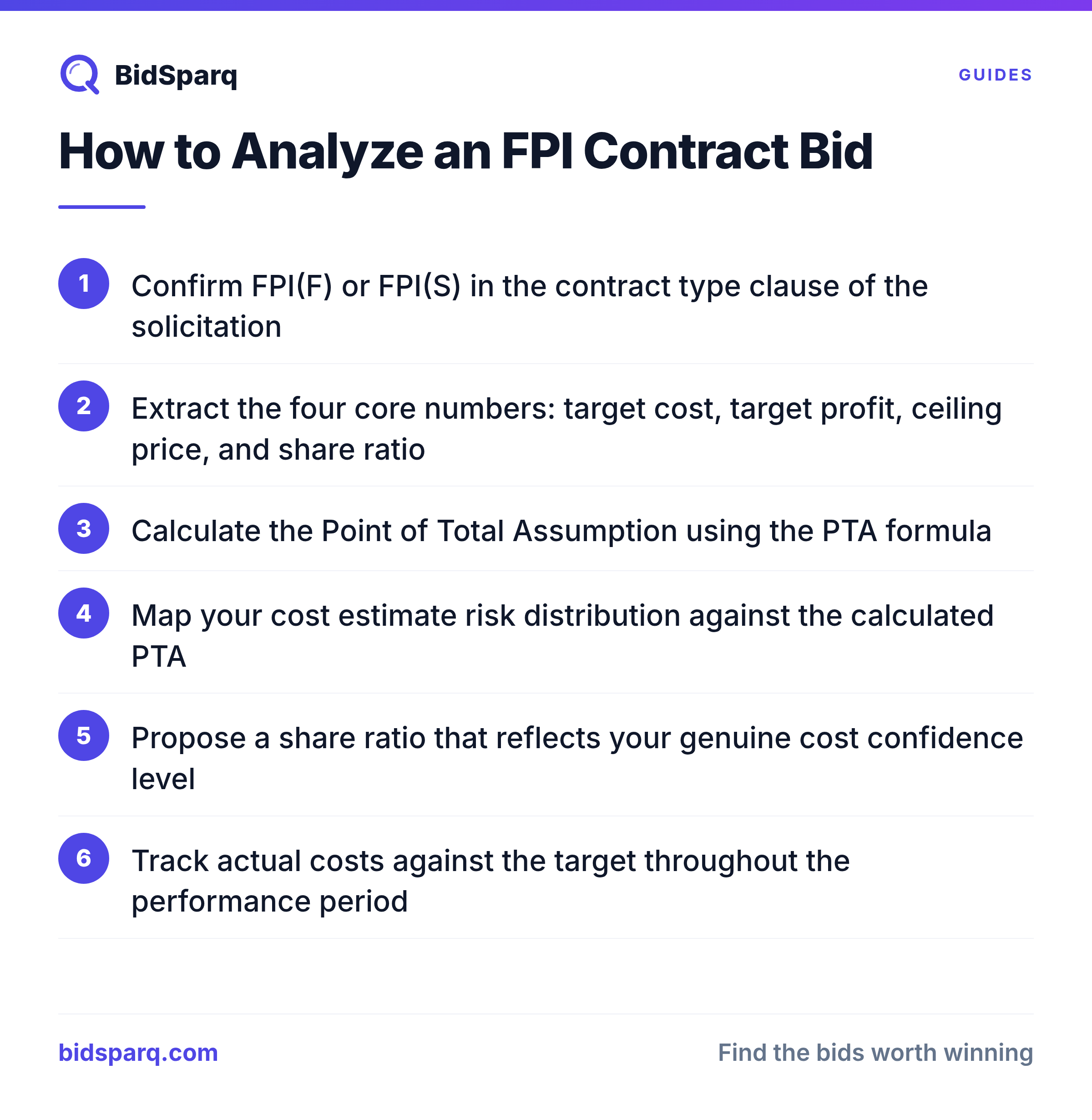
Every FPI contract is built on four negotiated values, and a weakness in any one of them will distort your entire proposal strategy. Target cost is your best estimate of what contract performance will actually require. Target profit is what you earn if actual costs match the target exactly. Ceiling price is the maximum the government will pay under any circumstances. The share ratio, written as government/contractor, tells you how savings and overruns divide once actual costs diverge from target.
These four numbers interact through the Point of Total Assumption formula: PTA equals target cost plus the result of (ceiling price minus target price) divided by the government's share percentage. Above the PTA, the contractor absorbs 100% of every additional dollar up to the ceiling. The exact PTA location shifts based on how close the ceiling sits to the target price and on the negotiated share ratio. Small changes in either variable can meaningfully shift when full contractor exposure begins. The governing FAR authority for all FPI structures is Part 16.403.
FPI(F) vs. FPI(S): how to read the solicitation
The solicitation's contract type clause specifies either Fixed-Price Incentive with Firm Target or Fixed-Price Incentive with Successive Targets, and the distinction changes your proposal approach from page one. FPI(F), governed by FAR 16.403-1, is the more common form. All four core numbers are negotiated and locked before award and remain fixed through contract performance. It suits acquisitions where the government has enough technical definition to commit to a credible cost estimate at contract start.
FPI(S), governed by FAR 16.403-2, applies when cost uncertainty is too high at award to set a firm target. An initial target, share ratio, and ceiling are established at contract start, but the contract specifies a re-determination point at which actual cost data triggers a new negotiation. FPI(S) appears most often in early-stage development programs and prototype acquisitions where scope definition will improve significantly as work proceeds. For contractors operating in state and local government, higher education, or commercial markets, the analytical logic of share ratios and cost ceilings translates directly into gain-share contracts and performance-based service agreements common outside the federal context.
How to calculate the PTA and use it in your proposal
Running the PTA calculation before finalizing your cost volume is one of the highest-leverage actions a proposal team can take on any FPI bid. The formula: PTA equals target cost, plus (ceiling price minus target price) divided by the government's share percentage. Apply it to your specific proposed numbers before submitting. The result identifies the exact cost level at which your profit is consumed and losses begin, which is typically a lower and more constraining number than the ceiling price itself.
Proposal teams that model cost risk against the share curve, rather than simply layering contingency on top of target cost, produce bids that are both more competitive and more defensible. A share ratio that reflects genuine cost confidence reads differently to a contracting officer than one that hedges without clear rationale. If your cost estimate's probability distribution places meaningful probability of actual costs above the PTA, that exposure sits entirely with you, and the proposal needs to account for it before submission.
Finding FPI solicitations before your competitors do
FPI contracts surface across dozens of federal acquisition systems, and no single portal publishes all of them. SAM.gov is the mandatory posting point for most federal solicitations above the simplified acquisition threshold and is the correct baseline for any search. Defense-related FPI opportunities also appear on military component acquisition sites and are captured in the Federal Procurement Data System. Civilian agency solicitations appear on agency-specific portals that vary widely in search capability and update frequency.
The scale of the problem is significant. As of September 2026, BidSparq tracks 56,798 open solicitations across 23,000+ sources. Manually monitoring SAM.gov and a handful of agency sites captures only a fraction of that landscape. Solicitations are posted and amended on timelines that do not accommodate manual search routines, and a solicitation your team did not see is a contract you cannot pursue.
Semantic search reads solicitation language by meaning rather than keywords, which matters for FPI bids because contract type is often described using clause references, abbreviations, and program-specific language that keyword filters miss. Fit scoring against your past performance and capability profile quickly separates the FPI opportunities worth a proposal investment from those outside your competitive range.
Search open federal solicitations free on BidSparq, no credit card required. See matched and scored active bids before your team spends hours on manual portal searches.
FAQ
What is the difference between an FPI contract and a firm-fixed-price contract?
A firm-fixed-price contract sets one price at award: the contractor absorbs all cost overruns and keeps all savings. An FPI contract uses a target cost and a negotiated share ratio so both contractor and government share the financial impact of cost variances. FPI contracts still have a ceiling price the government will not exceed, but between the target and the ceiling, risk is divided rather than sitting entirely with the contractor.
How is the Point of Total Assumption calculated in an FPI contract?
The PTA formula is: target cost plus (ceiling price minus target price) divided by the government's share percentage. Above the PTA, the contractor absorbs 100% of additional costs up to the ceiling price. Calculating the PTA before finalizing your cost volume is essential because it identifies the exact cost level where profit is consumed and losses begin, which is typically well below the ceiling price.
Where can I find FPI contract solicitations to bid on?
SAM.gov is the required starting point for most federal FPI solicitations. Defense agency opportunities also appear on military component acquisition sites and in the Federal Procurement Data System. For broader coverage, platforms that aggregate across thousands of federal and agency sources and apply semantic matching consistently surface FPI opportunities that standard keyword searches on individual portals miss.
Ready to build a stronger FPI bid pipeline? Start finding and scoring active solicitations free across the full federal acquisition landscape, no subscription required to get started.
Find RFPs that match your business
BidSparq monitors 23,000+ procurement sources and uses AI to score every opportunity against your capabilities. Try it free for 14 days.
Start Free Trial →