Signs of a Wired RFP (And What to Do About It)
20-30% of RFPs show signs of a predetermined winner. Learn the 6 red flags experienced contractors use to spot wired contracts before wasting weeks on a proposal you can't win.
Let's talk about the elephant in every government contracting discussion: wired contracts. RFPs where the decision was essentially made before the solicitation was ever published, and competing vendors exist only to satisfy procurement rules.
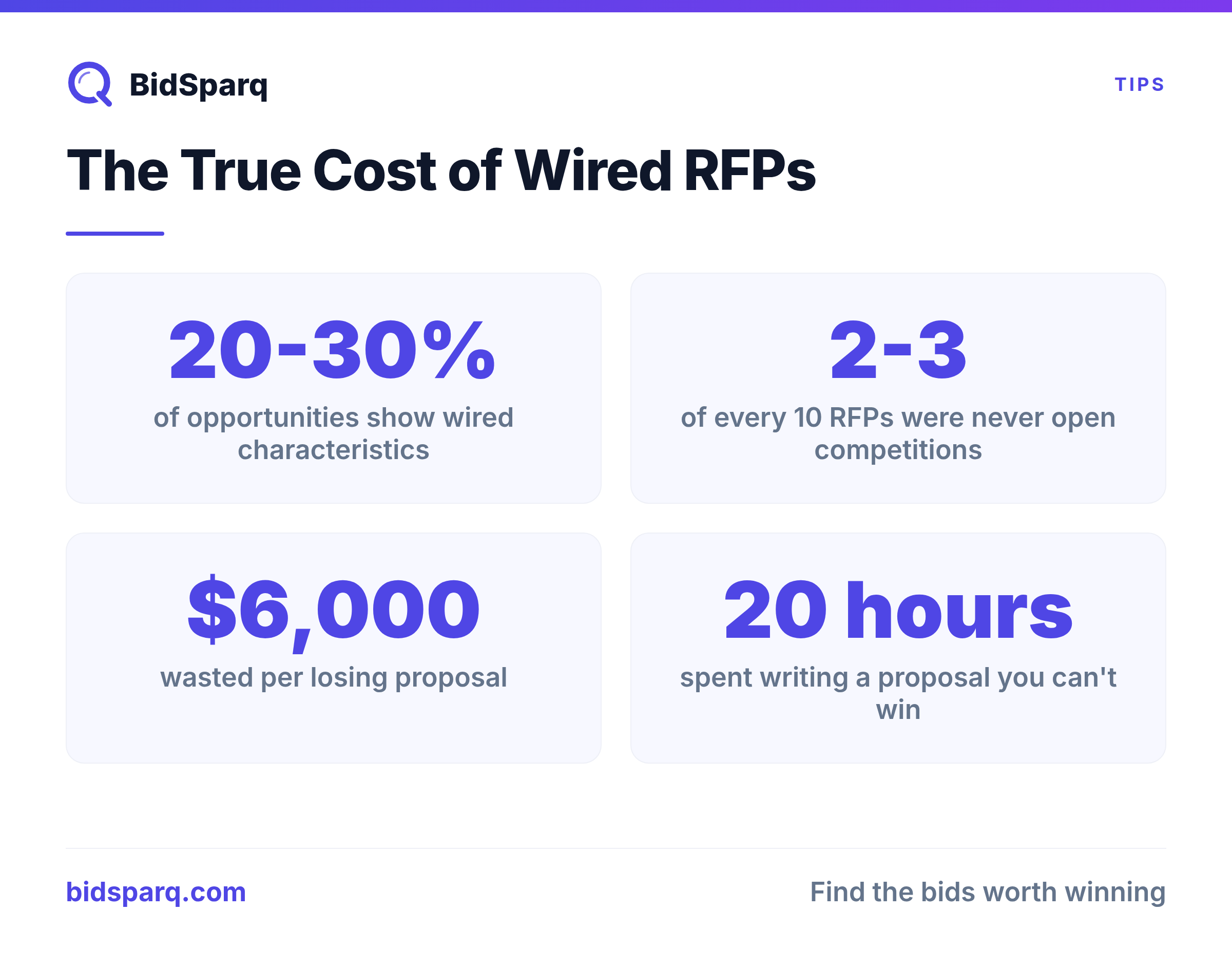
Experienced contractors estimate that 20-30% of opportunities show wired characteristics. That means for every 10 RFPs you spend time evaluating, 2-3 were never really open competitions.
"Half of them already have a preferred vendor and the rest are just fishing for free work." (r/sales (score=456, 126 comments))
You can't eliminate wired contracts from the system. But you can learn to spot them quickly, before you burn $6,000 and 20 hours writing a proposal you were never going to win.
What Makes an RFP "Wired"?
A wired (or "pre-wired" or "walled") RFP is one where the issuing agency has a preferred vendor and the competitive process is a formality. This isn't always intentional corruption: often it's a natural result of a deep working relationship between an agency and its incumbent contractor.
The incumbent knows the agency's systems, culture, and pain points. They may have helped shape the requirements. They have years of performance history. They start the competition with massive advantages that are perfectly legal but nearly impossible to overcome.
The question isn't whether this happens: it's whether you can detect it before investing your resources.
The 6 Red Flags of a Wired Contract
This framework comes from experienced government contractors who tracked patterns across hundreds of opportunities. Any single red flag might be innocent. Three or more together should trigger a serious no-bid conversation.
1. Same Incumbent for Multiple Recompetes
Check USASpending for the contract history. If the same vendor has won this contract through 2 or more recompete cycles, the agency-vendor relationship runs deep.
This doesn't automatically mean it's wired: maybe the incumbent genuinely delivers the best value. But it means you're fighting against institutional inertia, and the incumbent likely has insights into the agency's needs that you don't.
What to check: Search USASpending by awarding agency and NAICS code. Look at the last 5-10 years of similar awards. Same recipient name appearing repeatedly is the signal.
2. Unreasonably Short Response Window
A complex RFP with a 5-10 day turnaround is a major red flag. Writing a quality proposal for a complex scope takes weeks, not days.
When the timeline is disproportionately short, it often means one bidder had advance notice: they knew the RFP was coming and started preparing before it was published. Everyone else is scrambling to catch up.
"14 days for a 50-page tech volume? Someone had a head start." (r/GovernmentContracting)
What to check: Compare the release-to-due window against the scope complexity. A simple supply purchase with a 5-day window is normal. An IT modernization program with a 10-day window is suspicious.
3. Brand-Name Requirements Without "Or Equal"
When an RFP specifies a particular vendor's product by name: "Must be compatible with [Brand X] platform" or "Requires [specific product] certification" (it narrows the competition to vendors associated with that brand)
Government procurement rules require agencies to use "or equal" language to allow alternative products. If the RFP omits this, or if the "or equal" requirements are so specific that only one product qualifies, the spec was likely written around a specific vendor's solution.
What to check: Search the requirements section for brand names, product names, and proprietary technology references. Look for whether alternatives are genuinely accepted.
4. Incumbent Contract Expires Within 30 Days of RFP Deadline
If the current contract's end date is just weeks after the RFP proposal deadline, the agency has almost no time for evaluation, selection, and transition. This urgency creates pressure to stay with the incumbent for continuity.
In practice, the agency will either extend the existing contract (bridge contract) or award quickly to the incumbent to avoid a gap in services. New entrants rarely benefit from this timeline.
What to check: Find the current contract on USASpending or FPDS. Compare its end date to the RFP's expected award date. If they're within 30-60 days of each other, the agency is under pressure.
5. Thin Statement of Work on a Large Contract
When a $5M contract has a 2-page Performance Work Statement, something is off. Large contracts with vague, minimal scope descriptions often indicate that the buyer already knows who they want: they don't need to specify the work in detail because the winner already understands it from years of working together.
Contrast this with a new requirement, where the agency needs to thoroughly document the scope so that unfamiliar vendors can prepare accurate proposals.
"A thin PWS on a large contract often means the incumbent helped shape the requirements." (r/GovernmentContracting)
6. "Intent to Award" or Sole-Source Language Buried in the Description
Sometimes the signals are hiding in plain text. Look for phrases like:
- "The government intends to award to..."
- "This is a follow-on to contract [number]..."
- "Only one responsible source..."
- "Brand name justification..."
These don't always mean you can't compete, but they reveal the agency's preferred outcome. If you see this language and you're not the named vendor, your odds are extremely low.
The Three-Flag Rule
Any single red flag can have an innocent explanation. Short timelines happen when agencies face unexpected budget deadlines. Incumbents win recompetes because they do good work. Brand names appear in specs because they're the only product that meets a legitimate requirement.
But when multiple flags stack up, the probability of a fair competition drops dramatically:
| Red Flags Present | Assessment | Recommendation |
|---|---|---|
| 0-1 | Normal competition | Evaluate on merit using your bid/no-bid framework |
| 2 | Elevated risk | Proceed with caution: only if you score well on other criteria |
| 3+ | Likely predetermined | Strong no-bid. Redirect your resources to winnable opportunities. |
"Stack three or more on the same opportunity and your win probability drops to near zero." (r/GovernmentContracting)
What to Do When You Spot a Wired RFP
Option 1: Walk Away (Usually the Right Call)
The math is clear. If your win probability is 5% on a wired contract, your $6,000 response cost yields an expected value of near zero. Redirect those 20 hours to an opportunity where you have a real shot.
Option 2: Bid Strategically (Rare Circumstances)
Sometimes it's worth bidding even on a likely wired contract:
- You want to establish a relationship with the agency for future opportunities
- The contract value is large enough that even a 5% chance has significant expected value
- You want to submit a protest basis (see below)
- You're genuinely confident your solution is dramatically better
If you do bid, keep your investment proportional to your odds. Don't write your best proposal: write a competent one.
Option 3: Submit Questions to Test the Waters
During the Q&A period, ask pointed questions that reveal whether the competition is real:
- "Can the government clarify why the response timeline is [X days] for a scope of this complexity?"
- "Will the government accept [alternative product] as an 'or equal' to the specified [Brand X]?"
- "Can the government provide the current contractor's name and contract number for transition planning?"
The answers, and sometimes the non-answers: tell you a lot.
Option 4: File a Protest (Nuclear Option)
If you have evidence that the procurement was genuinely unfair: not just competitive advantages for the incumbent, but actual violations of FAR or agency policy, you can file a bid protest with the GAO. This is expensive, adversarial, and slow. Reserve it for clear violations on high-value contracts.
Preventing the Problem: Pre-RFP Positioning
The best defense against wired contracts is to become the vendor with the relationship: to position yourself early so you're not encountering the opportunity for the first time at RFP release.
- Respond to Sources Sought notices. This is your chance to inform the agency of your capabilities before they write the RFP.
- Attend industry days. Face time with contracting officers and program managers is irreplaceable.
- Monitor recompetes. Use USASpending research to identify contracts expiring in 6-18 months and reach out early.
- Submit capability statements proactively. A well-crafted capability statement gets you on the agency's radar.
"Sole Source isn't luck. It's engineering. They responded to the RFI. They showed up to the industry day. They submitted a capability statement. When the CO needed to justify the award, there was a documented trail." (r/GovernmentContracting)
How BidSparq Helps You Avoid Wired Contracts
BidSparq's AI automatically surfaces intelligence that helps you detect wired signals:
- Competitive Intelligence: Shows incumbent contractors and award history for each RFP, no manual USASpending research needed
- "Should I Bid?" Verdict: Factors in competitive signals when assessing your win probability
- Recompete flagging: Identifies when an RFP is a recompete of an expiring contract
- AI Chat: Ask "who holds this contract?" or "is this a recompete?" for instant analysis
Next Steps
- Start your free trial: see incumbent data and competitive intelligence on every matched RFP
- Build a disciplined bid/no-bid process that incorporates wired-contract detection
- Learn to use USASpending for competitive intelligence to research incumbents yourself
- Read about reading RFPs efficiently to spot red flags in the first 5 minutes
- See our complete guide on how to find RFPs: including how to avoid wasting time on the wrong portals
Find RFPs that match your business
BidSparq monitors 23,000+ procurement sources and uses AI to score every opportunity against your capabilities. Try it free for 14 days.
Start Free Trial →