RFP & Proposal Management Software: Free & Paid | BidSparq
Compare RFP and government proposal management software, including free options, for tracking opportunities and deadlines. See top picks from BidSparq.
Most teams shopping for RFP software are really trying to solve one of two problems that vendors love to blur together: finding the right RFPs to pursue, and writing proposals that win them. Buyers in education, healthcare, construction, IT services, commercial, and government all hit the same wall. The best RFP software solves one of these problems extremely well, and only a few attempt both. Figuring out which problem is actually slowing you down will save you thousands of dollars a year in subscriptions.
This guide compares the top RFP and proposal management software for 2026, including free options, across three categories: discovery platforms, proposal response tools, and hybrid solutions. Each entry gives you an honest read on pricing, strengths, and who the tool is genuinely built for, whether you sell to a school district, a hospital system, a state agency, or a federal buyer.
For a discovery platform built to surface winnable bids automatically, BidSparq monitors 23,000+ bid sources and assigns every opportunity a 0 to 100 fit score against your profile, so you stop keyword-searching portals by hand.
Key Takeaways
- RFP software splits into two jobs: discovery (finding and scoring the right bids) and response (writing and assembling the proposal). Most tools do one well and the other poorly.
- Match the tool to your bottleneck. If you cannot find enough good opportunities, buy discovery first; a proposal engine is wasted without a pipeline to feed it.
- Government is one vertical, not the whole market. Education, healthcare, construction, and commercial RFPs often outnumber federal opportunities for small and mid-size firms.
- AI matching beats keyword search. Scoring opportunities 0 to 100 against your NAICS codes, certifications, and past performance surfaces winnable bids automatically instead of noise.
- Free options exist, with tradeoffs. SAM.gov is free but federal-only and manual; BidSparq offers a free tier plus paid Pro Max at $249/mo ($199/mo billed annually).
What Is RFP Software?
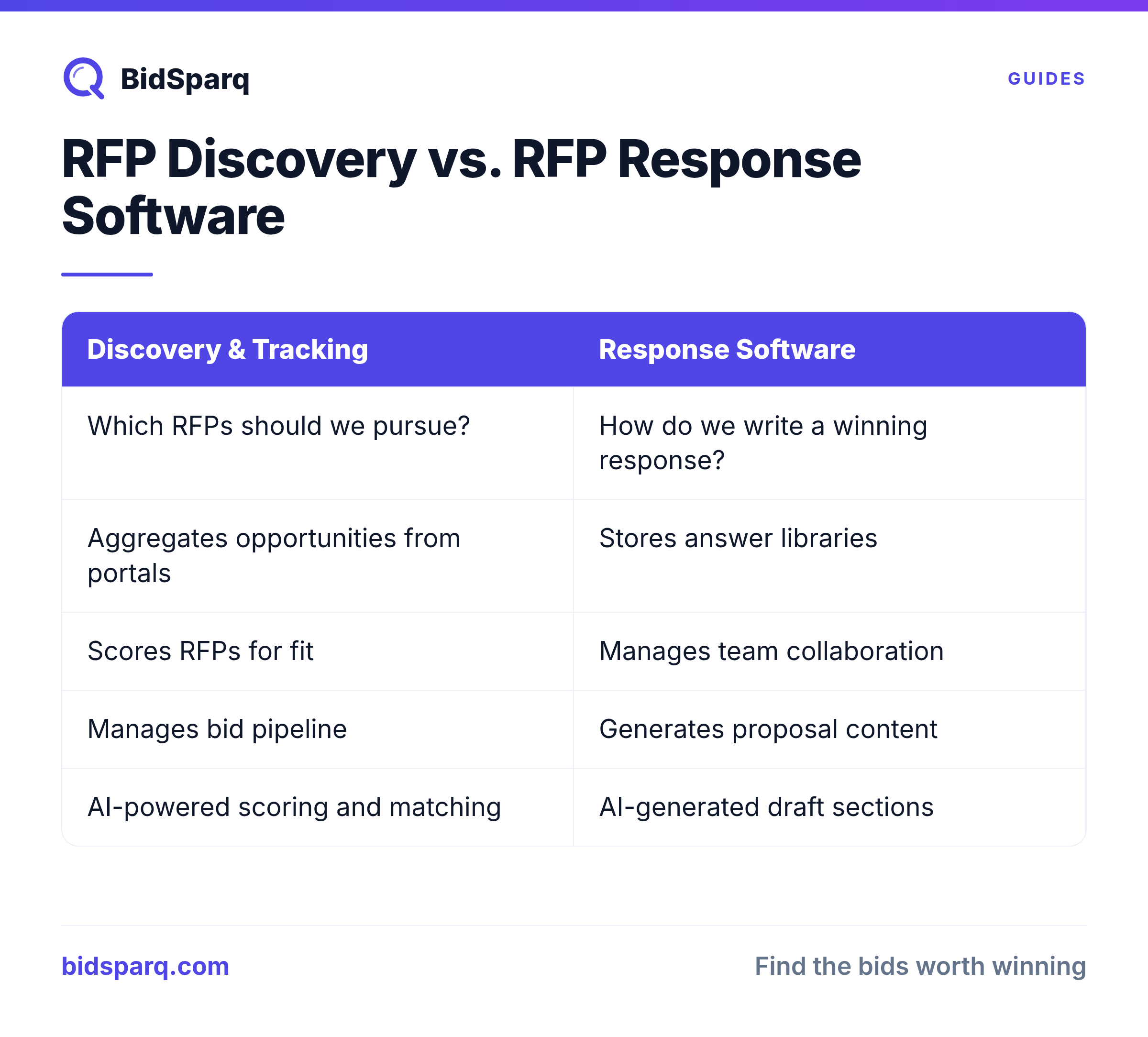
Start by recognizing that "RFP software" describes two very different categories of tools, and buying the wrong one is the most common and expensive mistake buyers make. The term, sometimes called RFP management software or an RFP platform, gets used for both:
- RFP discovery and tracking software: tools that aggregate opportunities from procurement portals, score them for fit, and help you manage your bid pipeline. The core question: Which RFPs should we pursue?
- RFP response software: tools that help you write, organize, and submit proposals. They store answer libraries, manage team collaboration, and generate proposal content. The core question: How do we write a winning response?
A growing third category, AI RFP software, uses artificial intelligence to automate parts of both workflows: AI-powered scoring and matching on the discovery side, and AI-generated draft sections on the response side. RFP automation is still early but evolving fast.
Large organizations often need both discovery and response tools. Smaller firms, especially those early in their bidding journey, usually need discovery first. There is no point building a proposal engine if you have not identified the right opportunities to respond to.
What to Look for in RFP Management Software
Judge every tool against the criteria that actually move win rates, not the feature list on the pricing page. Before reviewing specific tools, here is what matters most:
1. Source Coverage (Discovery Tools)
Federal procurement (SAM.gov) is just one slice of the market. State, local, education, and special district spending often represents more relevant opportunity for small and mid-size firms. A tool that only covers federal RFPs will miss the majority of opportunities in most verticals. Ask vendors: how many procurement portals do you monitor, and how quickly do new opportunities appear?
2. Matching Quality vs. Keyword Search
Keyword search returns everything that mentions your terms, including plenty of irrelevant results. AI-powered matching scores opportunities against your company profile (NAICS codes, past performance, certifications, location) to surface only the RFPs where you have a realistic shot. For high-volume procurement markets, the gap between keyword noise and AI-matched results is the difference between 2 hours a week and 20.
3. Proposal Response Capabilities
For firms responding to 10 or more RFPs per year, a structured content library, where past proposal answers are tagged, searchable, and reusable, pays for itself quickly. Look for tools that support multi-user collaboration, version control, and compliance matrix generation. AI draft generation is a newer feature that varies widely in quality.
4. Bid Pipeline Management
Even if you use separate tools for discovery and response, you need somewhere to track bid status. A proper pipeline tool lets you move opportunities through stages (identified, go/no-go, in progress, submitted, and awarded), track deadlines, and measure win rates over time. Spreadsheets work until they don't.
5. Domain-Specific Intelligence
General-purpose proposal tools do not know that your NAICS code matters, that set-aside type determines your competition, or that USASpending data can reveal an incumbent contractor. Specialized platforms bake in this context. Government is the clearest example, but education (E-Rate rules) and other verticals carry their own domain knowledge too. The more specialized the tool, the less tribal knowledge you have to apply by hand.
6. Pricing Transparency and Contract Terms
Enterprise procurement tools are notorious for "contact sales" pricing and annual contracts with significant lock-in. For small and growing organizations, monthly subscription options and transparent pricing matter. Know what you are committing to before signing.
Top RFP & Proposal Management Software (2026)
Match each tool below to the specific job you are hiring it for, because none of them wins on every dimension.
1. BidSparq: Best for RFP Discovery and AI Matching
Best for: small to mid-size organizations that need to find winnable RFPs across government, education, healthcare, construction, and commercial markets without spending hours on manual search.
BidSparq is purpose-built for RFP discovery. It monitors 23,000+ procurement sources, including SAM.gov, state portals, county and city purchasing pages, education and E-Rate portals, transit authorities, and more, then assigns each opportunity a 0 to 100 fit score against your company profile. Instead of returning a list of keyword matches, it ranks RFPs by that 0 to 100 fit score, weighing NAICS alignment, set-aside eligibility, location, and past performance signals, so the bids you are most likely to win rise to the top. That is the automated alternative to reading through thousands of listings by hand.
Where BidSparq stands apart from general procurement tools is its AI chat layer: you can ask questions like "Show me IT RFPs in Texas under $500K set aside for small businesses" or "Which of my saved RFPs have compliance requirements I might miss?" and get structured, sourced answers in seconds instead of building filters manually. The platform also generates an AI compliance checklist for each RFP and offers PDF and DOCX export for proposal prep, so nothing slips through when you move from finding a bid to writing it.
Strengths: broadest source coverage in its price range; 0 to 100 AI fit scoring and per-RFP chat; compliance checklist generation; 7-stage bid pipeline tracker; transparent flat-rate pricing.
Limitations: not a full proposal-writing platform. It does not include a reusable answer library or multi-user proposal collaboration, so high-volume bidders pair it with a proposal response tool.
Pricing: Free tier (with a 14-day Pro Max trial), then Pro Max at $249/mo or $199/mo billed annually. No annual lock-in required.
2. Responsive (formerly RFPIO): Best for Enterprise RFP Response
Best for: mid-to-large organizations responding to a high volume of formal RFPs, RFIs, and security questionnaires who need a scalable content library and team collaboration.
Responsive is the market leader in RFP response software, used by many of the largest government contractors and defense firms. Its core strength is the Answer Library, a searchable, AI-curated repository of approved past proposal answers that can be automatically suggested as you build new responses. The platform handles multi-user workflows with role-based permissions, approval queues, and audit trails that satisfy compliance requirements.
Responsive added AI draft generation and auto-fill capabilities that can dramatically accelerate initial proposal drafts, particularly for boilerplate sections and standard compliance questions. Integration with Salesforce, HubSpot, and major CRMs makes it fit naturally into enterprise BD workflows. The platform has no meaningful government-specific features, since it is industry-agnostic, but its core proposal mechanics are best-in-class.
Strengths: industry-leading answer library; robust team collaboration; strong AI draft capabilities; enterprise security and compliance certifications.
Limitations: no RFP discovery or opportunity sourcing; pricing is enterprise-tier; overkill for firms responding to fewer than 20 to 30 RFPs per year.
Pricing: the Emerging edition is listed as "starting from $10,000" on Responsive's pricing page; the Growth and Enterprise editions are quoted through sales. No self-serve option.
3. Loopio: Best Mid-Market RFP Response Platform
Best for: mid-size organizations that need structured proposal collaboration and knowledge management but are not ready for enterprise-tier pricing.
Loopio competes directly with Responsive at a somewhat lower price point and with a cleaner, more approachable interface. Its Loop Library organizes past content by topic, author, and win/loss outcome, making it easier to surface your strongest past answers rather than just any answer that matches a keyword. The Magic Review feature uses AI to flag outdated library content before it gets used in a live proposal.
Loopio's project management features are strong, with Gantt-style timelines, task assignments, and automated kickoff workflows that help proposal managers coordinate across subject matter experts without constant manual follow-up. Like Responsive, it has no government-specific intelligence or opportunity discovery features, so you will need a separate tool for finding RFPs to respond to.
Strengths: clean UX with fast onboarding; strong knowledge library management; good project timeline tooling; competitive mid-market pricing.
Limitations: no RFP sourcing; AI features less mature than Responsive; limited set-aside or government-specific context.
Pricing: not published. Loopio quotes its Foundations, Enhanced, and Enterprise plans through a sales call.
4. QorusDocs: Best for AI-Generated Proposal Drafts
Best for: teams that want AI to generate full proposal draft sections quickly, especially those heavily embedded in Microsoft 365 workflows.
QorusDocs is one of the more AI-forward proposal platforms, offering AI-generated draft sections that pull from your content library and Microsoft SharePoint documents. Its native integration with Word, PowerPoint, and Teams means proposal teams can work in familiar tools rather than switching to a separate platform. The AI Assist feature can generate an entire SOW or management approach section from a prompt, then refine it based on your approved content.
For organizations already using Microsoft 365 for document management, QorusDocs often slots in with less friction than platforms that require migrating to a new system. Its government-specific template library includes common federal formats (SF-330, statements of qualifications, past performance narratives), which saves significant setup time.
Strengths: deep Microsoft 365 integration; strong AI draft generation; government proposal templates included; works within Word and PowerPoint directly.
Limitations: less powerful answer library than Responsive or Loopio; no RFP discovery features; pricing less transparent.
Pricing: not published. QorusDocs quotes its ValueHub, ProposalHub, and PitchHub packages after a personalized demo and offers no self-serve trial.
5. Kantiv: AEC-Native Proposal and Pursuit Platform
Best for: architecture, engineering and construction firms whose proposals are built on past-project experience.
Kantiv (formerly Joist AI) is the only tool on this list built specifically for the AEC industry. Instead of a generic answer library, it organizes a firm’s institutional knowledge, past projects, resumes, and prior proposals, and surfaces the most relevant experience for each new pursuit before drafting begins. AI drafting works from the firm’s own project history, and requirement tracking flags compliance gaps before submission.
The company reports more than 200 AEC firms on the platform, including roughly one in five of the ENR Top 50 design firms; customers include Mortenson, PCL Construction and Woodard & Curran. Like the generalist response platforms above, it has no RFP discovery, so AEC firms typically pair it with a discovery tool.
Strengths: AEC-specific from the ground up; drafts grounded in the firm’s real project history; requirement and compliance tracking; strong enterprise customer base.
Limitations: no RFP sourcing or discovery; AEC-only focus makes it a poor fit outside architecture, engineering and construction.
Pricing: custom pricing, demo on request.
6. Privia: Best for Capture Management
Best for: federal contractors who need integrated capture management, BD pipeline tracking, and proposal collaboration in a single government-focused platform.
Privia is one of the few platforms specifically designed for government contractors, with features built around the federal procurement lifecycle: capture planning, color reviews (Pink Team, Red Team, Gold Team), compliance matrix generation, and lessons-learned tracking. Where tools like Responsive optimize for speed of response, Privia optimizes for the full government BD process from opportunity identification through award.
The platform integrates with GovWin IQ for opportunity data, which gives it basic discovery capabilities, though the intelligence depth is limited compared to dedicated discovery platforms. Privia's strength is the structured capture workflow, ensuring nothing falls through the cracks between early opportunity identification and final submission.
Strengths: government-specific workflows (capture, color reviews, compliance matrices); strong audit trail for contract compliance; integrates with GovWin for basic opportunity data.
Limitations: dated interface; primarily federal-focused; limited AI features compared to newer platforms; expensive for small firms.
Pricing: not published. Privia has been acquired by Xait and its capture features now ship inside XaitPorter, quoted after a demo.
7. Deltek GovWin IQ: Best Federal Market Intelligence
Best for: large federal contractors and BD teams who need deep agency-level market intelligence, analyst-curated opportunity data, and competitive analysis.
GovWin IQ is the most comprehensive federal market intelligence platform available, combining a large opportunity database with analyst-written agency profiles, contract vehicle intelligence, and competitive landscape reports. It is genuinely useful for strategic capture planning at a level no automated tool can replicate, since analysts track agency priorities, budget trends, and incumbent contractor relationships in ways that matter for large pursuits.
The tradeoff is cost and complexity. GovWin is priced for enterprises: Deltek publishes no price list, and buyers report roughly $6,000 to $13,000 a year for one seat and $12,000 to $42,000 or more for teams on annual contracts. State, local, and education coverage is sold as a separate market on top of federal. For small businesses, or for firms whose opportunities are primarily state and local, the cost-benefit is hard to justify.
Strengths: best-in-class federal market intelligence; analyst-curated agency profiles; contract vehicle database; competitive landscape data.
Limitations: very expensive; state, local, and education coverage is a separate market on top of federal; no proposal writing tools; no AI matching.
Pricing: quote-only. Buyers report roughly $6,000 to $13,000 per year for one seat and $12,000 to $42,000 or more for teams, on annual contracts with no monthly option. Deltek advertises a free trial through a lead form, with its length unpublished.
8. SAM.gov: Best Free Federal RFP Source
Best for: any organization doing federal work, since registration is mandatory, not optional. Use it as your primary federal source, supplemented by tools with better search and AI capabilities.
SAM.gov (System for Award Management) is the official federal procurement portal and the authoritative source for all federal solicitations, awards, and contract data. Registration is free and required for anyone bidding on federal contracts. The search functionality has improved in recent years with saved searches, email alerts, and NAICS-code filtering.
SAM.gov's limitations are well-known: the search interface is clunky, set-aside filtering is imprecise, and there is no way to filter by your capabilities or past performance to surface the most relevant opportunities. It is also federal-only, so state, local, and education procurement do not appear here. Most organizations use SAM.gov as the source of record but rely on a discovery platform to actually find opportunities efficiently.
Strengths: free; authoritative federal source; registration required anyway; includes awards data and entity search.
Limitations: federal-only; poor search UX; no AI matching or scoring; no state, local, or education coverage.
Pricing: free.
9. PandaDoc: Best for Proposal Document Automation
Best for: teams that need professional-looking proposal documents quickly, with e-signature and CRM integration, but do not need government-specific features.
PandaDoc is primarily a document automation and e-signature platform that has expanded into proposals. Its template library and drag-and-drop editor make it easy to produce polished proposal documents without InDesign or Word formatting headaches. The platform integrates with most major CRMs (Salesforce, HubSpot, Pipedrive) and handles contract execution with legally binding e-signature.
PandaDoc is not purpose-built for government procurement, so it lacks compliance matrices, color review workflows, and government-specific templates. But for teams that need to produce clean, branded proposals for state and local clients (where format requirements are less rigid than federal), it is a cost-effective option. The Business tier at $49/user/month is significantly more affordable than enterprise proposal tools.
Strengths: clean document editor and templates; strong e-signature; good CRM integrations; affordable pricing; analytics on proposal views.
Limitations: not government-specific; no answer library for RFP-specific sections; no federal compliance features; no opportunity discovery.
Pricing: Starter $19/user/mo, Business $49/user/mo, Enterprise custom.
10. Proposal Kit: Best Budget Option for Proposal Templates
Best for: very small firms or solopreneurs who need professional proposal templates without a monthly subscription.
Proposal Kit is a long-standing collection of proposal templates, legal contracts, and business document templates sold as a one-time purchase. It includes hundreds of government-specific proposal templates covering everything from IT services to construction to consulting, formatted to common federal and state requirements. For a business that writes proposals occasionally and does not need a full platform, it provides a solid starting point at a fraction of enterprise pricing.
The tradeoff is that it is fundamentally a static template library, with no collaboration, no AI, no answer management, and no integration with procurement portals. You download templates, edit them in Word, and manage everything manually. For high-volume proposal operations this does not scale, but for a small business writing 5 to 10 proposals per year it can be sufficient.
Strengths: one-time purchase (no subscription); large template library; good coverage of government proposal formats; affordable.
Limitations: static templates with no collaboration or AI; no answer library; no workflow management; no integrations.
Pricing: one-time purchase, typically $197 to $397 depending on package.
RFP Management Software Comparison Table
Use this table to shortlist in one pass: match your primary need to the tools that actually deliver it.
| Tool | Best For | RFP Discovery | Proposal Writing | Gov-Specific | AI Features | Starting Price |
|---|---|---|---|---|---|---|
| BidSparq | Discovery & AI matching | 23,000+ sources | AI compliance + export | Yes | 0-100 fit score, chat, checklists | $249/mo |
| Responsive | Enterprise proposal response | No | Best-in-class | No | Answer library AI, drafts | From $10,000 (Emerging), quote above |
| Loopio | Mid-market proposal response | No | Strong | No | Content review AI | Quote-only |
| QorusDocs | AI proposal drafts + M365 | No | Strong (AI-first) | Partial | AI draft generation | Quote-only |
| Kantiv | AEC proposal response | No | Strong (AEC-native) | No | Drafts from project history, compliance checks | Custom |
| Privia | Federal capture management | Basic (via GovWin) | Good | Yes (federal) | Limited | Quote-only (now XaitPorter) |
| GovWin IQ | Federal market intelligence | Federal, SLED sold separately | No | Yes (federal) | Limited | Quote-only ($6K to $42K+/yr reported) |
| SAM.gov | Federal source of record | Federal only | No | Yes (federal) | No | Free |
| PandaDoc | Document automation | No | Good (not gov-specific) | No | Basic AI | $19/user/mo |
| Proposal Kit | Budget templates | No | Templates only | Partial | No | $197 one-time |
Government Proposal Management Software and Free RFP Tools
Once you have decided to bid, government proposal management software is what gets a compliant, coordinated response out the door on deadline. It is a distinct category from discovery. Where a discovery tool answers "which RFPs should we pursue," government proposal management software answers "how do we assemble a winning, compliant response as a team." These platforms center on reusable content libraries, compliance matrices, color-team reviews (Pink, Red, and Gold), and multi-author collaboration.
For federal and SLED (state, local, and education) work specifically, the standouts are Privia (built around the capture-to-award lifecycle with color reviews and compliance matrices), QorusDocs (AI-generated draft sections plus government templates like SF-330, native to Microsoft 365), and the mid-market and enterprise content platforms Loopio and Responsive, which handle the answer library and team workflow even though they are industry-agnostic. If your proposals are stalling in coordination and rework rather than in sourcing, this is the category to invest in.
Free RFP software options, compared honestly
Free tools do exist, but each one trades away something. Here is the honest read:
- SAM.gov: free and authoritative, but federal-only, unscored, and manual. Registration is mandatory for federal work, so use it as your source of record.
- State and local portals: free but fragmented across thousands of sites, with no cross-portal search or scoring. Monitoring them by hand does not scale.
- BidSparq free tier: free access plus a 14-day full Pro Max trial with no credit card, so you can see AI-scored matches across 23,000+ sources before paying. Fully free tools generally trade away coverage, scoring, or both.
- Proposal Kit: not free, but a low one-time purchase for static templates if you write only a handful of proposals a year.
The pattern is consistent: free tools save money up front and cost you time in manual search and screening. Paid discovery earns its keep the first time it surfaces a winnable bid you would otherwise have missed.
How to Choose the Right RFP Software for Your Business
Pick your tool based on what is actually slowing you down, not on the longest feature list. The right choice depends on where you are in your bidding journey and where the bottleneck sits.
If you are new to bidding or under $1M in contract revenue:
Start with RFP discovery. You do not have a pipeline problem yet, you have a sourcing problem. Use SAM.gov for free federal access and supplement it with a discovery platform like BidSparq that covers state, local, education, and commercial markets with AI matching. Do not invest in an enterprise proposal tool until you are winning enough contracts to justify it.
If you are responding to 10 to 30 RFPs per year:
You have likely outgrown manual processes. Consider adding a mid-market proposal tool like Loopio or PandaDoc to systematize your proposal content, and continue using a discovery platform for opportunity sourcing. At this stage a structured answer library starts to pay for itself, because you are reusing enough past content that the time savings are real.
If you are responding to 30+ RFPs per year or have a dedicated BD team:
Enterprise proposal tools like Responsive become cost-effective at this volume. The answer library and collaboration workflows scale to large teams in ways lighter tools cannot. Pair with GovWin IQ or a similar intelligence platform if you are primarily pursuing large federal contracts, and maintain a separate discovery subscription for broader state and local coverage.
If you primarily pursue state, local, and education contracts:
Most enterprise RFP tools are built for federal contractors and do not add much value for SLED procurement. Focus on a discovery platform with strong SLED coverage and a lightweight proposal tool. Small businesses particularly benefit from SLED because competition is typically lower than federal.
If you are a solopreneur or very small firm:
Keep it simple. SAM.gov (free) plus BidSparq for discovery, and Proposal Kit or PandaDoc for documents. Avoid enterprise tools until your revenue justifies the cost. One well-placed contract won through a $249/month platform more than pays for itself.
If your real problem is finding the right bids rather than managing responses, start with our comparison of the best RFP search engines and platforms for 2026.
Frequently Asked Questions
Here are the questions buyers ask most before choosing RFP software.
What is the difference between RFP management software and proposal management software?
RFP management software typically refers to the full lifecycle: finding, tracking, responding to, and managing RFPs through award. Proposal management software (or RFP response software) is more specifically focused on the writing and collaboration phase, covering answer libraries, team workflows, and document generation. In practice, vendors use the terms interchangeably, so always check whether a tool covers discovery, response, or both before buying.
Is SAM.gov enough for government RFP tracking?
SAM.gov is essential, since it is the authoritative federal procurement source and registration is mandatory. But it is not sufficient on its own. It only covers federal opportunities, the search UX is limited, and there is no AI matching or bid pipeline management. Most contractors use SAM.gov as their federal source and supplement it with a platform like BidSparq for broader coverage and smarter filtering.
What is AI RFP software and is it worth it?
AI RFP software uses machine learning and large language models to automate parts of the procurement workflow. On the discovery side, AI can score RFPs 0 to 100 against your company profile and surface the best-fit opportunities automatically. On the response side, AI can generate draft proposal sections from your content library. The best AI RFP tools, such as BidSparq for discovery or Responsive for proposals, combine AI with domain-specific context (NAICS codes, set-aside types, past award data) rather than generic AI. RFP automation is genuinely useful for reducing manual screening time and accelerating first drafts, but human review is still essential for final proposals.
How much should a small business spend on RFP software?
For discovery, $250/month or less covers the best tools available and is typically cost-justified by winning even a single small contract per year. For proposal writing, the mid-market and enterprise response platforms in this guide are quoted rather than listed; the one published floor is Responsive's Emerging edition at "starting from $10,000", so plan on a five-figure annual budget once you are responding to 15 or more RFPs a year. Enterprise editions make sense for large BD operations with dedicated proposal teams. Do not pay enterprise prices if you are not doing enterprise volume.
Can one tool handle both RFP discovery and proposal writing?
Most tools do one well and the other poorly, if at all. Discovery-focused platforms like BidSparq do not have deep proposal-writing workflows. Proposal tools like Responsive and Loopio do not monitor procurement portals. Privia and GovWin come closest to an integrated solution for federal contractors, but even they have gaps. For most organizations, a two-tool stack, one for discovery and one for response, outperforms any single all-in-one platform.
What is the best RFP software for defense contractors?
Defense contractors need coverage of DoD solicitations (SAM.gov, GSA eBuy, SBIR/STTR) alongside set-aside and past-performance scoring. BidSparq monitors 23,000+ federal, state, and local sources, gives every opportunity a 0 to 100 fit score against your NAICS codes and capabilities, and flags recompetes and incumbents, for $249/month with a free 14-day trial, versus the $12,000 to $42,000 or more per year that buyers report paying for enterprise tools like GovWin IQ.
Is there free RFP software?
SAM.gov is free but federal-only, unscored, and manual. Among the tools with paid tiers, BidSparq offers a free tier plus a 14-day full-access trial with no credit card, so you can evaluate AI-scored matches across 23,000+ sources before paying. Fully free tools generally trade away coverage, scoring, or both.
What is government proposal management software?
Government proposal management software helps teams write and assemble a proposal after they have decided to bid, with reusable content libraries, compliance matrices, and multi-author collaboration (tools like Loopio and Responsive). It is distinct from RFP discovery software like BidSparq, which finds the right opportunities, assigns a 0 to 100 fit score, and extracts the compliance checklist. Many contractors run a discovery tool for finding bids and a proposal tool for writing them.
Start free and see which winnable RFPs you are missing. Create a free BidSparq account, connect your company profile, and get 0 to 100 AI fit scores across 23,000+ bid sources before you pay anything.
Find RFPs that match your business
BidSparq monitors 23,000+ procurement sources and uses AI to score every opportunity against your capabilities. Try it free for 14 days.
Start Free Trial →