Current Solicitations for Fleet Vehicle Cleaning Services
How to find current solicitations for fleet vehicle cleaning services across education, healthcare, transit, and commercial buyers, with the right portals to check and compliance requirements to prepare.
Finding current fleet vehicle cleaning solicitations before their submission windows close is harder than it looks, but this guide gives you the portals, compliance requirements, and discovery approach to build a reliable bid pipeline across commercial, education, healthcare, and transit buyers. These contracts are spread across hundreds of portals under inconsistent scope titles, and providers relying on manual keyword searches routinely miss entire buyer segments.
- Fleet vehicle cleaning is a distinct category from facility cleaning: a school district runs an annual bus wash program under a commodity bid, while a transit authority issues a multi-year depot cleaning contract with chemical certification requirements and wastewater disposal provisions.
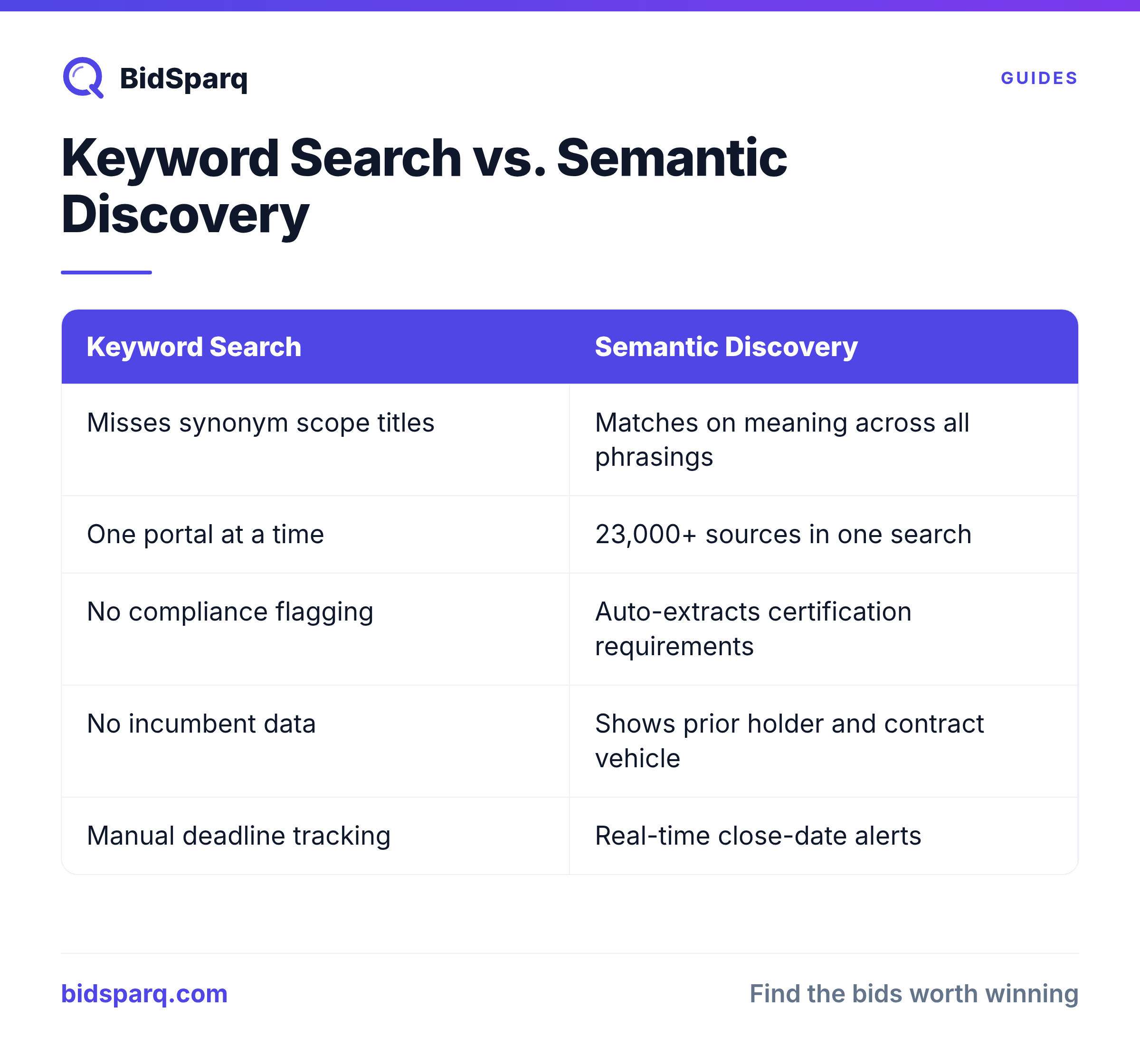
- Scope language varies sharply across buyers, so keyword searches routinely miss "mobile wash station," "fleet sanitation program," and "vehicle hygiene services" as valid matches for the same work.
- Each vertical adds its own compliance layer: transit fleets often require EPA-certified chemicals, healthcare transport adds infection-control documentation, and commercial food-distribution fleets may require FSMA-adjacent sanitation records.
- Knowing whether an incumbent holds the contract and whether a cooperative purchasing vehicle already exists shapes your bid strategy before you write a single line of proposal.
- Late discovery is the category's structural disadvantage: most fleet cleaning solicitations have compressed bid windows, and by the time a provider finds the opportunity through manual searching, days of response time may already be gone.
The short answer
Current solicitations for fleet vehicle cleaning services are open right now across commercial delivery, education, healthcare, and transit buyers, and building a reliable pipeline requires a discovery approach that matches on meaning rather than keywords. The category spans school bus wash programs, medical transport sanitation agreements, transit depot vehicle cleaning, and commercial fleet hygiene contracts, so effective search has to surface all of those phrasings. As of October 2026, 57,360 solicitations are open across the 23,000+ sources we track, and 1,585 of those close within the next 14 days, many with bid windows that are already half elapsed by the time a manual search surfaces them. Starting with the right free portals and layering semantic discovery on top is how providers turn this fragmented market into a predictable bid pipeline.
Who buys fleet vehicle cleaning services
Expand your definition of the buyer beyond government fleets and this category is far larger than it initially appears. Commercial logistics companies operating delivery, pharmaceutical distribution, or food-service fleets often carry EPA or OSHA compliance requirements that trigger regular vehicle sanitation contracts. Hospital systems managing patient transport and ambulance operators issue separate solicitations for vehicle hygiene on procurement cycles entirely distinct from their facility cleaning. School districts run bus wash programs bid annually or through cooperative agreements, and transit authorities with large bus and light-rail fleets issue multi-year contracts for depot vehicle cleaning. These are effectively separate markets within the same service category: a transit authority with 200 buses runs a multi-year depot cleaning contract with wastewater disposal and chemical certification requirements that simply do not appear in a school district's annual bus wash bid, which means you need a distinct qualification and compliance approach for each buyer type you target.
Finding solicitations before they close
The practical obstacle is not scarcity; it is that opportunities are scattered across hundreds of portals under inconsistent scope titles with no shared naming convention. A county transportation authority may post "Mobile Fleet Wash Services," while a school district calls the identical scope "Bus Sanitation Program," and a hospital system lists "Vehicle Hygiene Contract." Manual keyword searches on a single portal will miss most of these variations, and even when they surface a match there is no automatic way to rank which of dozens of open opportunities are worth your proposal hours. As of October 2026, 4,058 new solicitations were posted in the last 30 days across the sources we track, and 1,585 of them close within the next 14 days, meaning a meaningful share of this month's new opportunities are already in their final response window by the time a provider discovers them through manual search. Semantic discovery paired with 0-to-100 fit scoring closes both gaps at once.
Search fleet vehicle cleaning solicitations free on BidSparq, no credit card required. Semantic matching across 23,000+ sources surfaces every relevant opportunity regardless of how each agency titled the scope.
Where to search for active fleet cleaning bids
Knowing the right portals to check, even before adding automated tools, saves hours of dead-end searching each week. SAM.gov is the mandatory posting point for federal fleet contracts; setting keyword alerts there for "fleet wash," "vehicle sanitation," and "fleet hygiene" covers the main phrasing variations. Massachusetts and Maryland are currently among the most active procurement markets in the country: if you work in either state, COMMBUYS (Massachusetts's official eProcurement system) and eMMA (the eMaryland Marketplace Advantage portal) are essential daily checks. Most states operate a central eProcurement portal where state agency and county contracts are posted; pairing that with your regional transit authority's own procurement page and any cooperative purchasing organization you belong to covers the majority of local opportunities. For school district bus-wash contracts specifically, BoardDocs board agendas often surface upcoming procurements before they appear on state portals, since districts must approve award recommendations at public board meetings.
What compliance requirements appear in fleet cleaning bids
Read the compliance section of any fleet cleaning solicitation before you calculate your price, because required certifications can change your cost structure in ways that are not visible from the scope description alone. Transit and municipal fleet contracts commonly require proof of EPA-registered cleaning agents, wastewater disposal permits, and liability insurance coverage above typical janitorial thresholds. School bus contracts often add chemical restrictions near minors, with documentation required from your chemical supplier. Healthcare transport and ambulance fleet solicitations frequently require infection-control protocols aligned with CDC guidelines, sometimes with staff training certificates as a compliance exhibit. Commercial fleets in food distribution may require FSMA-adjacent sanitation documentation covering cargo-contact surfaces. BidSparq pulls the required certifications and insurance thresholds directly from each solicitation so you see the compliance checklist before you open the full document, letting you rule out a poor-fit opportunity in seconds rather than after a full document review. Gathering these proactively before bid day, rather than scrambling during the submission window, is what separates consistently compliant providers from those disqualified on a technicality.
Incumbent and contract-vehicle intelligence
Before committing proposal hours to a fleet cleaning bid, determine who holds the current contract and whether a cooperative purchasing vehicle lets you win work without competing on a new solicitation. An incumbent who has held a contract through multiple renewal cycles with no open competition is unlikely to lose it on price alone; an agency running its first competitive solicitation in several years is a far more winnable pursuit. Contract vehicles such as state cooperative purchasing agreements, NASPO ValuePoint categories, or regional cooperative organizations sometimes include fleet maintenance and cleaning categories, letting qualifying agencies award contracts without issuing a new bid at all. BidSparq surfaces both pieces of intelligence alongside each live opportunity: prior contract holder data and cooperative vehicle availability, so you can prioritize genuinely winnable pursuits rather than spending proposal resources on work that is effectively pre-awarded regardless of the posted notice.
FAQ
Where can I find current solicitations for fleet vehicle cleaning services?
Start with SAM.gov for federal opportunities and your state's central eProcurement portal for state and local contracts. Massachusetts solicitations are posted on COMMBUYS; Maryland's are on eMMA. For school district bus-wash programs, check BoardDocs board agendas and your state department of education procurement page. Adding a semantic discovery platform that aggregates across all of these sources closes the gap created by inconsistent scope titles across buyers.
How do I know if a fleet cleaning solicitation is still open?
Every solicitation carries a formal submission deadline published on the originating portal. Check both the portal's "last updated" timestamp and the official bid document for the hard close date, because extensions and addenda can shift deadlines after the initial posting. Setting keyword alerts on SAM.gov and your state portal ensures you catch those deadline changes on solicitations you are already tracking, not just on new postings.
What causes fleet cleaning bids to be disqualified?
Missing required certifications is the most common cause: proof of EPA-registered chemicals, wastewater disposal permits, and insurance certificates at the specified coverage level are frequently required but absent from otherwise competitive proposals. Incomplete pricing forms, unsigned addenda acknowledgments, and submissions received after the hard deadline are also common disqualifiers. Reading the compliance and general conditions sections before you price the work, not after, is the most reliable way to avoid these issues.
Ready to stop missing fleet cleaning contracts because of naming variations? Explore open fleet vehicle cleaning solicitations free, with no credit card needed and semantic matching across 23,000+ sources.
Find RFPs that match your business
BidSparq monitors 23,000+ procurement sources and uses AI to score every opportunity against your capabilities. Try it free for 14 days.
Start Free Trial →