Government Contracting Software: The Complete Buyer's Guide (2026)
Compare the best government contracting software for finding RFPs, writing proposals, managing bids, and tracking contracts. Feature comparison and pricing.
Government contracting software helps businesses find opportunities, write proposals, manage bids, and track contracts across federal, state, and local agencies. But the market is fragmented: different tools solve different problems, and pricing varies from free to $20,000+ per year.
This guide covers the major categories of gov contracting software, compares the leading tools, and helps you decide what's worth the investment based on your business size and goals.
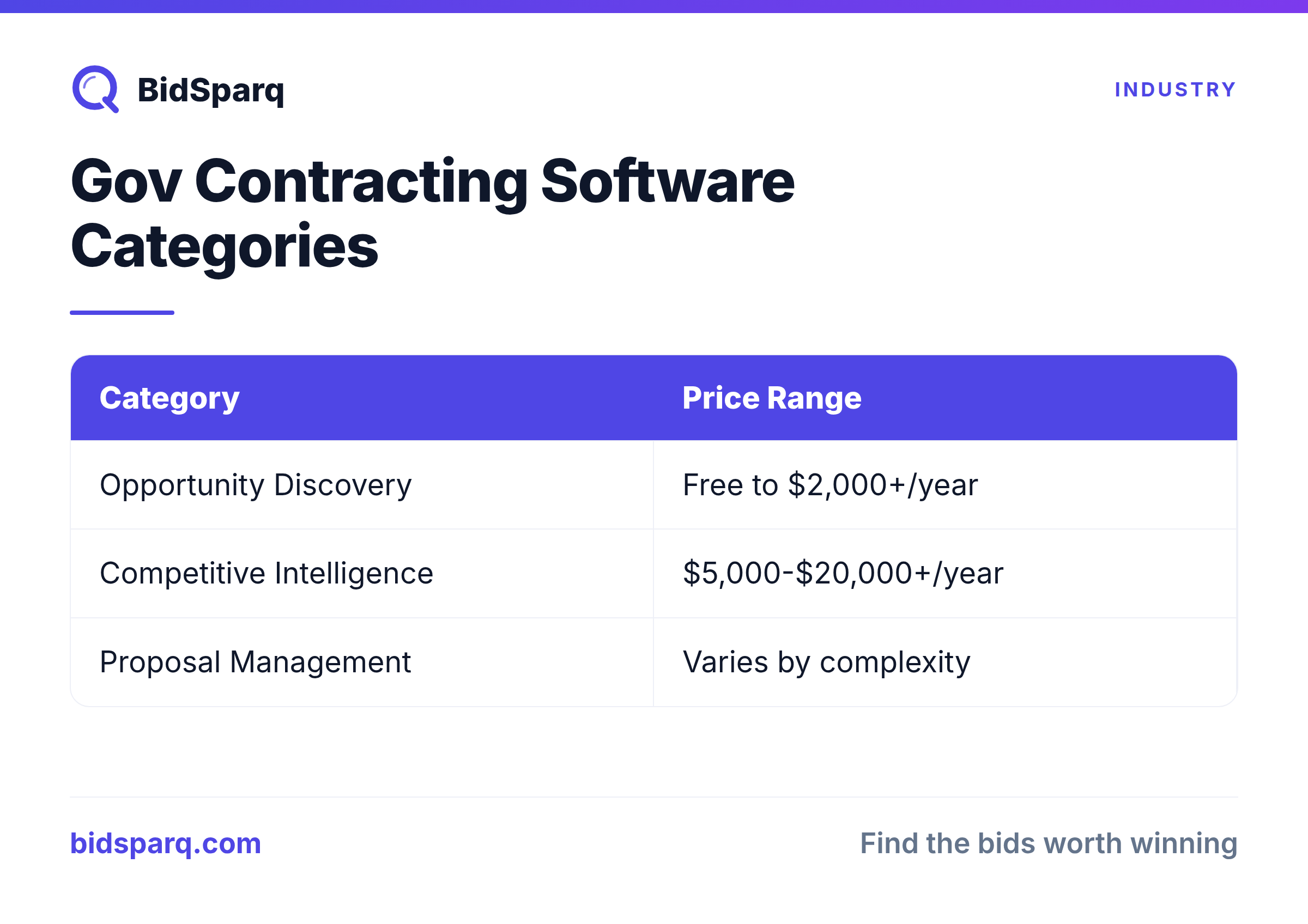
Categories of Government Contracting Software
1. Opportunity Discovery (Finding RFPs)
Tools that aggregate solicitations from government portals and deliver matching opportunities. This is the starting point: you can't win contracts you don't know about.
- What they do: Scan procurement portals, filter by NAICS/keywords, send alerts
- Key differentiators: Number of sources monitored, freshness of data, AI matching quality
- Price range: Free (limited) to $2,000+/year
2. Competitive Intelligence
Tools that help you research incumbents, analyze agency spending patterns, and understand the competitive landscape before bidding.
- What they do: Mine FPDS data, track contract awards, map agency relationships
- Key differentiators: Data depth, analytics quality, integration with opportunity tools
- Price range: $5,000-$20,000+/year
3. Proposal Management
Tools for writing, reviewing, and submitting proposals: especially for complex federal bids that require compliance matrices, past performance volumes, and pricing templates.
- What they do: Template management, collaboration, compliance tracking, document assembly
- Key differentiators: Template library, team collaboration, compliance automation
- Price range: $3,000-$15,000+/year
4. Contract Management
Tools for managing active contracts: tracking deliverables, modifications, invoicing, and performance.
- What they do: Milestone tracking, document management, subcontractor management
- Price range: $5,000-$25,000+/year
Opportunity Discovery Tools Compared
For most small to mid-size contractors, opportunity discovery is the highest-ROI investment. Here's how the major tools compare:
| Tool | Sources | AI Matching | Price | Best For |
|---|---|---|---|---|
| BidSparq | 23,000+ (federal, state, local, education) | Yes: AI scoring + enrichment | Free + $249/mo | SMBs wanting broad coverage with AI |
| GovWin (Deltek) | Federal + state | Limited | $10,000+/year | Large firms needing intel + pipeline |
| BidNet | State & local aggregator | No | $500-$1,500/year | State/local focused vendors |
| SAM.gov | Federal only | No | Free | Federal-only, manual search |
| GovSignals | Federal + some state | Yes | $200-$500/mo | Federal contractors wanting alerts |
What to Look For
When evaluating government contracting software, prioritize:
- Source coverage. How many procurement portals does it monitor? Federal-only tools miss the $2 trillion SLED market.
- Data freshness. Stale data means missed deadlines. Look for daily or more frequent updates.
- Matching quality. Keyword matching produces noise. AI-based matching that understands your business profile delivers better results.
- Ease of use. Complex tools with steep learning curves don't get used. The best tool is the one your team actually opens every day.
- Price-to-value ratio. A $15,000/year tool that helps you win one $200K contract has paid for itself. But for small businesses, lower-cost tools with good coverage can deliver the same ROI.
DIY vs. Software: When to Invest
You might not need software if you:
- Only bid on federal contracts (SAM.gov is free and sufficient for manual searches)
- Have 1-2 target agencies that you monitor directly
- Are just getting started and need to learn the market first
You should invest in software when:
- You're missing opportunities because you can't monitor enough sources manually
- You're spending 5+ hours per week on opportunity research
- You want to expand into SLED markets (impossible to monitor manually)
- Your pipeline is inconsistent and you need steady deal flow
Frequently Asked Questions
What's the best free government contracting tool?
SAM.gov is the best free tool for federal opportunities. For state and local, individual state procurement portals are free but time-consuming to monitor. BidSparq's free tier provides limited access to opportunities across all levels of government.
Is GovWin worth $10,000+ per year?
For large federal contractors with $1M+ annual revenue from government work, GovWin's competitive intelligence is valuable. For small businesses, the ROI is harder to justify: the opportunity discovery alone isn't 10x better than lower-cost alternatives.
Do I need proposal writing software?
For complex federal proposals (50+ pages, multiple volumes), proposal management software like Privia or Lohfeld helps. For most small businesses bidding on simplified acquisitions or SLED contracts, Word/Google Docs is sufficient.
Next Steps
- Try BidSparq free: AI-matched opportunities from 23,000+ sources, with a free tier and Pro Max at $249/mo
- Compare us directly: BidSparq vs. GovWin | BidSparq vs. BidNet
- Read our complete guide to finding RFPs
- Learn about the SLED market: the largest segment most tools ignore
Find RFPs that match your business
BidSparq monitors 23,000+ procurement sources and uses AI to score every opportunity against your capabilities. Try it free for 14 days.
Start Free Trial →